10-K: Annual report [Section 13 and 15(d), not S-K Item 405]
Published on February 17, 2026
UNITED STATES
SECURITIES AND EXCHANGE COMMISSION
Washington, D.C. 20549
Form
For the fiscal year ended
Or
For the transition period from _____________ to _____________
Commission file number
TTM TECHNOLOGIES, INC.
(Exact Name of Registrant as Specified in Its Charter)
|
||
(State or Other Jurisdiction of Incorporation or Organization) |
|
(I.R.S. Employer Identification No.) |
|
(Zip Code) |
|
(Address of Principal Executive Offices) |
|
|
(
(Registrant’s telephone number, including area code)
Securities registered pursuant to Section 12(b) of the Act:
|
|
|
|
Title of each class |
Trading symbol(s) |
Name of each exchange on which registered |
|
Securities registered pursuant to Section 12(g) of the Act: None
Indicate by check mark if the registrant is a well-known seasoned issuer, as defined in Rule 405 of the Securities Act.
Indicate by check mark if the registrant is not required to file reports pursuant to Section 13 or 15(d) of the Act. Yes ☐
Indicate by check mark whether the registrant: (1) has filed all reports required to be filed by Section 13 or 15(d) of the Securities Exchange Act of 1934 during the preceding 12 months (or for such shorter period that the registrant was required to file such reports), and (2) has been subject to such filing requirements for the past 90 days.
Indicate by check mark whether the registrant has submitted electronically every Interactive Data File required to be submitted pursuant to Rule 405 of Regulation S-T (§232.405 of this chapter) during the preceding 12 months (or for such shorter period that the registrant was required to submit such files).
Indicate by check mark whether the registrant is a large accelerated filer, an accelerated filer, a non-accelerated filer, a smaller reporting company, or an emerging growth company. See the definitions of “large accelerated filer,” “accelerated filer”, “smaller reporting company” and “emerging growth company” in Rule 12b-2 of the Exchange Act:
☑ |
Accelerated filer |
☐ |
|
Non-accelerated filer |
☐ |
Smaller reporting company |
|
|
|
Emerging growth company |
If an emerging growth company, indicate by check mark if the registrant has elected not to use the extended transition period for complying with any new or revised financial accounting standards provided pursuant to Section 13(a) of the Exchange Act. ☐
Indicate by check mark whether the registrant has filed a report on and attestation to its management’s assessment of the effectiveness of its internal control over financial reporting under Section 404(b) of the Sarbanes-Oxley Act (15 U.S.C. 7262(b)) by the registered public accounting firm that prepared or issued its audit report.
If securities are registered pursuant to Section 12(b) of the Act, indicate by check mark whether the financial statements of the registrant included in the filing reflect the correction of an error to previously issued financial statements.
Indicate by check mark whether any of those error corrections are restatements that required a recovery analysis of incentive-based compensation received by any of the registrant’s executive officers during the relevant recovery period pursuant to §240.10D-1(b). ☐
Indicate by check mark whether the registrant is a shell company (as defined in Rule 12b-2 of the Act). Yes ☐ No
The aggregate market value of Common Stock held by non-affiliates of the registrant (based on the closing price of the registrant’s Common Stock as reported on the Nasdaq Global Select Market on June 30, 2025, the last business day of the most recently completed second fiscal quarter), was $
As of February 11, 2026, there were outstanding
DOCUMENTS INCORPORATED BY REFERENCE
Portions of the registrant’s definitive Proxy Statement for its 2026 Annual Meeting of Stockholders will be incorporated by reference into Part III of this Annual Report on Form 10-K. Such Proxy Statement, or an amendment to this Report, will be filed with the Securities and Exchange Commission within 120 days after the end of the fiscal year to which this Report relates.
Auditor Firm Id: |
Auditor Name: |
Auditor Location: |
TTM TECHNOLOGIES, INC.
ANNUAL REPORT ON FORM 10-K
TABLE OF CONTENTS
|
||
ITEM 1. |
4 |
|
ITEM 1A. |
13 |
|
ITEM 1B. |
24 |
|
ITEM 1C. |
24 |
|
ITEM 2. |
27 |
|
ITEM 3. |
27 |
|
ITEM 4. |
27 |
|
|
|
|
|
||
ITEM 5. |
28 |
|
ITEM 6. |
29 |
|
ITEM 7. |
MANAGEMENT’S DISCUSSION AND ANALYSIS OF FINANCIAL CONDITION AND RESULTS OF OPERATIONS |
30 |
ITEM 7A. |
39 |
|
ITEM 8. |
40 |
|
ITEM 9. |
CHANGES IN AND DISAGREEMENTS WITH ACCOUNTANTS ON ACCOUNTING AND FINANCIAL DISCLOSURE |
41 |
ITEM 9A. |
41 |
|
ITEM 9B. |
41 |
|
ITEM 9C. |
DISCLOSURE REGARDING FOREIGN JURISDICTIONS THAT PREVENT INSPECTIONS |
42 |
|
|
|
|
||
ITEM 10. |
43 |
|
ITEM 11. |
43 |
|
ITEM 12. |
SECURITY OWNERSHIP OF CERTAIN BENEFICIAL OWNERS AND MANAGEMENT AND RELATED STOCKHOLDER MATTERS |
43 |
ITEM 13. |
CERTAIN RELATIONSHIPS AND RELATED TRANSACTIONS AND DIRECTOR INDEPENDENCE |
43 |
ITEM 14. |
43 |
|
|
|
|
|
||
ITEM 15. |
44 |
|
ITEM 16. |
46 |
|
47 |
||
48 |
||
2
Glossary of Terms and Acronyms
The following table provides definitions of certain terms and acronyms that may be used within the text of this report.
2025 Repurchase Program |
|
Share repurchase program authorized by the Board of Directors on May 8, 2025 |
|
NISPOM |
|
National Industrial Security Program Operating Manual |
A&D |
|
Aerospace and Defense |
|
NOLs |
|
Net operating losses |
ABL Revolving Loans |
|
U.S. ABL and Asia ABL, collectively |
|
OBBBA |
|
One Big Beautiful Bill Act |
AESA |
|
Active electronically scanned array |
|
ODMs |
|
Original design manufacturers |
AI |
|
Artificial intelligence |
|
OECD |
|
Organization for Economic Co-operation and Development |
Asia ABL |
|
Asia Asset-Based Lending Credit Agreement |
|
OEMs |
|
Original equipment manufacturers |
ASICs |
|
Application Specific Integrated Circuits |
|
PCB |
|
Printed circuit board |
ASU |
|
Accounting Standards Update |
|
Plan |
|
2023 Incentive Compensation Plan |
CEO |
|
Chief Executive Officer |
|
PRUs |
|
Performance-based restricted stock units |
CFO |
|
Chief Financial Officer |
|
QTA |
|
Quick turnaround |
CIC |
|
Custom Integrated Circuit |
|
R&D |
|
Research and development |
CIRT |
|
Cybersecurity Incident Response Team |
|
REACH |
|
Registration, Evaluation, Authorisation and Restriction of Chemicals |
CME |
|
Chicago Mercantile Exchange |
|
Report |
|
This Annual Report on Form 10-K for the fiscal year ended December 29, 2025 |
CODM |
|
Chief operating decision maker |
|
RF |
|
Radio frequency |
Company |
|
TTM Technologies, Inc. |
|
RF&S Components |
|
RF and Specialty Components |
DCF |
|
Discounted cash flow |
|
RMB |
|
Renminbi |
DCSA |
|
Defense Counterintelligence and Security Agency |
|
RoHS |
|
Restriction of Hazardous Substances |
DFM |
|
Design-for-manufacturability |
|
ROU |
|
Right-of-use |
DoW |
|
U.S. Department of War |
|
RSUs |
|
Restricted stock units |
EAR |
|
Export Administration Regulations |
|
SBR |
|
Special Board Resolution |
EBITDA |
|
Earnings before interest, tax, depreciation, and amortization expense |
|
SEC |
|
Securities and Exchange Commission |
EMS |
|
Electronic manufacturing services |
|
SH E-MS |
|
Shanghai E-MS |
ERP |
|
Enterprise resource planning system |
|
SLP |
|
Substrate-like PCB |
Exchange Act |
|
Securities Exchange Act of 1934, as amended |
|
SOFR |
|
Secured Overnight Financing Rate |
FASB |
|
Financial Accounting Standards Board |
|
SSA |
|
Special Security Agreement |
FCPA |
|
Foreign Corrupt Practices Act |
|
SVHCs |
|
Substances of Very High Concern |
Guarantors |
|
Subsidiary Guarantors of the Company, subject to certain exceptions |
|
SVP-IT |
|
Senior Vice President of Information Technology |
HDI |
|
High-Density Interconnect |
|
Telephonics |
|
Telephonics Corporation and ISC Farmingdale Corp. |
HNTE |
|
High and new technology enterprise |
|
Term Loan Facility |
|
First Amendment, dated as of August 1, 2024, to that certain Amended and Restated Term Loan Credit Agreement, dated as of May 30, 2023 |
IC |
|
Integrated circuit |
|
TSR |
|
Total stockholder return |
IFF |
|
Identification Friend or Foe |
|
TTM |
|
TTM Technologies, Inc. |
IT |
|
Information technology |
|
U.S. ABL |
|
U.S. Asset-Based Lending Credit Agreement |
ITAR |
|
International Traffic in Arms Regulations |
|
U.S. ABL Priority Collateral |
|
Perfected first priority security interest in certain deposit accounts, cash and cash equivalents, accounts receivable, and certain U.S. inventory |
MIDA |
|
Malaysia Investment Development Authority |
|
U.S. GAAP |
|
Accounting principles generally accepted in the United States of America |
MYR |
|
Malaysian ringgit |
|
USG |
|
U.S. federal government |
3
PART I
Statement Regarding Forward-Looking Statements
This Report contains forward-looking statements regarding future events or our future financial and operational performance. Forward-looking statements include statements regarding markets for our products; trends in net sales, gross profits, and estimated expense levels; liquidity and anticipated cash needs and availability; and any statement that contains the words “anticipate,” “believe,” “plan,” “forecast,” “foresee,” “estimate,” “project,” “expect,” “seek,” “target,” “intend,” “goal,” and other similar expressions. The forward-looking statements included in this Report reflect our current expectations and beliefs, and we do not undertake publicly to update or revise these statements, even if experience or future changes make it clear that any projected results expressed in this Report or future quarterly reports to stockholders, press releases or company statements will not be realized. In addition, the inclusion of any statement in this Report does not constitute an admission by us that the events or circumstances described in such statement are material. Furthermore, we wish to caution and advise readers that these statements are based on assumptions that may not materialize and may involve risks and uncertainties, many of which are beyond our control, that could cause actual events or performance to differ materially from those contained or implied in these forward-looking statements. These risks and uncertainties include the business and economic risks described in “Item 1A, Risk Factors”.
Unless otherwise indicated or unless the context requires otherwise, all references to time periods refer to our fiscal year, and all reference to “TTM,” “the Company,” “we,” “us,” “our,” and similar names refer to TTM Technologies, Inc. and its subsidiaries.
ITEM 1. BUSINESS
General
We are a leading global manufacturer of technology products, including mission systems, RF components, RF microwave/microelectronic assemblies, and technologically advanced interconnect products, including PCBs and substrates. In 2025, we generated approximately $2.9 billion in net sales and ended the year with approximately 18,200 employees worldwide. We currently operate a total of 24 specialized facilities in North America and Asia. We focus on providing time-to-market and volume production of advanced technology products and offer a one-stop design, engineering, and manufacturing solution to our customers. This solution allows us to align technology development with the diverse needs of our customers and to enable them to reduce the time required to develop new products and bring them to market. We serve a diversified customer base consisting of approximately 1,300 customers in various markets throughout the world, including aerospace and defense, data center computing, automotive, medical, industrial, and instrumentation, and networking. Our customers include OEMs, EMS providers, ODMs, distributors, and government agencies (both domestic and allied foreign governments).
We report our worldwide operations based on three reportable segments: (1) A&D, which consists of 13 domestic system, subsystem, and PCB fabrication plants; (2) Commercial, which consists of three domestic PCB fabrication plants, four PCB fabrication plants in China, one in Malaysia, and one in Canada; and (3) RF&S Components, which consists of one domestic RF component plant and one RF component plant in China. Each segment operates predominantly in the same industries with facilities that produce customized products for our customers and use similar means of product distribution.
Additional information on our reportable segments and product information is contained in Part II, Item 8, Note 4, Segment Information, of the Notes to Consolidated Financial Statements.
Industry Overview
Advanced interconnect products serve as the foundation for virtually all electronic products, including the electronic components and subsystems integrated into automobiles, high-end commercial electronic equipment such as medical robotics and testing equipment, data center switches and servers, and aerospace and defense electronic systems. Products designed to offer faster data transmission, thinner and more lightweight packaging, and reduced power consumption generally require increasingly complex interconnect products. Advanced technology interconnect product solutions such as HDI and SLP technologies provide increased circuit densities, rigid-flex circuits can be found in small and lightweight end products and other space-challenged electronics packaging applications, and high-performance substrates that serve as the interconnect between the IC and the PCB in many advanced electronic products are all found across a wide variety of end markets. Combined with the engineered systems and assemblies described above, these “advanced technologies" generally have growth rates which are higher than conventional technologies. In addition, most of our markets have low volume requirements during the prototype stage, which later transitions to higher volume requirements during product ramp.
TTM’s engineered systems are sold primarily to the aerospace and defense market, generally tier one subcontractors but also directly to government agencies (both domestic and allied foreign governments). Due to modernization priorities, an increased proportion of defense budgets is geared towards defense electronics such as radar, communications, and surveillance. These are the key markets for our engineered systems products.
4
TTM’s RF microwave/microelectronic assemblies are also used in complete defense electronic systems and sold to tier one subcontractors. They benefit from increasing electronics content in defense programs as well as increased focus on solid-state AESA radar systems. Based on our internal market intelligence, we expect this market to grow faster than the overall defense market.
TTM’s high-volume commercial RF components product lines are utilized by TTM’s customers to achieve advance signal conditioning in transceiver applications for 5G and other communication systems. The growth of the 5G transceiver market is expected to exceed overall telecommunications market growth over the next several years.
Our Strategy
Our vision is to inspire innovation as a global preeminent technology company. Our core strategy includes the following elements:
Provide differentiated capabilities by incorporating advanced design-to-specification engineering support, testing, components, and specialized assembly into the value-added solution provided to customers. With our past acquisitions of Anaren, Inc. and Telephonics, we moved beyond build-to-print manufacturing and assembly capabilities and expanded into integrated systems and deepened our RF and radar-related engagement to meet the technology needs of our customers, particularly our key aerospace and defense customers. As a result of additional design capabilities, we are more capable of providing cost-effective, ready for manufacture, enabling technologies to the customer.
Maintain our customer-driven culture and provide superior service to our customers in our core markets of aerospace and defense, automotive, data center computing, medical, industrial, and instrumentation, and networking. Our customer-oriented culture is designed to achieve extraordinary service, competitive differentiation, and superior execution. Our customer-oriented strategies include engaging in collaborative research and development and the co-development of new technologies and products, capturing new technology products for next generation equipment, and continuing investments to enhance our broad offering of advanced interconnect and RF/microwave technologies from components through integrated mission systems. We have invested in and employ a diverse group of design engineers and field application engineers (FAEs) to provide technical expertise to our customers with the goal of designing the best product and service solutions for their needs, and to provide ongoing technical support. We believe our ability to anticipate and meet customers’ needs is critical to retaining existing customers and attracting leading companies as new customers.
Drive operational efficiency and productivity. We are highly focused on improving our operational execution to increase efficiency, productivity, and yields. We strongly believe in the benefits of sharing best practices across our extensive manufacturing footprint and rely on stringent goals for throughput, quality, and customer satisfaction to measure our effectiveness. The fast-paced nature of our business requires a disciplined approach to manufacturing that is rooted in continuous improvement and new capability development.
Accelerate customer, end market, and technology diversification through strategic mergers and acquisitions. We have a history of executing successful acquisitions that have been key to our growth and profitability. Historically, we focused on strategic opportunities that could facilitate our efforts to further diversify into other growing end markets. Now that we have a more diversified end market mix, our focus is to strengthen and expand our leadership positions in existing end markets. We will also look for strategic opportunities that further strengthen our leading-edge technology capabilities and aim to manage our exposure to cyclical businesses.
Accelerate our expansion into growing markets using our advanced technology and diversified global manufacturing footprint as key points of differentiation. With rising requirements for faster data transmission, shrinking features (i.e., lightweight and thin), thermal management and lower power consumption, many advanced interconnect product designs have migrated to more complex multilayer and advanced HDI PCBs from conventional multilayer PCB technologies. As our customers consolidate their supply chains, our objective is to differentiate ourselves as a strategic supplier with the technology breadth to meet most, if not all, of our customers’ advanced interconnect and RF related requirements. Additionally, we intend to strategically invest to expand and develop our manufacturing footprint both domestically and internationally to meet customer requirements with the goals of supply chain reliability, resiliency, and geographic diversification.
Address customer needs in all stages of the product life cycle. By aiming to provide a one-stop solution, we work to service our customers’ needs from the earliest stages of product design and development through volume production. We believe that by engaging with our customers early in the development process, we are better able to develop solutions for our customers’ needs and establish an incumbent position early in the product development cycle, which translates into additional opportunities as our customers move into volume production. Our expertise is enhanced by our ability to deliver highly complex interconnect and integration solutions to customers in significantly compressed lead times. This rapid delivery service enables OEMs to develop sophisticated electronic products more quickly and reduce their time to market. Further, we believe our customized RF solutions from the concept stage through volume production and our complete engineered systems enhance our early customer engagement.
Deliver consistently strong financial performance and execute on our balance sheet strategy. We aspire to deliver industry‑leading financial performance. We expect to achieve this by servicing our customers’ needs in higher-growth end markets in a cost‑efficient and effective manner. We believe that this strategy will allow us to generate strong cash flows, which we expect will provide us with the financial flexibility for continued investments for growth and return of capital to shareholders.
5
Continuously enhance the elements that make TTM an appealing employer. We aim to attract the right employees who are aligned with our values and desire growth in their professional careers. We believe our employee engagement model, emphasis on communications and inclusion, commitment to career development and talent, and collaborative culture are the top reasons employees embrace us. Our ability to retain valued talent while attracting the right candidates is paramount to our continued human capital strategy.
Products and Services
We offer a wide range of engineered systems, RF and microwave assemblies, advanced interconnect products including PCBs and IC substrates, custom assemblies and integrated systems, passive and advanced ceramic RF components, hi-reliability multi-chip modules, and beamforming and switching networks. We also offer value-added services including DFM, PCB layout design, simulation and testing, QTA production, and specialized RF assembly and testing. By offering this wide range of engineered systems, RF components and subsystems, advanced interconnect products, and complementary value-added services, we provide our customers with a “one-stop” manufacturing solution for their hardware technology and integration requirements. Below we describe our product lines in more detail.
Radar Systems. We provide a wide range of high-performing, lightweight, and cost-effective multi-mode surveillance and weather avoidance radar systems for fixed- and rotary-wing aircraft, Unmanned Aerial Vehicles (UAVs), and shipboard platforms to the USG, tier one OEMs, and numerous international defense agencies. At this time, we are also the sole provider of the U.S. Navy’s AN/APS-153 multi-mode radar on the MH-60R helicopter, and the communications suite within the MH-60R/S multi-mission helicopters. Our multi-mode radars offer advanced features such as Ground Moving Target Indicator (GMTI), Synthetic Aperture Radar (SAR), Inverse Synthetic Aperture Radar (ISAR), Sense and Avoid, Automatic Identification System (AIS), and weather avoidance. Our MOSAIC® AESA radar family supports maritime surveillance, counter UAS, and advanced air mobility end markets.
Surveillance. We are a global leader in IFF, Monopulse Secondary Surveillance Radars (MSSR), and Air Traffic Control (ATC) systems enabling military and civilian air traffic controllers to identify aircraft and vehicles as friendly. Our active and passive surveillance solutions are used by all branches of the U.S. military, Federal Aviation Administration (FAA), North Atlantic Treaty Organization (NATO), and numerous international defense agencies including those of Japan and South Korea.
Communications Systems. Our advanced wired and wireless communication systems serve as the digital backbone for defense and civil platforms worldwide, including fixed- and rotary-wing aircraft and ground control shelters. Our vehicle-based intercommunications systems are utilized by all the branches of the U.S. military, aerospace manufacturers, commercial airlines, and audiometric original equipment manufacturers.
RF and Microwave Assemblies. We design, produce, and test specialized multi-chip RF modules and components used for radar, transmit/receive antennas, and similar wireless applications. We serve defense, avionics, satellite, and commercial applications including telecommunications, networking, instrumentation, and automotive. We also offer specialized radio frequency assembly, test services, and integrated solutions to provide sophisticated integrated electronics for numerous platforms.
Passive RF Components. We manufacture off-the-shelf surface mount microwave components that provide passive microwave signal distribution functions and can be placed on PCBs with automated production equipment. These products are used in cellular base stations, Wireless Local Area Network (WLAN), Bluetooth, satellite television, and 5G applications.
Advanced Ceramic RF Components and Modules. We offer standard and etched thick-film ceramic substrates. These products are generally customer-designed for high-performance applications in the medical, industrial, and defense markets.
Hi-Reliability Multi-Chip Modules. We provide custom hybrid and multi-chip modules, high-performance radiation-hardened and space-qualified microelectronics, and power management and control electronics utilizing chip and wire 2D construction as well as capability for 2.5DHI advanced packaging assembly.
Beamforming and Switching Networks. Our passive and active beamforming technologies are used in military and space applications, offering a variety of active and passive high‑performance RF assemblies, including L-band/LEO and L- and S-band/GEO space beamformers, UHF thru Ka-band radar AESA RF networks, Butler matrices, multi-octave, and more.
Custom Designed ASICs. Our CIC group has designed nearly 400 mixed-signal custom ASICs for automotive, industrial, defense/avionics, and smart energy markets, including radiation harden/tolerant devices. The CIC organization takes complete responsibility for the ASICs development process from the initial specification definition through qualification and volume production.
Conventional PCBs. We focus on advanced technology higher layer count conventional PCBs, which are multilayer PCBs that can accommodate more complex circuitry than a single‑sided or double-sided PCB and as such, requires more sophisticated production techniques. These PCBs support electronic products including data center switching and networking equipment, high‑performance computing systems, medical robotics, test equipment and devices, industrial automation and robotics, semiconductor test equipment, automotive communications, computing and control systems, and aerospace and defense systems.
High-density interconnect or HDI PCBs. Our facilities produce HDI PCBs, which are PCBs with high-density characteristics including micro-sized holes, or microvias (diameter at or less than 0.15 mm), fine line circuitry (circuit line width and spacing at or less than 0.075 mm), and are fabricated with thin high-performance materials. As electronic devices have become smaller and more
6
portable with higher functionality, demand for advanced HDI PCB (defined as those having more than one layer of microvia interconnection structure) products has increased significantly.
Substrate-like PCBs or SLPs. SLPs represent the next evolution of high-end HDI PCBs with even higher interconnect density per unit area and finer line circuitry (width and spacing at or less than 0.02 mm). They require more sophisticated manufacturing technology adapted from IC substrate fabrication. We offer an alternative approach to building SLP technology in the U.S. for lower-volume, higher-mix commercial and aerospace and defense applications.
Flexible PCBs. Flexible PCBs are printed circuits produced on flexible films that can be folded or bent for three-dimensional application movement and flexible electronic connectivity. They enable improved reliability and electrical performance, reduced weight and size, and reduced assembly costs when compared with traditional wire harness or ribbon cable packaging.
Rigid-flex PCBs. Rigid-flex circuitry integrates multiple PCB assemblies using thin, light composites that integrate wiring in ultra-thin, flexible ribbons between rigid sections. In rigid-flex packaging, a flexible circuit provides a backbone of wiring with rigid multilayer circuit sections built up as modules where needed. This technology provides compact three-dimensional packaging, miniaturization, and thinness of product design, and is essential for aerospace and defense, industrial, transportation systems, handheld and wearable electronics, and ultra-miniaturized products.
Custom assemblies. Our assembly facilities produce various custom electronic assemblies, including backplane and mid-plane, flexible and rigid-flex, RF assemblies, chassis integration and test. Each of these assemblies involves mounting electronic components to PCBs and testing for electrical continuity.
IC substrates. IC substrates provide the mechanical support and electrical interconnect used to package ICs either in single chip packages or multi-chip modules. They are highly miniaturized circuits with micron-scale features to bridge the gap between sub-micron IC features and millimeter scale PCBs. IC substrates are manufactured in a clean room environment using advanced HDI processes and manufacturing approaches used in SLP technology.
Quick turnaround services. We provide custom-fabricated PCBs within 24 hours to 15 days and receive premium pricing for our ability to meet critical time requirements for our customers. We manufacture prototype PCBs in small quantities and deliver within 24 hours to ten days. Our ramp-to-volume services typically include manufacturing up to several hundred PCBs per order with delivery times ranging from five to 15 days.
Thermal management. Increased component density on circuit boards often requires improved thermal dissipation to reduce operating temperatures. We produce PCBs with heavy copper cores, embedded and press-fit coins, electrically passive heat sinks laminated externally on a circuit board or between two circuit boards, and electrically active thermal cores.
Manufacturing Technologies
The market for our products is characterized by rapidly evolving technology. The trend in the electronic products industry continues to be to implement and develop means to increase the speed, complexity, and performance of components while reducing their size. We believe our technological capabilities allow us to address the needs of manufacturers to bring complicated electronic products to market faster.
We manufacture advanced interconnect products according to customer circuit designs, which we review to ensure data accuracy and product manufacturability. With computer aided manufacturing (CAM) technology, we develop circuit patterns on individual layers using advanced photographic and direct imaging processes. Through plating and etching processes, we selectively add and remove conductive materials to form horizontal layers of thin circuitry, which are separated by electrical insulating material. A multilayer circuit board is produced by laminating together multiple layers of circuitry, using intense heat and pressure under vacuum. Vertical connections between layers are achieved by drilling and plating through small holes, called vias. Vias are made by highly specialized drilling equipment capable of achieving extremely fine tolerances with high accuracy. We specialize in high layer count PCBs with extremely fine geometries and tolerances, and employ clean rooms that are designed to prevent defects on the circuit patterns. We also use automated optical inspection systems and electrical testing systems to ensure consistent quality of the circuits we produce.
Our highly specialized equipment and advanced manufacturing processes enable us to reliably produce PCBs with the following characteristics:
7
Our Integrated Electronics manufacturing organization principally designs and manufactures state-of-the-art microwave-based hardware for use in advanced radar systems, advanced jamming systems, missiles, and decoys, electronic surveillance systems, and satellite and ground-based communication systems. Several core manufacturing technology areas include:
Customers and Markets
Our customers include end-users, OEMs, EMS providers, ODMs, and distributors that primarily serve the aerospace and defense, automotive, data center computing, medical, industrial, and instrumentation, and networking end markets of the electronics
8
industry. Included in the end markets that our OEM and EMS customers serve is the USG. As a result, we are a supplier, primarily as a subcontractor, to the USG. In addition, we also sell directly to government agencies (both domestic and allied foreign governments).
See table in Part II, Item 7, Management’s Discussion and Analysis of Financial Condition and Results of Operations for the percentage of our net sales in each of the principal end markets we serve.
Sales attributed to OEMs include sales made through EMS providers and ODMs. Although our contractual relationships are often with the EMS or ODM companies, we typically negotiate price and volume requirements directly with the OEMs. In addition, we are on the approved vendor lists of several of our EMS providers. This positions us to participate in business that is awarded at the discretion of the EMS provider.
Our staff of engineers, sales support personnel, and managers assist our sales representatives in advising customers with respect to manufacturing feasibility, design review, and technological capabilities through direct communication and visits. We combine our sales efforts with customer service personnel at each facility to better serve our customers. Each large customer is typically assigned an account manager to coordinate all of the Company’s services across all of our facilities. Additionally, the largest and most strategic customers are also supported by select program management and engineering teams. Our global sales force is comprised of direct sales personnel, complemented by commission-based independent representatives, and supports customers throughout North America, Europe, Asia, and the Middle East.
For certain risks attendant to our foreign operations, see Item 1A, Risk Factors.
Suppliers
For advanced interconnect products, primary raw materials include copper clad laminates and chemical solutions such as copper and gold for plating operations, photographic film, carbide drill bits, and plastic for testing fixtures. Most of the raw materials are generally readily available from numerous suppliers in the open market.
For engineered systems, RF components, RF subsystems, backplane assemblies, and other PCB assemblies, primary raw materials are manufactured components such as PCBs, ceramic and ferrite substrates, connectors, capacitors, resistors, diodes, and integrated circuits, many of which are custom made and sourced from customer-approved vendors. The more complicated RF subsystems require integrated subassemblies and super-components such as RF oscillators, frequency converters, power supplies, and microprocessors. Some components for backplane assemblies and other PCB assemblies have limited or sole sources of supply. The backplane assemblies, PCB assemblies, and precision metal fabricated chassis and enclosures are often incorporated into a fully integrated and tested system delivered to our customer. These products often incorporate procured power, thermal, interconnect, and mechanical components sourced from either customer directed or our selected suppliers.
Radar, Communication, and Surveillance systems use highly sophisticated electronic subassemblies including Transmitter and Receiver CCA’s/Modules, Traveling Wave Tube Assemblies, Exciters, Wave Form Generators, and Frequency Generators. Many of these systems also require the acquisition of RF antenna arrays, illuminated panel subassemblies, inertial navigation/GPS subassemblies from OEMs, or parts specifically designed for certain applications. The materials for these systems come from a variety of sources, including OEMs and Contract Manufacturers.
We typically use just-in-time procurement practices to maintain our raw materials inventory at low levels and work closely with our suppliers to obtain technologically advanced raw materials. In addition, we periodically seek alternative supply sources with the goal of ensuring that we are receiving competitive pricing and service. Supply for PCB materials can vary over time depending on supply/demand dynamics for key raw materials such as copper clad laminates. See Item 1A, Risk Factors for more details.
Competition
For PCBs, our competitors are mostly based in China and Taiwan. For engineered products such as RF subassemblies and systems, we compete with a different set of competitors largely based in the U.S. and Europe. The PCB industry remains highly fragmented and characterized by intense competition. There are several competitive factors our customers consider when choosing their supplier including, but not limited to, technical capabilities, capacity availability, pricing, service, support, reliability, quality, and location. Our principal competitors for our A&D segment include BAE Systems plc, Curtiss-Wright Corporation, Leonardo DRS, Inc., Mercury Systems, Inc., and Sanmina Corporation. Our principal competitors for our Commercial segment include AT&S (Austria Technologie & Systemtechnik Aktiengesellschaft), Founder Technology Group Co., Ltd., Gold Circuit Electronics Ltd., Isu Petasys Co., Ltd., Kinwong Electronic Co. Ltd., Unimicron Technology Corp., Victory Giant Technology Co., Ltd., and WUS Printed Circuit Co., Ltd. Our principal competitors for our RF&S Components segment include Advanced Micro Devices, Inc., IDT Corporation, MACOM Technology Solutions Holdings, Inc., Microchip Technology Incorporated, Qorvo, Inc., and Silicon Laboratories Inc.
We believe that our key competitive strengths include:
Leading global technology manufacturer, offering breadth of technology and products, and one-stop solution for customers. We are one of the largest technology manufacturers in North America and have a global sales and manufacturing presence. We believe we have significant economies of scale, an increasing end-to-end value chain solution for customers, a regionally diversified and resilient manufacturing footprint, and the technology breadth and scale to emerge as a preferred partner. We offer a wide range of
9
engineered systems, passive RF components, advanced ceramic RF components, hi-reliability multi-chip modules, beamforming and switching networks, IC substrates, and PCB and RF products, including HDI and ultra-HDI PCBs, conventional PCBs, flexible PCBs, rigid-flex PCBs, and custom assemblies. We also offer certain value-added services to support our customers’ needs for RF design-to-specification capability, DFM, PCB layout design, simulation and testing services, and QTA services. We provide a one-stop design, manufacturing, and test solution to our customers with design services, engineering support and prototype development through final volume production around the globe. We believe our facility specialization strategy allows us to reduce the time required to develop new products by directing each customer to the facility best suited to their product type, delivery time, complexity, and volume needs. As our commercial customers ramp to volume, we are positioned to transition them to one of our volume facilities in China or Malaysia.
Leading aerospace and defense supplier. We are a trusted supplier to the aerospace and defense industry. Our global manufacturing footprint and breadth of capabilities enable us to serve multiple key end markets, particularly the aerospace and defense industry. We combine our traditional market strength in core PCB technology with advanced technologies, RF capabilities, and engineered systems to grow requirements in both traditional and AESA radar systems for defense applications. We have passed OEM and government certification processes, and the administrative requirements associated with participation in government and commercial aerospace programs. When supplying various departments and agencies of the USG, we are required to maintain facility security clearances under the NISPOM and ITAR. Along with supply of traditional and RF PCBs, we offer a variety of RF components and subassemblies, engineered systems, engineering services, and assembly capabilities to provide additional value to our customers.
Diversified business model. Our sales are diversified across end markets with over 1,300 customers and long-term relationships exceeding ten years with our ten largest customers, which reduces our exposure to any single end market or customer.
Seasonality
We do not consider any material portion of our business to be seasonal. Various factors, however, can affect the distribution of our sales between accounting periods, including the timing of customer orders, the availability of customer funding, product deliveries, and customer acceptance.
Intellectual Property
Our intellectual property strategy remains deliberate and aimed at protecting the innovations critical to TTM’s business and the success of our customers. We now have a total of approximately 185 patents, with approximately 84 pending patent applications. These patents are derived from internal research and development as well as a number of intellectual property portfolio acquisitions beginning in 2018. Our PCB business depends on the effectiveness of our fabrication techniques, proprietary PCB structures, and our ability to continually improve our manufacturing processes. We rely on the collective experience of our employees in the manufacturing process to ensure that we continuously evaluate and adopt new technologies available within our industry. In addition, we depend on robust training, recruiting, and retention of our employees, who are required to be knowledgeable in the operation of advanced equipment and complicated manufacturing processes. In regard to our RF products, the vast majority are proprietary and protected or covered by approximately 48 patents and 3 currently pending patent applications directed towards products for both the wireless infrastructure and aerospace and defense markets.
National Security Matters
A portion of our business consists of manufacturing defense and defense-related items for various departments and agencies of the USG, including the DoW, which requires that we maintain facility security clearances under the NISPOM. The NISPOM requires that a corporation with significant foreign ownership maintaining a facility security clearance take steps to prevent foreign ownership, control, or influence (FOCI). In February of 2023, our Board of Directors passed an SBR, replacing the SSA that we entered into with the DCSA in 2010. The replacement of the SSA with the SBR is a result of the significantly reduced foreign ownership of TTM. DCSA accepted the SBR and the effective date of the SBR was February 2, 2023. The SBR codifies the maintenance of the Government Security Committee of the Board to oversee our compliance and cybersecurity efforts and to put into place best practices in our facilities in the U.S. and overseas to ensure that we maintain robust security practices and policies as we serve the interests of our customers in the aerospace and defense market. The Government Security Committee of our Board of Directors consists of at least three Board members that hold a National Security Clearance. The DCSA will continue to review TTM’s compliance with the terms of the SBR annually at each of TTM’s sites which operate under a DoW security clearance. In addition, all of TTM’s Board is currently comprised of U.S. citizens and per the terms of the SBR, in the future, no foreign citizen will be allowed to sit on TTM’s Board.
Other Governmental Regulations
Our operations are subject to federal, state, local, and foreign laws and regulations relating to export control, environmental compliance, waste management, and health and safety matters, including other measures relating to the release, use, storage, treatment, transportation, discharge, disposal, and remediation of contaminants, emissions, hazardous substances, and waste, as well as practices and procedures applicable to the construction and operation of our facilities, including, but not limited to USG regulations and corresponding regulations in China, Canada, and Malaysia for our foreign facilities.
10
Human Capital
At TTM, we believe a key differentiator is our culture, which has been shaped through considerable thought and energy. Our culture has served us well as we integrate acquired companies and optimize our organizational structures and teams to better serve our customers. The following elements underpin our culture:
Commitment to Values and Ethics. The foundation of our strategic vision is our corporate culture and our way of doing business with integrity, teamwork, clear communication, and performance excellence. We seek to demonstrate the importance of these values through our goal setting and performance management process as well as providing ethics training to employees every year.
Our Code of Conduct includes topics such as anti-corruption, discrimination, harassment, privacy, appropriate use of company assets, protecting confidential information, and reporting Code of Conduct violations. It reinforces the importance of an open and welcoming environment in which all employees have a voice and a confidential outlet to raise concerns regarding potential violations.
Talent Acquisition. Our vision is to provide exceptional talent acquisition through robust talent sources, use of technology, and a compelling employment brand to create a seamless, engaging, and candidate-centric experience. We aim to build a workforce that drives the company's success and fosters a culture of growth and opportunity.
Talent Development. We ensure focus on individual career development through regular talent reviews of performance, potential, development gaps, and progress to evaluate the depth and strength of our integrated succession plans. We track the completion of development plans for our employees in management, technical, and professional career tracks. For different levels of leaders, we provide recurring instructor-led learning, online courses, and leadership programs. Additionally, we offer competency-based training, sponsor job rotations, form project teams comprised of emerging talent, and provide extensive internal and external materials in our global learning management system. We provide tuition reimbursement assistance.
Inclusion. We strive to build and maintain talent and promote an inclusive culture to support key corporate-wide initiatives. We have expanded and continue to develop our existing policies and training to address harassment, bullying, and the elimination of bias in the workplace, where respect is essential, and everyone is encouraged to participate.
Employee Engagement and Turnover. We periodically survey our employees to identify and act on specific opportunities to enhance our work environment, improve communications, and strengthen the connection between supervisors and employees. The voice of our employees provides valuable insights on how we invest in people and prioritize specific actions and programs to attract and retain talent.
Our two regional change agent networks (Asia and North America) exist to improve communications from the factory and office floor up to the senior management team. These networks discuss and communicate the key initiatives within the sites in addition to employee concerns to prioritize initiatives around community activities, site improvement projects, recognition programs, and new communication methods.
Compensation and Benefits. We align our compensation and benefit programs with market conditions by reviewing our programs annually and recommending changes to improve our market competitiveness and ability to attract and retain our talent. Our goal is to invest in our employees’ total cash compensation for competitive reasons while outlining career tracks and levels to provide development opportunities. Our people leaders are dedicated to engaging with their employees to explain the career framework, their compensation, and potential for future jobs. We have seen the positive impact of the adjustments we made to base salaries and incentive compensation coupled with the managers’ conversations on career opportunities.
We also offer comprehensive benefit plans for eligible employees, including mental health, employee assistance program (EAP), telemedicine offerings, several medical and dental plans with qualifying employer-funded health savings accounts, life insurance, specialty programs for diabetes and weight loss, wellness challenges, and an on-site health and physical therapy center at one of our largest U.S. facilities.
Employee Data
As of December 29, 2025, we had approximately 18,200 employees. Our employees were distributed by function approximately as follows: 14,800 in manufacturing positions, 1,800 in engineering or technician positions, 1,100 in professional, managerial, or other administrative positions, and 500 in sales and marketing positions. Of our 5,900 U.S. employees, 50 are represented by unions. In
11
China, approximately 9,900 employees are members of the All-China Federation of Trade Unions and accordingly are considered to be represented by a labor union. We believe that our relations with both our union and non-union employees are satisfactory.
Availability of Reports Filed with the Securities and Exchange Commission
We are a Delaware corporation founded in 1998, with our principal executive offices located at 200 East Sandpointe, Suite 400, Santa Ana, CA 92707. Our telephone number is (714) 327-3000. Our website address is www.ttm.com. We routinely post important information for investors on our website in the “Investor Relations” section. We use this website as a means of disclosing material information in compliance with our disclosure obligations under Regulation Fair Disclosure (FD). Accordingly, investors should monitor the “Investor Relations” section of our website, in addition to following our press releases, SEC filings, public conference calls, presentations, and webcasts. Information included on our websites is not incorporated into this Report. Our annual reports on Form 10-K, quarterly reports on Form 10-Q, current reports on Form 8-K, and amendments to those reports are available without charge on our website at https://investors.ttm.com/, as soon as reasonably practicable after they are filed with or furnished electronically to the SEC. Our SEC filings are also available to the public at www.sec.gov. Copies are also available without charge by (1) telephonic request by calling our Investor Relations Department at (714) 327-3000; (2) e-mail request to investor@ttmtech.com; or (3) a written request to TTM Technologies, Inc., Attention: Investor Relations, 200 East Sandpointe, Suite 400, Santa Ana, CA 92707.
12
ITEM 1A. RISK FACTORS
An investment in our common stock involves a high degree of risk. You should carefully consider the factors described below, in addition to those discussed elsewhere in this Report, in analyzing an investment in our common stock. If any of the events described below occurs, our business, financial condition, and results of operations would likely suffer, the trading price of our common stock could fall, and you could lose all or part of the money you paid for our common stock. Risks and uncertainties not known to us currently, or that may appear immaterial, also may have a material adverse effect on our business, financial condition, and results of operations.
Risks Related to our Business
Our business, financial position, results of operations, and/or cash flows have been and may in the future be adversely impacted by global economic conditions. The current uncertainty in the worldwide economic environment together with other unfavorable changes in economic conditions, such as higher inflation, interest rate increases, labor shortages, and market volatility, may negatively impact consumer confidence and spending in the industries where we operate. These and other uncertain economic conditions may negatively impact revenue, earnings, and demand for our products as well as our ability to accurately forecast and plan our future business activities. During challenging economic times, our current or potential future customers may experience difficulty earning sufficient revenue, securing financing, or generating cash flow and as a result may modify, delay, or cancel plans to purchase our products and/or may not be able to pay, or may delay payment of, accounts receivable that they owe us. Any inability of our current or potential future customers to pay us for our products may adversely affect our earnings and cash flow. Moreover, our key suppliers may reduce their output or become insolvent, thereby adversely impacting our ability to manufacture our products.
Uncertainty, volatility, or adverse changes in the global economy could lead to a significant decline in demand for the end products manufactured by our customers, which, in turn, could result in a decline in the demand for our products and increased pressure to reduce our prices. These adverse global economic conditions could also increase the cost and decrease the availability of potential sources of financing and increase our exposure to losses from bad debts. All of these impacts could have a material adverse effect on our financial condition, operating results, and cash flows.
The conflict between Russia and Ukraine and in other global regions has contributed to volatility in the global economy and markets and ongoing geopolitical instability and is likely to have further global economic consequences, including ongoing disruptions of the global supply chain and energy markets. The effects of the conflict have contributed to significant volatility in credit and capital markets, spikes in energy prices, changes in laws and regulations that may affect our business, sanctions or counter‑sanctions, and increased cybersecurity threats and concerns. As a result, there is a risk that supplies of our products may be significantly delayed by or may become unavailable as a result of the conflict between Russia and Ukraine and in other global regions affecting us or our suppliers. The conflicts may, at times, reduce demand for our products because of reduced global or national economic activity, disruptions and extreme volatility in global financial markets, increased rates of default and bankruptcy, and reduced levels of business and consumer spending. The effects of these conflicts could heighten or exacerbate many of the risk factors described in this Item 1A, Risk Factors, and may adversely affect our business, financial condition, and results of operation.
We have manufacturing facilities and serve customers outside the United States and are subject to the risks characteristic of international operations, including tariffs.
We have significant manufacturing operations in China, elsewhere in Asia and Canada and sales offices located in Asia and Europe. We continue to consider additional opportunities to make foreign investments and construct new foreign facilities.
In addition, for the year ended December 29, 2025, we generated approximately 50% of our net sales from non-U.S. operations, and a significant portion of our manufacturing material was provided by international suppliers during this period. The United States’ trade policies and those of foreign countries are subject to change which could adversely affect our ability to purchase and sell goods and materials without significant tariffs, taxes, or duties that may be imposed on the materials we purchase or the goods we sell, thereby increasing the cost of such materials and potentially decreasing our margins. Further, our revenues could be impacted if our customers’ ability to sell their goods is reduced by such tariffs, taxes, or duties. Both the U.S. and Chinese governments have included PCBs among items subjected to tariffs imposed on imports from such countries, which may negatively impact our revenue and profitability. In addition, we are subject to risks relating to significant international operations, including but not limited to: managing international operations and longer payment cycles; imposition of governmental controls, unstable regulatory environments, and government or political unrest; limitations on imports or exports and/or increases in duties and taxation levied on our products; inflation or changes in political and economic conditions; labor unrest, rising wages, difficulties in staffing, geographical labor shortages, and compliance with employment laws; conflict or war between nations over territory that impacts the electronics supply chain leading to potential trade restrictions to and from the nations involved, including Russia, Ukraine, and China; language, communication, and cultural barriers, as well as time zone differences; potentially adverse tax consequences; expropriation of private enterprises; strained trade relationships between the United States and its trading partners, including trade tariffs which could create competitive pricing risk; and government imposed sanction laws and regulations.
13
A portion of our cash, other assets, and liabilities is held in currencies other than the U.S. dollar. Changes in exchange rates among other currencies and the U.S. dollar will affect the value of these assets or liabilities and could negatively impact the amount of cash available to fund operations or repay debt. To the extent that we decide to repatriate some portion of these funds to the United States, the actual value transferred could be impacted by movements in exchange rates. Additionally, we have revenues and costs denominated in currencies other than the U.S. dollar, primarily the RMB and the MYR. Fluctuations in the exchange rates between the U.S. dollar and the RMB and/or the MYR could result in increases in our costs or decreases in our revenues which could negatively impact our business, financial condition, and results of operations. Significant inflation or disproportionate changes in foreign exchange rates could occur from general economic conditions, acts of war or terrorism, changes in governmental monetary or tax policy, or changes in local interest rates. Further, China’s government imposes controls over the convertibility of RMB into foreign currencies, which subjects us to further currency exchange risk.
We periodically evaluate whether events and circumstances have occurred, such that the potential for reduced expectations for future cash flows coupled with further decline in the market price of our stock and market capitalization may indicate that the remaining balance of goodwill and definite-lived intangible assets may not be recoverable. If forecasts and assumptions used to support the realizability of our long-lived assets change in the future, it could result in significant impairment charges. If factors indicate that assets are impaired, we would be required to reduce the carrying value of our goodwill, definite-lived intangible assets, and other long-lived assets, which could harm our results during the periods in which such a reduction is recognized.
We depend on the U.S. federal government for a significant portion of our business, which involves unique risks. Changes in government defense spending or regulations could have a material adverse effect on our business, financial condition, and results of operations.
A significant portion of our revenues is derived from products and services that are ultimately sold to the U.S. federal government by our OEM and EMS customers and is therefore affected by, among other things, the federal government budget process. We supply to defense prime companies, the U.S. federal government and its agencies, as well as foreign governments and agencies. The contracts between our direct customers and the government end-user are subject to political and budgetary constraints and processes, changes in short-range and long-range strategic plans, the timing of contract awards, the congressional budget authorization and appropriation processes, the government’s ability to terminate contracts for convenience or for default, as well as other risks, such as contractor suspension or debarment in the event of certain violations of legal and regulatory requirements. The termination or failure to fund one or more significant defense programs or contracts by the U.S. federal government could have a material adverse effect on our business, financial condition, and results of operations.
Future changes to the U.S. Munitions List could reduce or eliminate restrictions that currently apply to some of the products we produce. If these regulations or others are changed in a manner that reduces restrictions on overseas manufacturing, we would likely face increased competition and price pressure from overseas manufacturers, who are currently restricted by import and export laws.
We rely on suppliers and equipment manufacturers for the timely delivery of raw materials, components, equipment, and spare parts used in manufacturing our products. If a raw material supplier or equipment manufacturer experiences disruptions to their supply chain or operations, or otherwise fails to satisfy our product quality standards, or if the prices or availability of raw materials change, it could harm our ability to purchase new manufacturing equipment, service the equipment we have, or timely produce our products, thereby affecting our customer relationships.
Our success depends on our ability to deliver products timely to our customers, which requires successful planning and logistics infrastructure, including, ordering, transportation and receipt processing, and the ability of suppliers to meet our materials requirements.
Consolidations and restructuring in our supplier base and equipment fabricators related to our raw materials purchases or the manufacturing equipment we use to fabricate our products may result in adverse changes in pricing due to reduced competition and shortages of equipment and spare parts. Suppliers and equipment manufacturers may be impacted by other events outside our control, including macroeconomic events, financial instability, liquidation, environmental occurrences, public health crises, or interruptions due to fire, natural catastrophes, or otherwise. As a result, they may have extended lead times, limited supplies, reduced workforces, and/or increased prices due to capacity constraints and other factors, which could negatively impact our delivery times, inventory levels, and cash flow and could negatively impact our financial results. The severity of the constraints in the supply chain is continuously changing, which creates substantial uncertainties in our business.
Ongoing macroeconomic conditions, including the inflationary environment, have increased the cost of our raw materials and components. If raw material and component prices remain elevated and the cost of the metals that we use to produce our product, especially the prices of copper, gold, tin, palladium, and other precious metals remain elevated or otherwise continue to increase, it may reduce our gross margins. Should the supply of materials used in our manufacturing processes become limited, our ability to obtain the quantities necessary to meet our customers’ demand may be impacted, which would impact our profit margins. If either of these situations occurs, our financial condition and results of operations could be negatively impacted.
14
Given the high fixed costs of our operations, decreases in capacity utilization rates can have a significant effect on our business. Our ability to maintain satisfactory capacity utilization will depend on the demand for our products, the volume of orders we receive, our ability to maintain a sufficient workforce at our facilities, and our ability to offer products that meet our customers’ requirements at competitive prices. If current or future production capacity fails to match current or future customer demands, our facilities would be underutilized, our sales may not fully cover our fixed overhead expenses, and we would be less likely to achieve expected gross margins.
In addition, we generally schedule our quick turnaround production facilities at less than full capacity to retain our ability to respond to unexpected additional quick-turn orders. However, if these orders are not received, we may forego some production and could experience continued excess capacity. If we conclude we have significant, long-term excess capacity, we may decide to permanently close one or more of our facilities and lay off some of our employees. Closures or lay-offs could result in our recording of restructuring charges such as severance, other exit costs, and asset impairments, as well as potentially causing disruptions in our ability to supply customers.
Our results of operations are often subject to demand fluctuations. With a high level of fixed operating costs, even small revenue shortfalls would decrease our operating margins.
Our results of operations fluctuate for a variety of reasons, including, but not limited to, timing of orders from and shipments to major customers, manufacturing capacity utilization levels, price competition, and changes in our mix of revenues generated from quick-turn versus standard delivery time services.
A significant portion of our operating expenses are relatively fixed in nature, and planned expenditures are based in part on anticipated orders. We have experienced sales fluctuations in the capital budgeting, purchasing cycles, and inventory management practices of our customers and the end markets we serve, and as a result, our future quarterly operating results may fluctuate and may not meet the expectations of securities analysts or investors.
We participate in competitive industries, including the automotive industry, which requires strict quality control standards. Failure to meet these standards may adversely affect our business, financial condition, and results of operations.
Our customer base demands the highest customer service, on time delivery, and quality standards in a competitive market. Failure to meet these ever-increasing standards may result in a loss of market share for our products and services to our competitors, which may result in a decline in our revenue. Automotive customers have strict quality standards that generally exceed the quality requirements of other customers. If such products do not meet these quality standards, our business, financial condition, and results of operations may be materially adversely affected. If we were to lose automotive customers due to quality control issues, we might not be able to regain those customers or gain new automotive customers for long periods of time, which could have a material adverse effect on our financial condition and/or results of operations. Moreover, we may be required under our contracts with automotive industry customers to indemnify them for the cost of warranties and recalls relating to our products.
A small number of customers are responsible for a significant portion of our sales. Our five largest OEM customers collectively accounted for approximately 44%, 42%, and 41% of our net sales for the years ended December 29, 2025, December 30, 2024, and January 1, 2024, respectively, and two customers collectively represented 23% of our net sales for the year ended December 29, 2025. Our current and future revenue growth partially depends on OEMs outsourcing their manufacturing needs to us. Our customer concentration could fluctuate, depending on future customer requirements, which will depend on market conditions in the electronics industry segments in which our customers participate. In addition, we generate significant accounts receivable in connection with these customers.
During industry downturns, we may need to reduce prices to limit the level of order losses, and we may be unable to collect payments from our customers. There can be no assurance that key customers would not cancel orders, that they would continue to place orders with us in the future at the same levels as experienced by us in prior periods, that they would be able to meet their payment obligations, or that the end-products that use our products would be successful.
This concentration of customer base may materially adversely affect our business, financial condition, and results of operations due to: the loss or cancellation of business from any of our key customers; a decline in sales, decreases in prices, or significant changes in scheduled deliveries of our products to our significant customers; or the insolvency of one or more of our significant customers.
Competition in the PCB and worldwide electronics market is intense, and we could lose market share, or our profit margins may decrease, if we are unable to maintain our current competitive position in end markets using our quick-turn, high-technology, and high-mix manufacturing services.
The PCB industry is intensely competitive, highly fragmented, and rapidly changing. The worldwide electronics industry is characterized by relatively short product life cycles and significant fluctuations in product demand, and is subject to economic cycles
15
and recessionary periods. We expect competition to continue, which could result in price reductions, reduced gross margins, and loss of market share. In addition, we increasingly compete on an international basis, and new and emerging technologies may result in new competitors entering our markets.
Some of our competitors and potential competitors have advantages over us, including: greater financial and manufacturing resources that can be devoted to the development, production, and sale of their products; more established and broader sales and marketing channels; preferred vendor status with existing and potential customers; more manufacturing facilities worldwide, some of which are closer in proximity to OEMs and/or located in countries with lower production costs; lower capacity utilization, which in peak market conditions can result in shorter lead times to customers; ability to add capacity faster or more efficiently; and larger customer bases.
In addition, these competitors may respond more quickly to new or emerging technologies or adapt more quickly to changes in customer requirements than we do. We must continually develop improved manufacturing processes to meet our customers’ needs for complex products, and our manufacturing process technology is generally not subject to significant proprietary protection. During recessionary periods in the electronics industry, we may need to compete more on the basis of price, which would cause our gross margins to decline.
Competitors may reduce their average selling prices faster than our ability to reduce costs, which can also accelerate the rate of decline of our selling prices and result in lower or no profit from sales. When prices decline, we may also be required to write down the value of our inventory.
The markets for our products and manufacturing services are characterized by rapidly changing technology and continual implementation of new designs and production processes. Our future success highly depends on our ability to maintain and enhance our technological capabilities, design and manufacture products that meet changing customer needs, and successfully anticipate or respond to technological changes on a cost-effective and timely basis. We expect that the investment necessary to maintain our technological position will increase as customers make demands for products and services requiring more advanced technology on a quicker turnaround basis. In addition, our failure to adopt and implement technological improvements quickly may cause inefficiencies in our production process as our product yields or quality may decrease, resulting in increased costs, and may lead to customers not adopting our product designs.
New emerging technology trends, such as AI, require us to keep pace with evolving regulations and industry standards. In the United States, there are various current and proposed regulatory frameworks relating to the use of AI in products and services. We expect that the legal and regulatory environment relating to emerging technologies such as AI will continue to develop and could increase the cost of doing business, and create compliance risks and potential liability, all which may have a material adverse effect on our financial condition and results of operations. Governments are also considering the new issues in intellectual property law that AI creates, which could result in different intellectual property rights in technology we create with AI and development processes and procedures and could have a material adverse effect on our business.
We manufacture products to our customers’ specifications, which are highly complex and may contain design or manufacturing errors or failures, despite our quality control and quality assurance efforts. Defects in our products, whether caused by a design, manufacturing, or materials failure or error, may result in delayed shipments, customer dissatisfaction, a reduction or cancellation of purchase orders, or liability claims against us. If these defects occur either in large quantities or too frequently, our business reputation may be impaired, and our customers may decrease the orders for products or services that they purchase from us, thereby decreasing our overall revenue. Since our products are used in products that are integral to our customers’ businesses, errors, defects, or other performance problems could result in financial or other damages to our customers beyond the cost of the PCB, for which we may be liable. Although our invoices and sales arrangements generally contain provisions designed to limit our exposure to product liability and related claims, existing or future laws or unfavorable judicial decisions could negate these limitation of liability provisions. If any of our products are or are alleged to be defective, we may be required to participate in a recall of such products, particularly with respect to our products for automotive customers. As suppliers become more integral to the vehicle design process and assume more of the vehicle assembly functions, vehicle manufacturers are increasingly looking to their suppliers for contributions when faced with product liability claims or recalls. In addition, vehicle manufacturers, which have traditionally borne the costs associated with warranty programs offered on their vehicles, are increasingly requiring suppliers to guarantee or warrant their products and may seek to hold us responsible for some or all of the costs related to the repair and replacement of parts supplied by us to the vehicle manufacturer.
16
The destruction or closure of any of our facilities for a significant period of time as a result of fire, explosion, blizzard, act of war or terrorism, flood, tornado, earthquake, lightning, other natural disasters, required maintenance, or other events could harm us financially, increasing our costs of doing business and limiting our ability to deliver our manufacturing services on a timely basis.
Our insurance coverage with respect to damages to our facilities or our customers’ products caused by natural disasters is limited and is subject to deductibles and coverage limits. Such coverage may not be adequate or continue to be available at commercially reasonable rates and terms.
In the event one or more of our facilities is closed on a temporary or permanent basis as a result of a natural disaster, required maintenance or other event, our operations could be significantly disrupted. Such events could delay or prevent product manufacturing and shipment for the time required to transfer production or repair, rebuild, or replace the affected manufacturing facilities. This time frame could be lengthy and result in significant expenses for repair and related costs. While we have disaster recovery plans in place, there can be no assurance that such plans will be sufficient to allow our operations to continue in the event of every natural or man‑made disaster, required repair, or other extraordinary event. Any extended inability to continue our operations at unaffected facilities following such an event would reduce our revenue and potentially damage our reputation as a reliable supplier.
Sales to EMS companies represented approximately 30%, 28%, and 31% of our net sales for the years ended December 29, 2025, December 30, 2024, and January 1, 2024, respectively. Sales to EMS providers include sales directed by OEMs as well as orders placed with us at the EMS providers’ discretion. EMS providers source on a global basis to a greater extent than OEMs. The growth of EMS providers increases the purchasing power of such providers and has in the past, and could in the future, result in increased price competition or the loss of existing OEM customers. In addition, some EMS providers, including some of our customers, have the ability to directly manufacture PCBs and create backplane assemblies. If a significant number of our other EMS customers were to acquire these abilities, our customer base might shrink, and our sales might decline substantially. Moreover, if any of our OEM customers outsource the production of PCBs and creation of backplane assemblies to these EMS providers, our business, financial condition, and results of operations may be materially adversely affected.
We have pursued and intend to continue to pursue potential divestitures of assets and acquisitions of other businesses and may encounter risks associated with these activities, which could harm our business and operating results. If we are unable to manage our growth effectively, our business, financial condition, and results of operations could be materially adversely affected.
As part of our business strategy, we expect that we will continue to implement and align our strategy by pursuing potential divestitures of assets, such as our sale of Shanghai Backplane Assembly, and acquisitions of businesses, technologies, assets, or product lines that complement or expand our business, such as our acquisition of Telephonics in 2022.
Acquisitions of high technology companies and assets are inherently risky, and no assurance can be given that our prior or future acquisitions will be successful. Failure to manage and successfully integrate acquisitions we make could have a material adverse effect on our business, financial condition, and results of operations. Even when an acquired company has already developed and marketed products, product enhancements may not be made in a timely fashion. In addition, unforeseen issues might arise with respect to such products after any such acquisition.
As we continue to experience growth in the scope and complexity of our operations, we may be required to implement additional operating and financial controls and hire and train additional personnel. There can be no assurance that we will be able to do so in the future, and failure to do so could jeopardize our expansion plans and seriously harm our operations.
Other challenges and risks with regard to acquisitions include that they do not advance our business strategy, that we get an unsatisfactory return on our investment, that they raise new compliance-related obligations and challenges, that they distract management from our other businesses, and that announced transactions may not be completed. We also have limited ability to control or influence third-party sellers, which may impact our ability to realize the anticipated benefits.
The success of our acquisitions will depend in part on our ability to leverage new businesses to enhance our existing products and services, as well as the acquired companies’ ability to meet our policies and processes in areas such as data governance, privacy, digital safety, responsible AI, and cybersecurity. It may take longer than expected to realize the full economic benefits from acquisitions, such as increased revenue or enhanced efficiencies, or the benefits may ultimately be smaller than we expected. We have recorded, and may in the future be required to record, a significant charge in our consolidated financial statements during the period in which any impairment of our goodwill or amortizable intangible assets is determined, negatively affecting our results of operations. In addition, an acquisition may be subject to challenge even after it has been completed. These events could adversely affect our business, operations, financial condition, and results of operations.
Most of our sales are on an “open credit” basis, with standard industry payment terms. We monitor customer payment capability, seek to limit open credit to amounts we believe the customers can pay, and maintain reserves for doubtful accounts. Additionally, our
17
OEM customers often direct a significant portion of their purchases through a relatively limited number of EMS companies. As these EMS companies are obligated to pay us for our products, we will continue to be subject to the credit risk of these EMS customers. During periods of economic downturn in the electronics industry and the global economy, our exposure to credit risks from our customers increases. Although we have programs in place to monitor and mitigate the associated risks, such programs may not be effective in reducing our credit risks.
Our business is labor intensive, utilizing large numbers of engineering and manufacturing personnel. There is uncertainty with rising labor costs and labor shortages. Furthermore, labor disputes and strikes based partly on wages have in the past slowed or stopped production by certain manufacturers in China. In some cases, employers have responded by significantly increasing the wages of workers at such plants. Any increase in labor costs due to minimum wage laws or customer requirements about scheduling and overtime that we are unable to recover in our pricing to our customers could materially adversely affect our business, financial condition, and results of operations.
To respond to competitive pressures and customer requirements, we may further expand both domestically and internationally. If we pursue such expansions, we may be required to make additional capital expenditures. In addition, the cost structure in certain regions or countries that are now considered to be favorable may increase as economies develop, causing local wages to rise. As a result, we may need to seek new locations with lower costs and the employee and infrastructure base to support PCB manufacturing and we may lose business in our existing facilities as a result of such potential shifts in the market. We cannot assure investors that we will realize the anticipated strategic benefits of our new locations, or that such locations will contribute positively to our operating results.
In North America, we are experiencing labor shortages in certain sectors, rising health care costs, and certain pressures which are also mandated by local and state governments. In this labor environment, our business could be adversely impacted by increases in labor costs, which could include: increases in wages and benefits necessary to attract and retain high-quality employees with the right skill sets; increases triggered by regulatory actions regarding wages, scheduling, and benefits; and increases in health care and workers’ compensation insurance costs. In light of the current labor market conditions and existing labor shortages, our wages and benefits programs, and any steps we take to increase our wages and benefits, may be insufficient to attract and retain talent at all levels of our organization, which could adversely affect our production, overall business, and financial performance.
Strikes or labor disputes with our unionized employees, primarily in China, may adversely affect our ability to conduct our business. If we are unable to reach agreement with any of our unionized work groups on future negotiations regarding the terms of their collective bargaining agreements, we may be subject to work interruptions or stoppages. Any of these events could be disruptive to our operations and could result in negative publicity, loss of contracts, and a decrease in revenues. We may also become subject to additional collective bargaining agreements in the future if more employees or segments of our workforce become unionized, including any of our employees in the United States.
We believe that our future success will depend on our ability to attract, train, and retain highly skilled, knowledgeable and qualified managerial and professional personnel, particularly engineering and marketing personnel. The competition for these employees is intense, and the loss of these employees could harm our business. We have limited patent or trade secret protection for our manufacturing processes and rely on the collective experience of our employees involved in our manufacturing processes to ensure that we continuously evaluate and adopt new technologies in our industry. We may not be able to retain our executive officers and key personnel or attract additional qualified management in the future, and any such changes in executive management could have a material adverse effect on our business, financial condition, or results of operations.
In addition, our industry continues to experience a shortage of workers, which may prove to be systemic. If the labor markets remain tight and we are unable to adequately staff our facilities due to a shortage of qualified workers, our operations and financial performance would likely be adversely affected.
Our manufacturing processes require that we purchase significant quantities of energy from third parties, which results in the generation of greenhouse gases, either directly on-site or indirectly at electric utilities. Both domestic and international legislation to address the risks posed by potential climate change impacts, and the potential required disclosures of those risks, including by reducing greenhouse gas emissions, could create increases in energy costs and price volatility. We are subject to the reporting requirements of California’s SB 253 Climate Corporate Data Accountability Act, which could cause us to incur significant costs to monitor and report our greenhouse gas emissions, which would have negative impact on our profitability. Proposed and existing legislative efforts to
18
control or limit greenhouse gas emissions could affect our energy sources and supply choices, as well as increase the cost of energy and raw materials that are derived from sources that generate greenhouse gas emissions.
We rely on a combination of copyright, patent, trademark, trade secret laws, confidentiality procedures, contractual provisions, and other measures to establish and protect our proprietary and confidential information. All of these measures afford only limited protection. These measures may be invalidated, circumvented, breached, or challenged, and others may develop similar or superior intellectual property, technologies, or processes. Unauthorized parties may attempt to copy and succeed in copying our products or may obtain or use our proprietary information. Litigation to protect our intellectual property rights could be burdensome, costly, and distracting to management, and we may not prevail or obtain adequate remedies. Failure to successfully establish or enforce our intellectual property rights could materially and adversely affect our business, financial condition, and results of operations.
Furthermore, there is a risk that we may infringe on the intellectual property rights of others. As is the case with many other companies in the PCB industry, we periodically receive communications from third parties asserting patent rights over our products. Irrespective of the validity or the successful assertion of such claims, we could incur costs in either defending or settling any intellectual property disputes alleging infringement. If any claims, regardless of whether they have merit, are brought against our customers for such infringement, we could be required to expend significant resources in defending such claims, developing non-infringing alternatives, or obtaining licenses. We may not be successful in developing such alternatives or in obtaining such licenses on reasonable terms, or at all, and may be required to modify or cease marketing our products or services, which could disrupt the production processes, damage our reputation, and materially and adversely affect our business, financial condition, and results of operations.
Certain nations in which we operate may not grant us certain intellectual property rights that are customarily granted in more developed legal systems. Patent law reform in the United States and other countries may also weaken our ability to enforce our patent rights or make such enforcement financially unattractive. For example, despite continuing international pressure on the Chinese government, intellectual property rights protection continues to present significant challenges to foreign investors and, increasingly, Chinese companies. Chinese commercial law is considered by some to be relatively undeveloped compared to the commercial law in our other major markets and only limited protection of intellectual property is available in China as a practical matter. Although we have taken precautions in the operations of our Chinese subsidiaries and in our joint venture agreement to protect our intellectual property, any local design or manufacture of products that we undertake in China could subject us to an increased risk that unauthorized parties will be able to copy or otherwise obtain or use our intellectual property, which could harm our business. We may also have limited legal recourse in the event we encounter patent or trademark infringement. Uncertainties with respect to the Chinese legal system may adversely affect the operations of our Chinese subsidiaries. China has put in place a comprehensive system of intellectual property laws; however, incidents of infringement are relatively common, and enforcement of rights can, in practice, be difficult. If we are unable to manage our intellectual property rights, our business and operating results may be seriously harmed.
Risks Related to our Indebtedness
We have incurred, and may continue to incur, substantial debt in connection with our operations and acquisition strategy. As a result, we have, and expect to continue to have, significant debt service obligations under the Term Loan Facility, U.S. ABL, Asia ABL, the indenture governing the Senior Notes due 2029, and other debt instruments. We and a number of our direct and indirect subsidiaries also have various credit facilities and letters of credit. Such agreements also contain certain financial covenants which require us to maintain, under the occurrence of certain events, a consolidated fixed charge coverage ratio.
In addition, the indenture governing the Senior Notes due 2029 and the credit agreements governing the Term Loan Facility, the U.S. ABL, and the Asia ABL contains restrictive covenants that limit our ability to engage in activities that may be in our long-term best interest. Our failure to comply with those covenants could result in an event of default which, if not cured or waived, could result in the acceleration of all our debt and limit management’s discretion in operating our business.
Our Term Loan Facility and Asia ABL are subject to interest at a floating rate of Term SOFR plus a margin, and as a result, we have exposure to interest rate risk. Increases in interest rates increase our cost of borrowing and/or potentially make it more difficult to refinance our existing indebtedness, if necessary. We endeavored to mitigate this risk by entering into a four‑year pay-fixed, receive-floating (1-month CME Term SOFR) interest rate swap arrangement in March 2023. The swap has a notional amount of $250.0 million
19
for the period beginning April 1, 2023 and ending on April 1, 2027. Under the terms of the interest rate swap, we pay a fixed rate of 3.49% against the first interest payments of a portion of our Term SOFR-based debt and receive floating 1-month CME Term SOFR during the swap period. Although we have taken measures to mitigate our risk to interest rate increases, our swap instruments may not be wholly effective in mitigating this risk or otherwise provide an effective hedge against all interest rate volatility. See Part II, Item 7A, Quantitative and Qualitative Disclosures About Market Risk and Interest Rate Risks in this Report for further information.
Based on certain parameters defined in the Term Loan Facility, including a Secured Leverage Ratio, we may be required to make an additional principal payment on an annual basis if our Secured Leverage Ratio is greater than 2.0.
Our ability to make scheduled payments on or to refinance our debt obligations and to fund planned capital expenditures and expansion efforts depends on our ability to generate cash in the future and our financial condition and operating performance.
If our cash flows and capital resources are insufficient to fund our debt service obligations, we could face substantial liquidity problems and be forced to reduce or delay investments and capital expenditures, dispose of material assets or operations, seek additional capital (which could include obtaining additional equity capital on terms that may be onerous or highly dilutive), or restructure or refinance our indebtedness. We may not be able to affect any such alternative measures and, even if successful, those alternative actions may not allow us to meet our scheduled debt service obligations. Additionally, the credit agreements governing the Term Loan Facility, the U.S. ABL, the Asia ABL, and the indenture governing the Senior Notes due 2029 restrict our ability to effect such alternative measures to repay other indebtedness when it becomes due.
We conduct certain of our operations through our subsidiaries, and repayment of our indebtedness may be dependent on their generation of cash flow and ability to make such cash available to us. Our subsidiaries do not have any obligation to, and may not be able or permitted to, pay amounts due on our indebtedness unless they are guarantors of our indebtedness. While the indenture governing the Senior Notes due 2029 and the credit agreements governing the Term Loan Facility, the U.S. ABL, and the Asia ABL limit the ability of our subsidiaries to incur consensual restrictions on their ability to pay dividends or make other intercompany payments to us, these limitations are subject to qualifications and exceptions. Additionally, under certain circumstances, legal and contractual restrictions may limit our ability to obtain cash from our subsidiaries.
Our inability to generate sufficient cash flows to satisfy our debt obligations, or to refinance our indebtedness on commercially reasonable terms or at all, would materially and adversely affect our financial position and results of operations and our ability to satisfy our obligations under our indebtedness. If we cannot make scheduled payments on our debt, we will be in default and holders of the Senior Notes due 2029 could declare all outstanding principal and interest to be due and payable, the lenders under the Term Loan Facility, the U.S. ABL, and the Asia ABL could terminate their commitments to loan money, the lenders could foreclose against the assets securing their borrowings and we could be forced into bankruptcy or liquidation.
Regulatory Risks
A facility security clearance is required in order to be awarded and perform on classified contracts for the DoW and certain other agencies of the USG. As a cleared entity, we must comply with the requirements of the NISPOM, and any other applicable USG industrial security regulations. Further, our Board has adopted an SBR that has been approved by the DCSA that requires the Company to adopt certain corporate constructs, policies, and procedures.
If we were to violate the terms and requirements of the SBR, the NISPOM, or any other applicable U.S. government industrial security regulations (which may apply to us under the terms of classified contracts), we could lose our security clearance. If for some reason our security clearance is invalidated or terminated, we may not be able to continue to perform on classified contracts and would not be able to enter into new classified contracts, which could materially adversely affect our business, financial condition, and results of operations.
The government of China is adopting evolving policies regarding foreign and domestic trade. No assurance can be given that the government of China will continue to pursue policies that allow for open trade with foreign countries, that such policies will be successful if pursued, or that such policies will not be significantly altered from time to time, particularly in light of the trade and travel restrictions that the United States and China have implemented in recent years. Despite progress in developing its legal system, certain countries in Asia do not have a comprehensive and highly developed system of laws, particularly with respect to foreign investment activities and foreign trade. Enforcement of existing and future laws and contracts is uncertain, and implementation and interpretation thereof may be inconsistent. As the legal system develops, the promulgation of new laws, changes to existing laws, and the preemption of local regulations by national laws may adversely affect foreign investors. Further, any litigation may be protracted and may result in substantial costs and diversion of resources and management’s attention. Also, the evolving landscape of the interrelation between
20
China and Hong Kong may have an adverse impact on our operations in Hong Kong and may impact our ability to attract and maintain necessary talent in that area. In addition, though changes in government policies and rules are timely published or communicated, there is usually no indication of the duration of any grace period before which full implementation and compliance will be required. As a result, it is possible that we might operate our business in violation of new rules and policies before full compliance can be achieved. These uncertainties could limit the legal protections available to us and adversely impact our results of operations.
Our operations are regulated under a number of domestic and foreign environmental and safety laws and regulations that govern, among other things, the discharge of hazardous materials into the air and water, as well as the handling, storage, recycling, and disposal of such materials. These laws and regulations include the Clean Air Act, the Clean Water Act, the Resource Conservation and Recovery Act, the Superfund Amendment and Reauthorization Act, the Comprehensive Environmental Response, Compensation and Liability Act, the Toxic Substances Control Act, and the Federal Motor Carrier Safety Improvement Act, as well as analogous state, local, and foreign laws. Compliance with these environmental laws is a major consideration for us because our manufacturing processes use and generate materials classified as hazardous. Because we use hazardous materials and generate hazardous wastes in our manufacturing processes, we may be subject to potential financial liability for costs associated with the investigation and remediation of our own sites, or sites at which we have arranged for the disposal of hazardous wastes, if such sites become contaminated. Even if we fully comply with applicable environmental laws and are not directly at fault for the contamination, we may still be liable. The wastes we generate include spent ammoniacal and cupric etching solutions, metal stripping solutions, waste acid solutions, waste alkaline cleaners, waste oil, and waste waters that contain heavy metals such as copper, tin, lead, nickel, gold, silver, cyanide, and fluoride, and both filter cake and spent ion exchange resins from equipment used for on-site waste treatment.
Environmental law violations, including the failure to maintain required environmental permits, could subject us to fines, penalties, and other sanctions, including the revocation of our effluent discharge permits. This could require us to cease or limit production at one or more of our facilities and could have a material adverse effect on our business, financial condition, and results of operations. Even if we ultimately prevail, environmental lawsuits against us would be time consuming and costly to defend.
Environmental laws have generally become more stringent, and we expect this trend to continue over time, especially in developing countries, imposing greater compliance costs, and increasing risks and penalties associated with violation. We operate in environmentally sensitive locations, and we are subject to potentially conflicting and changing regulatory agendas of political, business, and environmental groups. Changes or restrictions on discharge limits, emissions levels, material storage, handling, or disposal might require a high level of unplanned capital investment or relocation to another global location where prohibitive regulations do not exist. It is possible that environmental compliance costs and penalties from new or existing regulations may materially adversely affect our business, financial condition, and results of operations.
We are increasingly required to certify compliance with various material content restrictions in our products based on laws of various jurisdictions or territories such as the RoHS and REACH directives in the European Union and China’s RoHS legislation. Similar laws have been adopted in other jurisdictions and may become increasingly prevalent. In addition, we must also certify as to the non‑applicability of the European Union’s Waste Electrical and Electronic Equipment directive for certain products that we manufacture. The REACH directive requires the identification of SVHCs periodically. We must survey our supply chain and certify to the non‑presence or presence of SVHCs to our customers. As with other types of product certifications that we routinely provide, we may incur liability and pay damages if our products do not conform to our certifications.
We are also subject to an increasing variety of environmental laws and regulations in China, which impose limitations on the discharge of pollutants into the air and water and establish standards for the treatment, storage, and disposal of solid and hazardous wastes for us and our vendors that assist us in managing the waste generated by our manufacturing processes. The manufacturing of our products generates gaseous chemical wastes, liquid wastes, wastewater, and other industrial wastes from various stages of the manufacturing process. Production sites, waste collectors, and vendors in China are subject to increasing regulation and periodic monitoring by the relevant environmental protection authorities. Environmental claims or the failure to comply with current or future regulations could result in the assessment of damages or imposition of fines against us, suspension of production, or cessation of operations.
The process to manufacture PCBs and our other products requires adherence to city, county, state, federal, and foreign environmental laws and regulations regarding the storage, use, handling, and disposal of chemicals, solid wastes, and other hazardous materials, as well as compliance with wastewater and air quality standards. We rely on our vendors for the transportation and disposal of our solid and hazardous wastes generated by our manufacturing processes. If we are not able to find such services, our ability to conduct our business and our results of operations may be adversely impacted. In Asia, the government has a history of changing legal requirements with no or minimal notice. We believe that our facilities in Asia comply in all material respects with current applicable environmental laws and regulations and have resources in place to maintain compliance to them. The capital expenditure costs expected for environmental improvement initiatives are included in our annual capital expenditure projections.
21
We operate on a global basis and are subject to anti-corruption, anti-bribery, and anti-kickback laws and regulations, including restrictions imposed by the FCPA. The FCPA and similar anti-corruption, anti-bribery, and anti‑kickback laws in other jurisdictions generally prohibit companies and their intermediaries and agents from making improper payments to government officials or any other persons for the purpose of obtaining or retaining business. We operate and sell our products in many parts of the world that have experienced governmental corruption to some degree and, in certain circumstances, strict compliance with anti-corruption, anti-bribery, and anti-kickback laws may conflict with local customs and practices. We also, from time to time, undertake business ventures with state-owned companies or enterprises.
Our global business operations must also comply with all applicable domestic and foreign export control laws, including ITAR and EAR. Some items we manufacture are controlled for export by the U.S. Department of Commerce’s Bureau of Industry and Security under EAR.
We train our employees concerning anti-corruption, anti-bribery, and anti-kickback laws and compliance with international regulations regarding trades and exports, and we have policies in place that prohibit employees from making improper payments. We cannot provide assurances that our internal controls and procedures will guarantee compliance by our employees or third parties with whom we work. If we are found to be liable for violations of the FCPA or similar anti-corruption, anti-bribery, or anti-kickback laws in international jurisdictions or for violations of ITAR, EAR, or other similar regulations regarding trades and exports, either due to our own acts or out of inadvertence, or due to the inadvertence of others, we could suffer criminal or civil fines or penalties or other repercussions, including reputational harm, which could have a material adverse effect on our business, financial condition, and results of operations.
Our global business operations also must be conducted in compliance with applicable economic sanction laws and regulations, such as laws administered by the U.S. Department of the Treasury’s Office of Foreign Asset Control, the U.S. State Department, and the U.S. Department of Commerce. We must comply with all applicable economic sanction laws and regulations of the United States and other countries. Imposition of economic sanction laws and regulations on a company or country could impact our revenue levels. Violations of these laws or regulations could result in significant additional sanctions including criminal or civil fines or penalties, more onerous compliance requirements, more extensive debarments from export privileges, or loss of authorizations needed to conduct aspects of our international business.
In certain countries, we may engage third-party agents or intermediaries, such as customs agents, to act on our behalf, and if these third-party agents or intermediaries violate applicable laws, their actions may result in criminal or civil fines or penalties or other sanctions being assessed against us. We take specific measures designed to ensure our compliance with U.S. export and economic sanctions laws, anti-corruption laws and regulations, and export control laws. However, it is possible that some of our products were sold or will be sold to distributors or other parties, without our knowledge or consent, in violation of applicable law. There can be no assurances that we will be in compliance in the future. Any such violation could result in significant criminal or civil fines, penalties, or other sanctions and repercussions, including reputational harm, which could have a material adverse effect on our business, financial condition, and results of operations.
In conjunction with defense procurements, some international customers require contractors to comply with industrial cooperation regulations, including entering into industrial participation, industrial development or localization agreements, sometimes referred to as offset agreements, as a condition to obtaining orders for our products and services. These offset agreements generally extend over several years and obligate the contractor to perform certain commitments, which may include in-country purchases, technology transfers, local manufacturing support, consulting support to in-country projects, investments in joint ventures and financial support projects, and to prefer local suppliers or subcontractors. The customer’s expectations in respect of the scope of offset commitments can be substantial, including high-value content, and may exceed existing local technical capability. Failure to meet these commitments, which can be subjective and outside of our control, may result in significant penalties, and could lead to a reduction in sales to a country.
Other Risks
We rely on IT networks and systems, some of which are owned and operated by third parties, to collect, process, transmit, and store electronic information. We depend on our information systems for a variety of functions, including worldwide financial reporting, inventory management, procurement, invoicing, and email communications. These information systems are susceptible to outages due to fire, floods, power loss, telecommunications failures, hacking, terrorist attacks, and similar cybersecurity threats. In the ordinary course of our business, we collect and store sensitive data in our data centers and on our networks, including intellectual property, our proprietary and confidential business information and that of our customers, suppliers and business partners, and personally identifiable information of our employees. The secure collection, processing, storage, maintenance, and transmission of this information is critical
22
to our operations. Despite the implementation of network security measures, our information systems, including those owned and operated by third parties, on which we rely are vulnerable to computer viruses, break-ins, cyber-attacks, attacks by hackers or breaches due to employee or third-party (including suppliers and business partners) error, malfeasance, or other disruptions that are material and adverse. Further, our operations could also be materially disrupted if our vendors experience such outages or breaches. While we have experienced cybersecurity incidents in the past, to date none have materially affected us or our business strategy, results of operations, financial condition, and/or cash flows. However, if unauthorized parties gain material access to our information systems or material information is used in an unauthorized manner, misdirected, altered, lost, or stolen, it could result in unfavorable publicity, governmental inquiry and oversight, difficulty in marketing our services, allegations by our customers that we have not performed our contractual obligations, loss of customers, litigation by affected parties, and possible financial obligations for damages related to the theft or misuse of such information, any of which could have a material adverse effect on our business, financial condition, and results of operations. In addition, some of our employees work remotely, including while traveling for business, which increases our cybersecurity risk, creates data accessibility concerns, and makes us more susceptible to security breaches or business disruptions.
In addition, threat actors are also increasingly using tools and techniques that circumvent controls, evade detection, and remove forensic evidence, which means that we and others may be unable to anticipate, detect, deflect, contain, or recover from cybersecurity incidents in a timely or effective manner. As AI capabilities improve and are increasingly adopted, we may see cybersecurity incidents created through AI. These attacks could be crafted with an AI tool to directly attack IT systems with increased speed and/or efficiency than a human threat actor or create more effective phishing emails. In addition, the cybersecurity threat could be introduced from the result of our, or our customers and business partners, incorporating the output of an AI tool that includes a threat, such as introducing malicious code by incorporating AI generated source code. Our information systems, as well as those of our customers and business partners, may be subject to unauthorized access by hackers or breached due to operator error, malfeasance, or other system disruptions.
Many U.S. and foreign laws and regulations require companies to provide notice of cybersecurity incidents involving certain types of personal data or unauthorized access to, or interference with, our information systems to the public, government authorities, or other third parties. If we are unable to appropriately assess a cybersecurity incident in the context of required analyses then we could face compliance issues under these laws and regulations, and we could be subject to lawsuits, regulatory fines, investigations, or other liabilities, any or all of which could adversely affect our business and operating results. Furthermore, cybersecurity incidents experienced by us, or by our customers and vendors, that lead to public disclosures may also lead to widespread negative publicity and increased government or regulatory scrutiny.
Cybersecurity incidents may result in increased costs for cybersecurity insurance. One or more large, successful claims against us in excess of our available insurance coverage, or changes in our insurance policies, including premium increases or large deductible or co-insurance requirements, could have an adverse effect on our business, operating results, and financial condition.
Our business is capital-intensive, and our ability to increase revenue, profit, and cash flow depends upon continued capital spending. If we are unable to fund our operations and make capital expenditures as currently planned or if we do not have sufficient liquidity to service the interest and principal payments on our debt, it would have a material adverse effect on our business, financial condition, and results of operations. If we do not achieve our expected operating results, we would need to reallocate our sources and uses of operating cash flows. This may include borrowing additional funds to service debt payments, which may impair our ability to make investments in our business.
Looking ahead at near- and long-term needs, we may need to raise additional funds for a number of purposes, including the following: (a) to fund capital equipment purchases to increase production capacity such as expanding our production for AI‑processing products, upgrade and expand our technological capabilities, and replace aging equipment or introduce new products; (b) to refinance our existing indebtedness; (c) to fund our current or planned operations; or (d) to fund potential acquisitions or strategic relationships. To raise funds for these activities could lead to additional indebtedness, and should we or our subsidiaries need to incur additional debt, we may become subject to covenants even more restrictive than those contained in our current debt instruments. There can be no assurance that additional capital, including any future equity or debt financing, would be available on a timely basis, on favorable terms, or at all.
We may issue additional shares of common stock in the future pursuant to current or future employee equity compensation plans or in connection with future acquisitions or financings. Should we choose to raise capital by selling shares of common stock for any reason, the issuance would have a dilutive effect on the holders of our common stock and could have a material negative effect on the market price of our common stock.
We are continuing the process of upgrading our ERP to enhance operating efficiencies and provide more effective management of our business operations. We are investing significant financial and personnel resources into this project. However, there is no
23
assurance that the system upgrade will meet our current or future business needs or that it will operate as designed. The transition to the new ERP will affect numerous systems necessary for our operation. If we fail to correctly implement one or more components of the ERP, we could experience significant disruption to our operations. Such disruptions could include, among other things, temporary loss of data, inability to process certain orders, failure of systems to communicate with each other, and the inability to track or reconcile key data. We are heavily dependent on automated management systems, and any significant failure or delay in the system upgrade could cause a substantial interruption to our business and additional expense, which could result in an adverse impact on our operating results, cash flows, or financial condition.
Under U.S. federal income tax law, a corporation’s ability to utilize its NOLs to offset future taxable income may be significantly limited if it experiences an “ownership change” as defined in Section 382 of the Internal Revenue Code of 1986, as amended. In general, an ownership change will occur if there is a cumulative change in a corporation’s ownership by “5‑percent shareholders” that exceeds 50 percentage points over a rolling three-year period.
A corporation that experiences an ownership change will generally be subject to an annual limitation on its pre-ownership change NOLs equal to the value of the corporation immediately before the ownership change, multiplied by the long-term tax-exempt rate (subject to certain adjustments). The annual limitation for a taxable year is generally increased by the amount of any “recognized built‑in gains” for such year and the amount of any unused annual limitation in a prior year. As a result of our acquisition of Viasystems Group, Inc., the NOLs acquired were subject to this limitation. Future transfers or sales of our common stock during a rolling three‑year period by any of our “5-percent shareholders” could cause us to experience an ownership change under Section 382, which could further limit our use of NOLs.
Our U.S. entities and certain of our foreign subsidiaries have deferred income tax assets. Based on our forecast for future earnings and analysis, we believe we may not utilize our deferred income tax assets in future periods in the U.S. and certain subsidiaries in foreign jurisdictions and as a result have established a valuation allowance against those deferred tax assets. If our estimates of future earnings and analysis changes, we may change our determination to have a valuation allowance against our deferred income tax assets, which will result in an increase or decrease to our income tax provision that can impact our results of operations.
We are subject to income taxes in the United States and various foreign jurisdictions. Significant judgment is required in determining our provision for income taxes and, in the ordinary course of business, there are many transactions and calculations in which the ultimate tax determination is uncertain. Our effective tax rates could be materially adversely affected by changes in the mix of earnings in countries and states with differing statutory tax rates, changes in the valuation of deferred income tax assets and liabilities, changes in tax laws or regulations as well as other factors. Many countries are considering implementing or have implemented legislation to align their tax law with guidance proposed by the OECD. In particular, the OECD’s Pillar Two proposes a global minimum tax of 15% on a country-by-country basis for multinational enterprises (MNEs) which have annual global revenue exceeding Euro (EUR) 750 million. The implementation of Pillar Two, which became effective in many countries on January 1, 2024, in countries in which we operate may adversely impact our effective tax rates. We have evaluated and will continue to evaluate the impact of Pillar Two as the countries in which we operate issue new guidance and regulations. Our tax determinations are regularly subject to audit by tax authorities, and developments in those audits could also adversely affect our income tax provision. Although we believe that our tax estimates are reasonable, the final determination of tax audits or tax disputes may be different from what is reflected in our historical income tax provisions, which could materially adversely affect our business, financial condition, and results of operations.
ITEM 1B. UNRESOLVED STAFF COMMENTS
None.
ITEM 1C. CYBERSECURITY
We depend on information systems and technology in substantially all aspects of our business, including communications among our employees and with suppliers and customers. Such uses of information systems and technology give rise to cybersecurity risks, including system disruption, security breach, ransomware, theft, espionage, and inadvertent release of information. Our business involves the storage and transmission of numerous classes of sensitive and/or confidential information and intellectual property, including customers’ and suppliers’ information, private information about employees, and financial and strategic information about the company and its business partners. Further, as we pursue new initiatives that improve our operations and cost structure, we are also expanding and improving our information technologies, resulting in a larger technological presence and increased exposure to cybersecurity risk. If we fail to properly assess and identify cybersecurity risks, we may become increasingly vulnerable to such risks.
24
We assess and identify security risk to the organization by:
We have established a continuous monitoring strategy and program, which includes:
Other processes in place to further manage any additional security risk to the organization include:
Our cybersecurity incident management plan includes the following, among other things:
25
systems we use, and the proprietary, confidential, and personal information residing therein, and mitigate potential risks, there can be no assurance that such actions will be sufficient to prevent cybersecurity incidents or mitigate all potential risks to such systems, networks, and data or those of our third-party providers.
Governance
We have invested in robust data security and privacy protections.
We maintain a CIRT, whose responsibilities are described above. We conduct periodic tests with this team to maintain readiness and resiliency while regularly reviewing its policies in the interest of protecting data security. External companies or agencies may be called upon to provide consulting, guidance, assistance, or some other form of support in response to a cybersecurity incident. The regular training of employees, at least annually, on the ever-present threat of cybersecurity helps maintain data security.
26
ITEM 2. PROPERTIES
The following table describes our headquarters and our principal manufacturing facilities as of December 29, 2025:
U.S. Locations |
|
Operating Segment |
|
Leased Square Feet |
|
|
Owned Square Feet |
|
|
Total Square Feet |
|
|||
Chippewa Falls, WI |
|
A&D |
|
|
— |
|
|
|
280,000 |
|
|
|
280,000 |
|
Eau Claire, WI |
|
Commercial |
|
|
— |
|
|
|
715,000 |
|
|
|
715,000 |
|
Farmingdale, NY |
|
A&D |
|
|
— |
|
|
|
172,000 |
|
|
|
172,000 |
|
Forest Grove, OR |
|
A&D |
|
|
— |
|
|
|
212,000 |
|
|
|
212,000 |
|
Littleton, CO |
|
A&D |
|
|
27,000 |
|
|
|
63,000 |
|
|
|
90,000 |
|
Logan, UT |
|
Commercial |
|
|
12,000 |
|
|
|
118,000 |
|
|
|
130,000 |
|
North Jackson, OH |
|
A&D |
|
|
— |
|
|
|
85,000 |
|
|
|
85,000 |
|
Salem, NH |
|
A&D |
|
|
44,000 |
|
|
|
— |
|
|
|
44,000 |
|
San Diego, CA |
|
A&D |
|
|
43,000 |
|
|
|
— |
|
|
|
43,000 |
|
San Jose, CA |
|
Commercial |
|
|
42,000 |
|
|
|
— |
|
|
|
42,000 |
|
Santa Ana, CA (1) |
|
Headquarters |
|
|
14,000 |
|
|
|
— |
|
|
|
14,000 |
|
Santa Ana, CA |
|
A&D |
|
|
18,000 |
|
|
|
83,000 |
|
|
|
101,000 |
|
Stafford, CT |
|
A&D |
|
|
— |
|
|
|
130,000 |
|
|
|
130,000 |
|
Stafford Springs, CT |
|
A&D |
|
|
— |
|
|
|
116,000 |
|
|
|
116,000 |
|
Sterling, VA (2) |
|
A&D |
|
|
101,000 |
|
|
|
— |
|
|
|
101,000 |
|
Syracuse, NY (3) |
|
A&D and |
|
|
38,000 |
|
|
|
378,000 |
|
|
|
416,000 |
|
Total |
|
|
|
|
339,000 |
|
|
|
2,352,000 |
|
|
|
2,691,000 |
|
Foreign Locations |
|
Operating Segment |
|
Leased Square Feet |
|
|
Owned Square Feet |
|
|
Total Square Feet |
|
|||
Canada |
|
|
|
|
|
|
|
|
|
|
|
|||
Toronto |
|
Commercial |
|
|
16,000 |
|
|
|
139,000 |
|
|
|
155,000 |
|
Malaysia |
|
|
|
|
|
|
|
|
|
|
|
|||
Penang |
|
Commercial |
|
|
876,000 |
|
|
|
— |
|
|
|
876,000 |
|
China |
|
|
|
|
|
|
|
|
|
|
|
|||
Dongguan |
|
Commercial |
|
|
— |
|
|
|
1,292,000 |
|
|
|
1,292,000 |
|
Guangzhou |
|
Commercial |
|
|
— |
|
|
|
2,251,000 |
|
|
|
2,251,000 |
|
Hong Kong (1) |
|
Asia Headquarters |
|
|
— |
|
|
|
25,000 |
|
|
|
25,000 |
|
Huiyang |
|
Commercial |
|
|
— |
|
|
|
518,000 |
|
|
|
518,000 |
|
Suzhou |
|
RF&S Components |
|
|
68,000 |
|
|
|
— |
|
|
|
68,000 |
|
Zhongshan |
|
Commercial |
|
|
192,000 |
|
|
|
1,298,000 |
|
|
|
1,490,000 |
|
Total |
|
|
|
|
1,152,000 |
|
|
|
5,523,000 |
|
|
|
6,675,000 |
|
We maintain our properties in good operating condition. We believe that our properties are suitable and adequate for us to operate at present levels, and the productive capacity and extent of utilization of the facilities are appropriate for our existing manufacturing requirements.
ITEM 3. LEGAL PROCEEDINGS
From time to time, we may become a party to various legal proceedings arising in the ordinary course of our business. There can be no assurance that we will prevail in any such litigation. We believe that the amount of any reasonably possible or probable loss for known matters would not be material to our financial statements; however, the outcome of these actions is inherently difficult to predict. In the event of an adverse outcome, the ultimate potential loss could have a material adverse effect on our financial condition, results of operations, or cash flows in a particular period.
ITEM 4. MINE SAFETY DISCLOSURES
Not applicable.
27
PART II
ITEM 5. MARKET FOR REGISTRANT’S COMMON EQUITY, RELATED STOCKHOLDER MATTERS, AND ISSUER PURCHASES OF EQUITY SECURITIES
Market Information
Our common stock is traded on the Nasdaq Global Select Market under the symbol “TTMI”.
As of February 11, 2026, there were approximately 221 holders of record of our common stock, although there are a significantly larger number of beneficial owners of our common stock.
STOCK PRICE PERFORMANCE GRAPH
The performance graph below compares, for the period from December 28, 2020 to December 29, 2025, the cumulative total stockholder return on our common stock against the cumulative total return of the Nasdaq Composite Index and the Dow Jones U.S. Electrical Components and Equipment Index.
The graph assumes $100 was invested in our common stock on December 28, 2020, and an investment in Nasdaq Composite Index and the Dow Jones U.S. Electrical Components & Equipment Index. The stock performance shown on the graph below represents historical stock performance and is not necessarily indicative of future stock performance.
COMPARISON OF 5 YEAR CUMULATIVE TOTAL RETURN*
Among TTM Technologies, Inc., the Nasdaq Composite Index
and the Dow Jones U.S. Electrical Components & Equipment Index
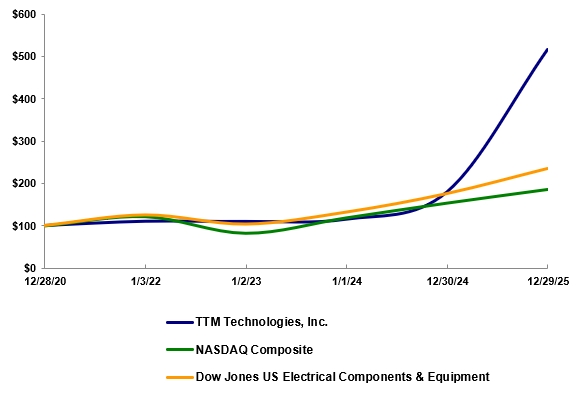
* $100 invested on December 28, 2020 in stock or index, including reinvestment of dividends.
|
12/28/2020 |
|
|
1/3/2022 |
|
|
1/2/2023 |
|
|
1/1/2024 |
|
|
12/30/2024 |
|
|
12/29/2025 |
|
||||||
TTM Technologies, Inc. |
$ |
100.00 |
|
|
$ |
110.11 |
|
|
$ |
109.67 |
|
|
$ |
114.98 |
|
|
$ |
179.64 |
|
|
$ |
517.89 |
|
Nasdaq Composite |
|
100.00 |
|
|
|
122.18 |
|
|
|
82.43 |
|
|
|
119.22 |
|
|
|
154.48 |
|
|
|
187.14 |
|
Dow Jones U.S. Electrical Components & Equipment |
|
100.00 |
|
|
|
125.35 |
|
|
|
103.42 |
|
|
|
132.15 |
|
|
|
176.57 |
|
|
|
236.57 |
|
The performance graph above shall not be deemed “filed” for purposes of Section 18 of the Exchange Act or otherwise subject to the liability of that section. The performance graph above will not be deemed incorporated by reference into any filing of our company under the Exchange Act.
28
Dividends
We have never declared or paid cash dividends on our common stock. We currently expect to retain future earnings for capital expenditures and acquisitions, and to fund working capital requirements, repay existing debt, and to repurchase shares and do not anticipate paying cash dividends in the foreseeable future. Additionally, our ability to pay dividends is limited pursuant to covenants contained in our various debt agreements.
Issuer Purchases of Equity Securities
On May 8, 2025, our Board of Directors authorized the 2025 Repurchase Program, under which we may repurchase up to $100.0 million in value of our common stock from time to time through May 7, 2027. Our previous two-year repurchase program expired on May 3, 2025. We did not repurchase any shares of our common stock during the quarter ended December 29, 2025.
ITEM 6. RESERVED
Not applicable.
29
ITEM 7. MANAGEMENT’S DISCUSSION AND ANALYSIS OF FINANCIAL CONDITION AND RESULTS OF OPERATIONS
This financial review presents our operating results for each of our three most recent fiscal years and our financial condition as of December 29, 2025. Except for historical information contained herein, the following discussion contains forward-looking statements which are subject to known and unknown risks, uncertainties, and other factors that may cause our actual results to differ materially from those expressed or implied by such forward-looking statements. We discuss such risks, uncertainties, and other factors throughout this Report and specifically under Item 1A, Risk Factors of Part I of this Report. In addition, the following discussion should be read in connection with the information presented in our consolidated financial statements and the related notes to our consolidated financial statements.
COMPANY OVERVIEW
We are a leading global manufacturer of technology products, including mission systems, RF components, RF microwave/microelectronic assemblies, and technologically advanced interconnect products, including PCBs and substrates. We focus on providing time-to-market and volume production of advanced technology products and offer a one-stop design, engineering, and manufacturing solution to our customers. This solution allows us to align technology development with the diverse needs of our customers and to enable them to reduce the time required to develop new products and bring them to market. We serve a diversified customer base consisting of approximately 1,300 customers in various markets throughout the world, including aerospace and defense, data center computing, automotive, medical, industrial, and instrumentation, and networking. Our customers include OEMs, EMS providers, ODMs, distributors, and government agencies (both domestic and allied foreign governments).
RECENT DEVELOPMENTS
On July 9, 2025, we announced the acquisition of a facility in Eau Claire, Wisconsin, as well as land rights for an additional future manufacturing site in Penang, Malaysia. We believe the Eau Claire, Wisconsin facility comes equipped with the necessary infrastructure to support advanced technology PCB manufacturing and enhances our ability to support future high-volume U.S. production of advanced technology PCBs across key markets, particularly data center computing and networking for generative AI applications. In addition, we acquired land rights for ten acres in Penang to establish a new production site that we anticipate will align with customers’ increasing interests in supply chain diversification beyond China. The future Penang facility will be in close proximity to our existing facility and will enable us to deliver cost-competitive, high-quality advanced technology PCB manufacturing to commercial markets such as data center computing, networking, and medical, industrial, and instrumentation. Together, these new investments support our strategy to offer regionally optimized, globally connected manufacturing solutions for our customers.
We previously announced we are in the process of constructing a new advanced technology PCB manufacturing facility in Syracuse, New York. We expect that our new facility will bring advanced technology capability for our domestic high-volume production of ultra-HDI PCBs in support of national security requirements. The building construction is complete, equipment is arriving, and we are beginning to install and test equipment setups. Volume production in this facility is expected to commence in the second half of 2026.
30
FINANCIAL OVERVIEW
Our customers include both OEMs and EMS providers. We sell to OEMs both directly and indirectly through EMS providers. For such indirect sales, we measure customers based on OEM companies as they are the ultimate end customers. Sales to our ten largest customers collectively accounted for 55%, 42%, and 41% of our net sales in 2025, 2024, and 2023, respectively.
The percentage of our net sales attributable to each of the principal end markets we served was as follows:
|
|
For the Year Ended |
|||||||
|
|
December 29, 2025 (1) |
|
December 30, 2024 (1) |
|
January 1, 2024 (1) |
|||
End Markets (2): |
|
|
|
|
|
|
|
|
|
Aerospace and Defense |
|
44 |
% |
|
46 |
% |
|
46 |
% |
Automotive |
|
10 |
|
|
13 |
|
|
16 |
|
Data Center Computing |
|
24 |
|
|
20 |
|
|
14 |
|
Medical/Industrial/Instrumentation |
|
14 |
|
|
14 |
|
|
16 |
|
Networking |
|
8 |
|
|
7 |
|
|
8 |
|
Total |
|
100 |
% |
|
100 |
% |
|
100 |
% |
We derive revenues primarily from the sale of PCBs, engineered systems using customer-supplied engineering and design plans as well as our long-term contracts related to the design and manufacture of highly sophisticated intelligence, surveillance, and communications solutions, and RF and microwave/microelectronics components, assemblies, and subsystems. Orders for products generally correspond to the production schedules of our customers and are supported with firm purchase orders. Our customers have continuous control of the work in progress and finished goods throughout the PCB and engineered systems manufacturing process, as these are built to customer specifications with no alternative use, and there is an enforceable right of payment for work performed to date. As a result, we recognize revenue progressively over time based on the extent of progress towards completion of the performance obligation. We recognize revenue based on a cost method as it best depicts the transfer of control to the customer which takes place as we incur costs. Revenues are recorded proportionally as costs are incurred.
We also manufacture certain components, assemblies, subsystems, and completed systems which service our RF&S Components customers and certain aerospace and defense customers. We recognize revenue at a point in time upon transfer of control of the products to our customer. Point in time recognition was determined as our customers do not simultaneously receive or consume the benefits provided by our performance and the asset being manufactured has alternative uses to us.
Net sales consist of gross sales less an allowance for returns, which typically have been approximately 2% of gross sales. We provide our customers a limited right of return for defective PCBs including components, assemblies, and subsystems. We record an estimate for sales returns and allowances at the time of sale based on historical results and anticipated returns.
Cost of goods sold consists of materials, labor, outside services, and overhead expenses incurred in the manufacture and testing of our products. Shipping and handling fees and related freight costs and supplies associated with shipping products are also included as a component of cost of goods sold. Many factors affect our gross margin, including product mix, production volume, supply chain costs, and yield.
Selling and marketing expenses consist primarily of salaries, labor-related benefits, and commissions paid to our internal sales force, independent sales representatives, and our sales support staff, as well as costs associated with marketing materials and trade shows.
General and administrative costs primarily include the salaries for executive, finance, accounting, information technology, and human resources personnel, as well as expenses for accounting and legal assistance, incentive compensation expense, and gains or losses on the sale or disposal of property, plant, and equipment.
Research and development expenses consist primarily of salaries and labor-related benefits paid to our research and development staff, as well as material costs.
CRITICAL ACCOUNTING POLICIES AND ESTIMATES
Our consolidated financial statements included in this Report have been prepared in accordance with U.S. GAAP. The preparation of these financial statements requires management to make estimates and assumptions that affect the reported amounts of assets, liabilities, net sales and expenses, and related disclosure of contingent assets and liabilities.
A critical accounting policy is defined as one that is both material to the presentation of our consolidated financial statements and requires us to make judgments that could have a material effect on our financial condition or results of operations. These policies require us to make assumptions about matters that are highly uncertain at the time of the estimate. Critical accounting estimates refers
31
to those estimates made in accordance with U.S. GAAP that have had or are reasonably likely to have a material impact on the amounts reported in the consolidated financial statements and the related notes due to the significant level of uncertainty involved in developing the estimate. Different estimates we could reasonably have used, or changes in the estimates that are reasonably likely to occur, could have a material effect on our financial condition or results of operations.
We base our estimates on historical experience and on various other assumptions that we believe to be reasonable under the circumstances, the results of which form the basis for making judgments about the carrying values of assets and liabilities that are not readily apparent from other sources. Actual results may differ from these estimates under different assumptions or conditions.
We believe the following critical accounting policies and estimates reflect the more significant judgments and estimates used by us in preparing our consolidated financial statements. For additional discussion of the application of our significant accounting policies, see Part II, Item 8, Note 1, Nature of Operations and Summary of Significant Accounting Policies, of the Notes to Consolidated Financial Statements in this Report.
For PCBs and engineered systems, customers have continuous control of the work in progress and finished goods throughout the PCB and engineered systems manufacturing process, as these are built to customer specifications with no alternative use, and there is an enforceable right to payment for work performed to date. As a result, we recognize revenue progressively over time based on the extent of progress towards completion of the performance obligation. See Part II, Item 8, Note 2, Revenues, of the Notes to Consolidated Financial Statements in this Report for further information.
For revenue recorded on an over time basis, we apply a gross margin estimate to inventory in process of being manufactured for customers to determine how much of a contract asset or contract liability should be recorded at period end. We use historical information to estimate the gross margin associated with performance obligations that are satisfied over time. We reevaluate our estimate of gross margins on a quarterly basis. Based on the review of gross margins, we update our estimate to the model as necessary. If our estimates of gross margins are inaccurate, we may recognize too much or too little revenue in a period. While experience has shown that trends in gross margins are not volatile, changes in pricing or cost efficiencies could create significant fluctuations. An increase or decrease of 200 basis points in gross margin estimates would have increased or decreased our contract assets by $3.7 million and $2.9 million, respectively, and decreased or increased our contract liabilities by $6.4 million and $5.8 million, respectively.
During the quarter ended June 30, 2025, in connection with our change in organizational structure to enhance clarity in sector performance, accountability, and operating costs, we concluded that we have three reportable segments: A&D, Commercial, and RF&S Components. In prior periods, we had two reportable segments: PCB and RF&S Components. In connection with our assessment of operating segments, we determined that our operating segments were also our reporting units and reallocated our PCB goodwill between A&D and Commercial based on the estimated relative fair values of the reporting units. In connection with the reallocation of goodwill, we performed a quantitative goodwill impairment assessment for these segments and concluded no impairment indicators existed as of June 30, 2025. See Part II, Item 8, Note 4, Segment Information, and Note 6, Goodwill and Definite-lived Intangibles, of the Notes to Consolidated Financial Statements in this Report for further information.
We completed our quantitative goodwill impairment analysis related to our PCB, A&D, and Commercial reporting units by comparing the fair value of each reporting unit with its carrying amount. Based on our analysis, we determined that the fair values of the PCB, A&D, and Commercial reporting units were greater than their respective carrying values. In making this assessment, we rely on a number of factors, including expected future operating results, business plans, economic projections, anticipated future cash flows, and business trends. We determined the fair value of the reporting units by using both a DCF and a market approach. Under the market approach, we used revenue and earnings multiples based on comparable industry multiples to estimate the fair value of the reporting unit.
Under the DCF approach, we estimated the future cash flows, as well as selected a risk-adjusted discount rate to measure the present value of the anticipated cash flows. When determining future cash flow estimates, we considered historical results adjusted to reflect current and anticipated future operating conditions. We estimated cash flows for the reporting unit over a discrete period and a terminal period (considering expected long-term growth rates and trends).
We reallocated PCB goodwill to the A&D and Commercial reporting units based on their estimated relative fair values. Estimating the fair value of the reporting unit requires us to make assumptions and estimates in such areas as future economic conditions, industry-specific conditions, product pricing, and necessary capital expenditures. The use of different assumptions or estimates for future cash flows, discount rates, or terminal growth rates, which are subject to a high degree of judgment, could produce substantially different estimates of the fair value of the reporting unit.
In the fourth quarter of 2025, we performed our annual goodwill impairment test qualitatively for the A&D, Commercial, and RF&S Components reporting units and concluded that it was more likely than not that there was no impairment to goodwill.
32
Management will continue to monitor the reporting units for changes in the business environment that could impact recoverability. The recoverability of goodwill is dependent upon the continued growth of cash flows from our business activities. If the economy or business environment falters and we are unable to achieve our assumed revenue growth rates or profit margin percentages, our projections used would need to be remeasured, which could impact the carrying value of our goodwill in one or more of our reporting units.
We also assess definite-lived intangibles for potential impairment given similar impairment indicators. When indicators of impairment exist related to our definite-lived intangible assets, we use an estimate of the undiscounted cash flows in measuring whether the carrying amount of the assets is recoverable. If the sum of the undiscounted cash flows is less than the carrying amount of the net assets, impairment is measured based on the difference between the net asset’s carrying value and estimated fair value. Fair value is determined through various valuation techniques, including cost-based, market, and income approaches as considered necessary, which involve judgments related to future cash flows and the application of the appropriate valuation model.
CONSOLIDATED OPERATING RESULTS
We operate on a 52 or 53 week fiscal calendar with the fourth quarter ending on the Monday nearest December 31. Fiscal years 2025, 2024, and 2023 consisted of 52 weeks ended on December 29, 2025, December 30, 2024, and January 1, 2024, respectively. All references to years relate to fiscal years unless otherwise noted.
Selected financial highlights are presented in the table below:
|
|
For the Year Ended |
|
|||||||||
|
|
December 29, 2025 |
|
|
December 30, 2024 |
|
|
January 1, 2024 |
|
|||
|
|
(In thousands, except margin rates) |
|
|||||||||
Net sales |
|
$ |
2,906,345 |
|
|
$ |
2,442,753 |
|
|
$ |
2,232,567 |
|
Cost of goods sold |
|
|
2,304,659 |
|
|
|
1,965,378 |
|
|
|
1,819,299 |
|
Gross profit |
|
|
601,686 |
|
|
|
477,375 |
|
|
|
413,268 |
|
Gross margin |
|
|
20.7 |
% |
|
|
19.5 |
% |
|
|
18.5 |
% |
Operating expenses: |
|
|
|
|
|
|
|
|
|
|||
Selling and marketing |
|
|
85,460 |
|
|
|
80,030 |
|
|
|
76,922 |
|
General and administrative |
|
|
192,149 |
|
|
|
170,107 |
|
|
|
149,631 |
|
Research and development |
|
|
28,992 |
|
|
|
31,845 |
|
|
|
27,272 |
|
Amortization of definite-lived intangibles |
|
|
27,554 |
|
|
|
35,550 |
|
|
|
48,675 |
|
Impairment of goodwill |
|
— |
|
|
|
32,600 |
|
|
|
44,100 |
|
|
Restructuring charges |
|
|
2,847 |
|
|
|
11,200 |
|
|
|
24,352 |
|
Total operating expenses |
|
|
337,002 |
|
|
|
361,332 |
|
|
|
370,952 |
|
Operating income |
|
|
264,684 |
|
|
|
116,043 |
|
|
|
42,316 |
|
Operating margin |
|
|
9.1 |
% |
|
|
4.8 |
% |
|
|
1.9 |
% |
Total other expense, net |
|
|
(54,347 |
) |
|
|
(32,094 |
) |
|
|
(42,019 |
) |
Income tax provision |
|
|
(32,889 |
) |
|
|
(27,650 |
) |
|
|
(19,015 |
) |
Net income (loss) |
|
$ |
177,448 |
|
|
$ |
56,299 |
|
|
$ |
(18,718 |
) |
Total net sales increased $463.6 million, or 19.0%, to $2,906.3 million for the year ended December 29, 2025 from $2,442.8 million for the year ended December 30, 2024. The primary driver of this increase was strong demand in our aerospace and defense, data center computing, and networking end markets, the latter two being driven by generative AI. In addition, our medical, industrial, and instrumentation end market was stronger as inventories and demand normalized in this end market.
Total net sales increased $210.2 million, or 9.4%, to $2,442.8 million for the year ended December 30, 2024 from $2,232.5 million for the year ended January 1, 2024. The primary driver of this increase was demand growth for generative AI applications in our data center computing end market and strong demand and improved operational execution in our aerospace and defense end market, partially offset by demand weakness due to customers' inventory correction in our automotive, medical, industrial, and instrumentation, and networking end markets. We also sold our Shanghai Backplane Assembly entity in the first quarter of 2023, which had the effect of reducing net sales in 2024 by $8.4 million.
Gross profit increased $124.3 million to $601.7 million for the year ended December 29, 2025, from $477.4 million for the year ended December 30, 2024. Gross margin rate increased to 20.7% for the year ended December 29, 2025, from 19.5% for the year ended December 30, 2024. These increases were primarily due to higher sales volume, improved operational execution, favorable product
33
mix, and increased volume of PCB shipments, partially offset by continued ramp-up costs in connection with our fabrication plant in Penang, Malaysia.
Gross profit increased $64.1 million to $477.4 million for the year ended December 30, 2024, from $413.3 million for the year ended January 1, 2024. Gross margin rate increased to 19.5% for the year ended December 30, 2024, from 18.5% for the year ended January 1, 2024. These increases were primarily due to higher sales volume and improved operational execution, partially offset by higher employee costs and continued ramp-up costs in connection with our fabrication plant in Penang, Malaysia.
Operating expenses decreased $24.3 million to $337.0 million for the year ended December 29, 2025, from $361.3 million for the year ended December 30, 2024, primarily due to the absence of a $32.6 million impairment of goodwill, decreases in restructuring charges and amortization of definite-lived intangibles, and the absence of a $6.1 million write down of our Hong Kong building that occurred during the year ended December 30, 2024, partially offset by higher stock-based compensation and incentive compensation expense as well as the absence of $14.4 million of gains on the sale of assets primarily related to the sale of two buildings vacated with the closure of our Anaheim and Santa Clara plants that occurred during the year ended December 30, 2024.
Operating expenses decreased $9.6 million to $361.3 million for the year ended December 30, 2024, from $371.0 million for the year ended January 1, 2024, primarily due to decreases in restructuring charges, amortization of definite-lived intangibles, and impairment of goodwill, partially offset by higher labor costs, consulting and other professional services expenses, stock-based compensation, bad debt, and incentive compensation. In addition, $14.4 million of gains on the sale of assets primarily related to the sale of two buildings vacated with the closure of our Anaheim and Santa Clara plants were partially offset by the write down of our Hong Kong building of $6.1 million that occurred during the year ended December 30, 2024.
Total other expense, net increased $22.3 million to $54.3 million for the year ended December 29, 2025 from $32.1 million for the year ended December 30, 2024, primarily due to a foreign exchange loss of $20.4 million during the year ended December 29, 2025 compared to a foreign exchange gain of $1.2 million during the year ended December 30, 2024. We utilize the RMB and MYR at our China and Malaysia facilities, respectively, for employee‑related and other costs of running our operations in foreign countries. There was an unrealized loss from foreign exchange of $14.6 million during the year ended December 29, 2025, compared to an unrealized gain from foreign exchange of $1.0 million during the year ended December 30, 2024. The unrealized loss was related to the translation of our China and Malaysia balance sheets from their local currencies into the U.S. dollar functional currency, resulting from strengthening RMB and MYR during the year ended December 29, 2025 as compared to the year ended December 30, 2024.
Total other expense, net decreased $9.9 million to $32.1 million for the year ended December 30, 2024 from $42.0 million for the year ended January 1, 2024. This decrease was primarily due to the weakening RMB resulting in a $1.2 million foreign exchange gain during the year ended December 30, 2024, as compared to a $3.9 million foreign exchange loss during the year ended January 1, 2024. In addition, there was a $3.8 million increase in interest income and $0.6 million decrease in interest expense.
Income tax expense increased $5.2 million to $32.9 million for the year ended December 29, 2025 from $27.7 million for the year ended December 30, 2024, primarily due to an increase in income before income taxes for the year ended December 29, 2025 and income tax accruals for assessments and uncertain tax positions in various jurisdictions, partially offset by the OBBBA tax impact, as discussed below, and an income tax benefit from the deduction of stock‑based compensation.
Income tax expense increased $8.6 million to $27.7 million for the year ended December 30, 2024 from $19.0 million for the year ended January 1, 2024, primarily due to an increase in income before income taxes.
On July 4, 2025, the OBBBA was enacted, introducing amendments to U.S. tax laws with various effective dates from 2025 to 2027. The OBBBA includes provisions such as the permanent extension of certain provisions of the Tax Cuts and Jobs Act that were set to expire at the end of 2025 and modifications to the international tax framework. Topic 740 requires the effects of changes in tax rates and laws on deferred tax balances to be recognized in the period in which the legislation is enacted. Accordingly, our tax provisions for the year ended December 29, 2025 incorporated the estimated effects of the tax law changes including the accelerated depreciation of qualified property and the immediate expensing of U.S. research and development expenditure paid or incurred for tax years beginning after December 31, 2024. We recorded a $6.0 million benefit from the decrease in the U.S. valuation allowance resulting from the OBBBA impact to our deferred tax assets.
Our effective tax rate is primarily impacted by the mix of foreign and U.S. income, tax rates in China and Hong Kong, the U.S. federal income tax rate, apportioned state income tax rates, the generation of credits and deductions available to us as well as changes in valuation allowances and certain non-deductible items.
34
SEGMENT OPERATING RESULTS
Basis of Presentation
During the quarter ended June 30, 2025, in connection with our change in organizational structure to enhance clarity in sector performance, accountability, and operating costs, our management finalized its assessment of our operating segments and concluded that we have three reportable segments: A&D, Commercial, and RF&S Components. As a result, certain prior period amounts have been reclassified to conform with this new presentation. See Part II, Item 8, Note 4, Segment Information, of the Notes to Consolidated Financial Statements in this Report for further information.
Selected segment financial highlights, with reconciliations to operating income, are presented in the table below:
|
|
For the Year Ended |
|
|||||||||
|
|
December 29, 2025 |
|
|
December 30, 2024 |
|
|
January 1, 2024 |
|
|||
|
|
(In thousands, except margin rates) |
|
|||||||||
Segment sales: |
|
|
|
|
|
|
|
|
|
|||
A&D |
|
$ |
1,292,523 |
|
|
$ |
1,139,955 |
|
|
$ |
1,045,983 |
|
Commercial |
|
|
1,585,701 |
|
|
|
1,275,701 |
|
|
|
1,164,672 |
|
RF&S Components |
|
|
40,014 |
|
|
|
37,317 |
|
|
|
38,619 |
|
Total |
|
$ |
2,918,238 |
|
|
$ |
2,452,973 |
|
|
$ |
2,249,274 |
|
Segment operating income: |
|
|
|
|
|
|
|
|
|
|||
A&D |
|
$ |
183,813 |
|
|
$ |
141,800 |
|
|
$ |
95,021 |
|
Commercial |
|
|
238,781 |
|
|
|
179,782 |
|
|
|
171,379 |
|
RF&S Components |
|
|
11,253 |
|
|
|
8,666 |
|
|
|
10,955 |
|
Total |
|
|
433,847 |
|
|
|
330,248 |
|
|
|
277,355 |
|
Segment operating margin rate: |
|
|
|
|
|
|
|
|
|
|||
A&D |
|
|
14.2 |
% |
|
|
12.4 |
% |
|
|
9.1 |
% |
Commercial |
|
|
15.1 |
% |
|
|
14.1 |
% |
|
|
14.7 |
% |
RF&S Components |
|
|
28.1 |
% |
|
|
23.2 |
% |
|
|
28.4 |
% |
Total |
|
|
14.9 |
% |
|
|
13.5 |
% |
|
|
12.3 |
% |
Unallocated amounts: |
|
|
|
|
|
|
|
|
|
|||
Restructuring |
|
|
(2,847 |
) |
|
|
(11,200 |
) |
|
|
(24,352 |
) |
Impairment of goodwill |
|
— |
|
|
|
(32,600 |
) |
|
|
(44,100 |
) |
|
Gain on sale of property, plant, and equipment |
|
— |
|
|
|
15,669 |
|
|
|
195 |
|
|
Acquisition-related and other charges |
|
|
(15 |
) |
|
|
(14,524 |
) |
|
|
(4,529 |
) |
Stock-based compensation |
|
|
(41,668 |
) |
|
|
(29,780 |
) |
|
|
(22,887 |
) |
Other corporate expenses |
|
|
(87,736 |
) |
|
|
(96,878 |
) |
|
|
(77,790 |
) |
Amortization of definite-lived intangibles (1) |
|
|
(36,897 |
) |
|
|
(44,892 |
) |
|
|
(61,576 |
) |
Operating income |
|
$ |
264,684 |
|
|
$ |
116,043 |
|
|
$ |
42,316 |
|
Segment operating income, as reconciled in Part II, Item 8, Note 4, Segment Information, of the Notes to Consolidated Financial Statements in this Report, and segment operating margin rate (segment operating income divided by segment sales) are presented in conformity with Accounting Standards Codification (ASC) Topic 280, Segment Reporting. These measures are reported to the CODM, who is the President and Chief Executive Officer, for purposes of making decisions about allocating resources to the segments and assessing their performance. For these reasons, these measures are excluded from the definition of non‑GAAP financial measures under the SEC's Regulation G and Item 10(e) of Regulation S-K.
35
A&D
Segment sales for the A&D reportable segment increased $152.6 million, or 13.4%, to $1,292.5 million for the year ended December 29, 2025, from $1,140.0 million for the year ended December 30, 2024. The primary drivers of this increase were improved spending in previous defense budgets, our strong strategic program alignment, and key bookings for ongoing franchise programs, including restricted programs. These increases were driven by increased sales related to missiles and munitions as well as strong demand in our mission systems and specialty assembly businesses.
Segment sales for the A&D reportable segment increased $94.0 million, or 9.0%, to $1,140.0 million for the year ended December 30, 2024, from $1,046.0 million for the year ended January 1, 2024. The primary driver of this increase was strong demand in our radar and missile systems.
Segment operating income for the A&D reportable segment increased $42.0 million to $183.8 million for the year ended December 29, 2025, from $141.8 million for the year ended December 30, 2024. Segment operating margin rate for the A&D reportable segment increased to 14.2% for the year ended December 29, 2025, from 12.4% for the year ended December 30, 2024. The primary drivers of these increases were higher sales volume, as discussed above, favorable product mix, and improved operational execution.
Segment operating income for the A&D reportable segment increased $46.8 million to $141.8 million for the year ended December 30, 2024, from $95.0 million for the year ended January 1, 2024. Segment operating margin rate for the A&D reportable segment increased to 12.4% for the year ended December 30, 2024, from 9.1% for the year ended January 1, 2024. The primary drivers of these increases were higher sales volume, as discussed above, and improved operational execution.
Commercial
Segment sales for the Commercial reportable segment increased $310.0 million, or 24.3%, to $1,585.7 million for the year ended December 29, 2025, from $1,275.7 million for the year ended December 30, 2024. The primary driver of this increase was strong demand in our data center computing and networking end markets driven by generative AI, and the recovery in medical, industrial, and instrumentation market.
Segment sales for the Commercial reportable segment increased $111.0 million, or 9.5%, to $1,275.7 million for the year ended December 30, 2024, from $1,164.7 million for the year ended January 1, 2024. The primary driver of this increase was demand growth for generative AI applications in our data center computing end market, partially offset by demand weakness due to customers' inventory correction in our automotive, medical, industrial, and instrumentation, and networking end markets. We also sold our Shanghai Backplane Assembly entity in the first quarter of 2023, which had the effect of reducing Commercial reportable segment net sales in 2024 by $8.4 million.
Segment operating income for the Commercial reportable segment increased $59.0 million to $238.8 million for the year ended December 29, 2025, from $179.8 million for the year ended December 30, 2024. Segment operating margin rate for the Commercial reportable segment increased to 15.1% for the year ended December 29, 2025, from 14.1% for the year ended December 30, 2024. The primary driver of these increases in segment operating income was higher sales volume, as discussed above, partially offset by increased ramp-up costs in connection with our fabrication plant in Penang, Malaysia.
Segment operating income for the Commercial reportable segment increased $8.4 million to $179.8 million for the year ended December 30, 2024, from $171.4 million for the year ended January 1, 2024. Segment operating margin rate for the Commercial reportable segment decreased to 14.1% for the year ended December 30, 2024, from 14.7% for the year ended January 1, 2024. The primary driver of the increase in segment operating income was higher sales volume, as discussed above, while the segment operating margin rate decreased due to continued ramp-up costs in connection with our fabrication plant in Penang, Malaysia.
RF&S Components
Segment sales for the RF&S Components reportable segment increased $2.7 million, or 7.2%, to $40.0 million for the year ended December 29, 2025, from $37.3 million for the year ended December 30, 2024. The primary driver of this increase was stronger new business development across the networking and medical, industrial, and instrumentation end markets.
Segment sales for the RF&S Components reportable segment decreased $1.3 million, or 3.4%, to $37.3 million for the year ended December 30, 2024, from $38.6 million for the year ended January 1, 2024. The primary driver of this decrease was lower demand in our networking end market.
36
Segment operating income for the RF&S Components reportable segment increased $2.6 million to $11.3 million for the year ended December 29, 2025, from $8.7 million for the year ended December 30, 2024. Segment operating margin rate for the RF&S Components reportable segment increased to 28.1% for the year ended December 29, 2025, from 23.2% for the year ended December 30, 2024. The primary drivers of these increases were higher sales volume as discussed above, and improved operational execution.
Segment operating income for the RF&S Components reportable segment decreased $2.3 million to $8.7 million for the year ended December 30, 2024, from $11.0 million for the year ended January 1, 2024. Segment operating margin rate for the RF&S Components reportable segment decreased to 23.2% for the December 30, 2024, from 28.4% for the year ended January 1, 2024. The primary driver of these decreases was lower sales volume, as discussed above.
Liquidity and Capital Resources
Our principal sources of liquidity have been cash provided by operations, the issuance of debt, and borrowings under our revolving credit facilities. Our principal uses of cash have been to finance capital expenditures, finance acquisitions, fund working capital requirements, repay debt obligations, and repurchase common stock. We anticipate that financing capital expenditures, financing acquisitions, funding working capital requirements, servicing debt, and repurchasing common stock will be the principal demands on our cash in the future.
Cash flow provided by operating activities during the year ended December 29, 2025 was $291.9 million as compared to $236.9 million in the same period in 2024. The increase in cash flow was primarily due to the $121.1 million increase in net income, partially offset by an increase in working capital.
Net cash used in investing activities was $273.9 million for the year ended December 29, 2025, primarily reflecting the use of $292.6 million for purchases of property, plant, and equipment and other assets, partially offset by the receipt of $17.8 million of proceeds from capital-related government incentives. Net cash used in investing activities was $146.2 million for the year ended December 30, 2024, primarily reflecting the use of $185.7 million for purchases of property, plant, and equipment and other assets. This was partially offset by the receipt of $32.9 million of proceeds from the sale of property, plant, and equipment and other assets primarily related to the sale of two buildings vacated with the closure of our Anaheim and Santa Clara plants and $6.7 million of proceeds from the sale of property associated with our Shanghai E‑MS subsidiary.
Net cash used in financing activities was $20.9 million for the year ended December 29, 2025, reflecting the use of $17.9 million for repurchases of our common stock and $3.8 million for the repayment of long-term debt borrowings, partially offset by the receipt of $1.5 million of customer deposits. Net cash used in financing activities was $36.8 million for the year ended December 30, 2024, reflecting the use of $34.5 million for repurchases of our common stock, $9.6 million for the repayment of long-term debt borrowings, and $1.2 million for payment of debt issuance costs, partially offset by $8.4 million of proceeds from long-term debt borrowings primarily related to the refinancing of our Term Loan Facility.
As of December 29, 2025, we had cash and cash equivalents of approximately $501.2 million, of which approximately $191.9 million was held by our foreign subsidiaries, primarily in China, and $195.8 million of available borrowing capacity under our revolving credit facilities. Should we choose to remit cash to the United States from our foreign locations, we may incur tax obligations which would reduce the amount of cash ultimately available to the United States. However, we believe there would be no material tax expenses not previously accrued for the repatriation of this cash.
Our total 2026 capital expenditures are expected to be in the range of $240.0 million to $260.0 million.
On May 8, 2025, our Board of Directors authorized the 2025 Repurchase Program, under which we may repurchase up to $100.0 million in value of our common stock from time to time through May 7, 2027. During the year ended December 29, 2025, under our previous two-year repurchase program that expired on May 3, 2025, we repurchased approximately 0.7 million shares of our common stock for a total cost of $17.9 million (including commissions). As of December 29, 2025, we have not repurchased any shares of our common stock under the 2025 Repurchase Program, and the remaining amount in value available to be repurchased thereunder was $100.0 million.
As of December 29, 2025, we had $916.2 million of outstanding debt, net of discount and debt issuance costs, composed of $497.4 million of Senior Notes due 2029, $336.8 million under the Term Loan Facility, $80.0 million under the Asia ABL, and $2.0 million of other loans.
37
Pursuant to the terms of the Senior Notes due 2029 and Term Loan Facility, we are subject to certain affirmative and negative covenants, including limitations on indebtedness, corporate transactions, investments, dispositions, and restricted payments. Under the ABL Revolving Loans, we are also subject to various financial covenants, including leverage and fixed charge coverage ratios. As of December 29, 2025, we were in compliance with the covenants under the Senior Notes due 2029, Term Loan Facility, and ABL Revolving Loans.
Based on our current level of operations, we believe that cash generated from operations, cash on hand, and cash from the issuance of term and revolving debt will be adequate to meet our currently anticipated capital expenditure, debt service, and working capital needs for the next 12 months. Additional information regarding our indebtedness, including information about the credit available under our debt facilities, interest rates, and other key terms of our outstanding indebtedness, is included in Part II, Item 8, Note 7, Long‑term Debt and Letters of Credit, of the Notes to Consolidated Financial Statements included in this Report.
We have agreements with financial institutions to facilitate payments to certain suppliers. Liabilities associated with these agreements are recorded in accounts payable on the consolidated balance sheets and amounted to $12.5 million and $17.2 million as of December 29, 2025 and December 30, 2024, respectively.
Contractual Obligations and Commitments
As part of our ongoing operations, we enter into contractual arrangements that obligate us to make future cash payments. These obligations impact our liquidity and capital resource needs. Our estimated future obligations consist of long-term debt obligations, interest on debt obligations, derivative liabilities, purchase obligations, and leases.
A summary of our long-term debt obligations as of December 29, 2025 is included in Part II, Item 8, Note 7, Long‑term Debt and Letters of Credit, of the Notes to Consolidated Financial Statements included in this Report.
Our aggregate interest on debt obligations as of December 29, 2025 amounted to $167.9 million, which are expected to be settled as follows: $44.7 million within 1 year, $85.0 million within 1-3 years, and $38.2 million within 4-5 years. For debt obligations based on variable rates, interest rates used are as of December 29, 2025.
As of December 29, 2025, an immaterial amount of our derivative liabilities is expected to be settled within one year and $0.4 million of our derivative liabilities are expected to be settled within 1-3 years.
We also have outstanding firm purchase orders with certain suppliers for the purchase of material and inventory. Orders for standard, or catalog, items can typically be canceled with little or no financial penalty. Our policy regarding non-standard or customized items dictates that such items are only ordered specifically for customers who have contractually assumed liability for the inventory, although exceptions are made to this policy in certain situations. In addition, a substantial portion of catalog items covered by our purchase orders are procured for specific customers based on their purchase orders or a forecast under which the customer has contractually assumed liability for such material. Accordingly, our liability from purchase obligations under these purchase orders is not expected to be significant.
A summary of our lease obligations as of December 29, 2025 is included in Part II, Item 8, Note 13, Leases, of the Notes to Consolidated Financial Statements included in this Report.
Seasonality
We do not consider any material portion of our business to be seasonal. Various factors, however, can affect the distribution of our sales between accounting periods, including the timing of customer orders, the availability of customer funding, product deliveries, and customer acceptance.
Recently Issued Accounting Standards
For a description of recently adopted and issued accounting standards, including the respective dates of adoption and expected effects on our results of operations and financial condition, see Part II, Item 8, Note 1, Nature of Operations and Summary of Significant Accounting Policies, of the Notes to Consolidated Financial Statements included in this Report.
38
ITEM 7A. QUANTITATIVE AND QUALITATIVE DISCLOSURES ABOUT MARKET RISK
In the normal course of business operations, we are exposed to risks associated with fluctuations in interest rates and foreign currency exchange rates. We address these risks through controlled risk management that includes the use of derivative financial instruments to economically hedge or reduce these exposures. We do not enter into derivative financial instruments for trading or speculative purposes. As of December 29, 2025, we did not have any material commodity contracts in place and believe our exposure to commodity price risk is not material.
We have not experienced any losses to date on any derivative financial instruments due to counterparty credit risk.
Interest Rate Risks
Our business is exposed to risk resulting from fluctuations in interest rates. Our interest expense is more sensitive to fluctuations in the general level of Term SOFR interest rates than to changes in rates in other markets. Increases in interest rates would increase interest expense relating to our outstanding variable rate borrowings and increase the cost of debt. Fluctuations in interest rates can also lead to significant fluctuations in the fair value of our debt obligations.
In March 2023, we entered into a four-year pay-fixed, receive-floating (1-month CME Term SOFR), interest rate swap arrangement with a notional amount of $250.0 million for the period beginning April 1, 2023 and ending on April 1, 2027. Under the terms of the interest rate swap, we pay a fixed rate of 3.49% against a portion of our Term SOFR-based debt and receive floating 1‑month CME Term SOFR during the swap period.
At inception, we designated the interest rate swap as a cash flow hedge and the fair value of the interest rate swap was zero. As of December 29, 2025, the fair value of the interest rate swap was recorded as a liability in the amount of $0.4 million included as a component of other long-term liabilities. As of December 30, 2024, the fair value of the interest rate swap was recorded as an asset in the amount of $3.1 million, of which $1.8 million is included as a component of prepaid expenses and other current assets and $1.3 million is included as a component of deposits and other non-current assets. No ineffectiveness was recognized for the year ended December 29, 2025. During the years ended December 29, 2025 and December 30, 2024, the interest rate swap decreased interest expense by $1.9 million and $4.2 million, respectively. For the year ended December 29, 2025, we received $10.6 million in floating-rate interest at an average rate of 4.24% and paid $8.8 million in fixed-rate interest at 3.49%.
See Liquidity and Capital Resources in Item 7, Management’s Discussion and Analysis of Financial Condition and Results of Operations and Part II, Item 8, Note 7, Long-term Debt and Letters of Credit, of the Notes to Consolidated Financial Statements included in this Report for further discussion of our financing facilities and capital structure. As of December 29, 2025, approximately 81.4% of our debt was based on fixed rates. Based on our borrowings as of December 29, 2025, an assumed 100 basis point change in variable rates would cause our annual interest cost to change by $1.7 million.
Foreign Currency Exchange Rate Risks
In the normal course of business, we are exposed to risks associated with fluctuations in foreign currency exchange rates related to transactions that are denominated in currencies other than our functional currencies, as well as the effects of translating amounts denominated in a foreign currency to the U.S. Dollar as a normal part of our financial reporting process. Most of our foreign operations have the U.S. Dollar as their functional currency. However, one of our China facilities utilizes the RMB, which results in recognition of translation adjustments included as a component of other comprehensive income (loss). Our foreign exchange exposure results primarily from employee-related and other costs of running our operations in foreign countries, foreign currency denominated purchases, and translation of balance sheet accounts denominated in foreign currencies. We do not engage in hedging to manage this foreign currency risk. However, we may consider the use of derivatives in the future. Our primary foreign exchange exposure is to the RMB and MYR.
39
Debt Instruments
The fiscal calendar maturities of our debt instruments for the next five years were as follows:
|
As of December 29, 2025 |
||||||||||||||||||||||||||||||||
|
|
2026 |
|
|
2027 |
|
|
2028 |
|
|
2029 |
|
|
2030 |
|
|
Total |
|
|
Fair |
|
|
Weighted |
||||||||||
|
|
(In thousands, except interest rates) |
|||||||||||||||||||||||||||||||
US$ Variable Rate (1) |
|
$ |
3,465 |
|
|
$ |
4,331 |
|
|
$ |
83,465 |
|
|
$ |
2,599 |
|
|
$ |
328,309 |
|
|
$ |
422,169 |
|
|
$ |
425,806 |
|
|
|
5.79 |
|
% |
US$ Fixed Rate |
|
|
350 |
|
|
|
404 |
|
|
|
363 |
|
|
|
500,419 |
|
|
|
445 |
|
|
|
501,981 |
|
|
|
490,306 |
|
|
|
4.01 |
|
|
Total |
|
$ |
3,815 |
|
|
$ |
4,735 |
|
|
$ |
83,828 |
|
|
$ |
503,018 |
|
|
$ |
328,754 |
|
|
$ |
924,150 |
|
|
$ |
916,112 |
|
|
|
|
|
|
ITEM 8. FINANCIAL STATEMENTS AND SUPPLEMENTARY DATA
Reference is made to our consolidated financial statements, the notes thereto, and the report thereon, commencing on page 48 of this Report, which consolidated financial statements, notes, and report are incorporated herein by reference.
40
ITEM 9. CHANGES IN AND DISAGREEMENTS WITH ACCOUNTANTS ON ACCOUNTING AND FINANCIAL DISCLOSURE
Not applicable.
ITEM 9A. CONTROLS AND PROCEDURES
Evaluation of Disclosure Controls and Procedures
Our management, under the supervision and with the participation of our CEO and CFO, has evaluated the effectiveness of the design and operation of our disclosure controls and procedures (as defined in Rules 13a-15(e) and 15d-15(e)) under the Exchange Act, as of the end of the period covered by this Report. Based on this evaluation, our CEO and CFO have concluded that, as of December 29, 2025 such disclosure controls and procedures were effective to provide reasonable assurance that information we are required to disclose in reports that we file or submit under the Exchange Act is (1) recorded, processed, summarized, and reported within the time periods specified in the SEC's rules and forms and (2) accumulated and communicated to our management, including our CEO and CFO, as appropriate to allow timely decisions regarding required disclosures.
Management’s Report on Internal Control over Financial Reporting
Our management is responsible for establishing and maintaining adequate internal control over financial reporting, (as defined in Exchange Act Rules 13a-15(f) and 15d-15(f)) to provide reasonable assurance regarding the reliability of our financial reporting and the preparation of financial statements for external purposes in accordance with U.S. GAAP. Under the supervision of and with the participation of our CEO and CFO, our management conducted an assessment of the effectiveness of our internal control over financial reporting as of December 29, 2025 based on the criteria established in Internal Control — Integrated Framework (2013) issued by the Committee of Sponsoring Organizations of the Treadway Commission (COSO). Based on this assessment, our management concluded that our internal control over financial reporting was effective as of December 29, 2025.
The effectiveness of our internal control over financial reporting as of December 29, 2025 has been audited by KPMG LLP, an independent registered public accounting firm, as stated in their report, which appears under the heading “Report of Independent Registered Public Accounting Firm” on page 49 of this Report.
Inherent Limitations on Effectiveness of Controls
A control system, no matter how well designed and operated, can provide only reasonable, not absolute, assurance that the control system’s objectives will be met. The design of a control system must reflect the fact that there are resource constraints, and the benefits of controls must be considered relative to their costs. Further, because of the inherent limitations in all control systems, no evaluation of controls can provide absolute assurance that misstatements due to error or fraud will not occur or that all control issues and instances of fraud, if any, have been detected.
Changes in Internal Control over Financial Reporting
We continue to expand our implementation of an ERP on a worldwide basis, which is expected to improve the efficiency of the financial reporting and related transaction processes. We have completed the implementation at certain locations and as a result, we made changes to our processes and procedures which, in turn, resulted in changes to our internal control over financial reporting, including the implementation of additional controls. We are in the process of rolling out the ERP to our remaining locations to standardize the ERP.
There were no other changes in our internal control over financial reporting (as defined in Rules 13a-15(f) and 15d-15(f) under the Exchange Act) during the quarter ended December 29, 2025 that have materially affected, or are reasonably likely to materially affect, our internal control over financial reporting.
ITEM 9B. OTHER INFORMATION
Rule 10b5-1 Trading Plans
During the quarter ended December 29, 2025, our directors and/or officers (as defined in Rule 16a-1(f) under the Exchange Act) adopted or terminated the contracts, instructions, or written plans for the purchase or sale of our securities set forth in the table below.
Name and Title |
|
Action |
|
Adoption / Termination Date |
|
Rule 10b5-1 (1) |
|
Non-Rule 10b5-1 (2) |
|
Total Number of Shares of Common Stock to be Sold (3) |
|
Expiration Date |
|
|
|
|
|
|
|
Indeterminable (4) |
|
41
Name and Title |
|
Action |
|
Adoption / Termination Date |
|
Rule 10b5-1 (1) |
|
Non-Rule 10b5-1 (2) |
|
Total Number of Shares of Common Stock to be Sold (3) |
|
Expiration Date |
|
|
|
|
|
|
|
Indeterminable (4) |
|
||||
|
|
|
|
|
|
|
Indeterminable (4) |
|
|
|||
|
|
|
|
|
|
|
Indeterminable (4) |
|
|
|||
|
|
|
|
|
|
|
Indeterminable (4)
|
|
|
|||
|
|
|
|
|
|
|
Indeterminable (4) |
|
|
|||
|
|
|
|
|
|
|
Indeterminable (4)
|
|
|
|||
|
|
|
|
|
|
|
Up to
|
|
||||
|
|
|
|
|
|
|
Up to |
|
|
|||
|
|
|
|
|
|
|
Indeterminable (4) |
|
|
|||
( |
|
|
|
|
|
|
Indeterminable (4)
|
|
|
|||
( |
|
|
|
|
|
|
Indeterminable (4)
|
|
|
|||
|
|
|
|
|
|
|
Indeterminable (4) |
|
|
ITEM 9C. DISCLOSURE REGARDING FOREIGN JURISDICTIONS THAT PREVENT INSPECTIONS
Not applicable.
42
PART III
ITEM 10. DIRECTORS, EXECUTIVE OFFICERS, AND CORPORATE GOVERNANCE
The information required by this Item is incorporated herein by reference from the definitive Proxy Statement to be filed pursuant to Regulation 14A of the Exchange Act for our 2026 Annual Meeting of Stockholders or will be included in an amendment to this Report.
ITEM 11. EXECUTIVE COMPENSATION
The information required by this Item is incorporated herein by reference from the definitive Proxy Statement to be filed pursuant to Regulation 14A of the Exchange Act for our 2026 Annual Meeting of Stockholders or will be included in an amendment to this Report.
ITEM 12. SECURITY OWNERSHIP OF CERTAIN BENEFICIAL OWNERS AND MANAGEMENT AND RELATED STOCKHOLDER MATTERS
The information required by this Item is incorporated herein by reference from the definitive Proxy Statement to be filed pursuant to Regulation 14A of the Exchange Act for our 2026 Annual Meeting of Stockholders or will be included in an amendment to this Report.
The information required by this Item is incorporated herein by reference from the definitive Proxy Statement to be filed pursuant to Regulation 14A of the Exchange Act for our 2026 Annual Meeting of Stockholders or will be included in an amendment to this Report.
ITEM 14. PRINCIPAL ACCOUNTANT FEES AND SERVICES
The information required by this Item is incorporated herein by reference from the definitive Proxy Statement to be filed pursuant to Regulation 14A of the Exchange Act for our 2026 Annual Meeting of Stockholders or will be included in an amendment to this Report.
43
PART IV
ITEM 15. EXHIBITS, FINANCIAL STATEMENT SCHEDULES
(a) Financial Statements
Financial Statements are listed in the Index to Consolidated Financial Statements on page 48 of this Report.
(b) Exhibits
|
|
|
|
|
|
|
|
|
|
|
|
|
Exhibit |
|
|
|
Filed/Furnished |
|
Incorporated by Reference |
||||||
Number |
|
Exhibit Description |
|
Herewith |
|
Form |
|
File Number |
|
Exhibit |
|
Filing Date |
|
|
|
|
|
|
|
|
|
|
|
|
|
2.1 |
|
|
|
|
8-K |
|
000-31285 |
|
2.1 |
|
June 27, 2022 |
|
|
|
|
|
|
|
|
|
|
|
|
|
|
3.1(a) |
|
Registrant’s Certificate of Incorporation, as amended June 3, 2011 |
|
|
|
8-K |
|
000-31285 |
|
3.1 |
|
June 6, 2011 |
|
|
|
|
|
|
|
|
|
|
|
|
|
3.1(b) |
|
TTM Technologies, Inc. Amended and Restated Certificate of Incorporation, effective May 8, 2024 |
|
|
|
8-K |
|
000-31285 |
|
3.1 |
|
May 10, 2024 |
|
|
|
|
|
|
|
|
|
|
|
|
|
3.1(c) |
|
|
|
|
8-K/A |
|
000-31285 |
|
3.3 |
|
June 10, 2024 |
|
|
|
|
|
|
|
|
|
|
|
|
|
|
3.2 |
|
|
|
|
8-K |
|
000-31285 |
|
3.2 |
|
May 10, 2024 |
|
|
|
|
|
|
|
|
|
|
|
|
|
|
4.1 |
|
|
|
|
8-K |
|
000-31285 |
|
4.1 |
|
August 30, 2005 |
|
|
|
|
|
|
|
|
|
|
|
|
|
|
4.2 |
|
|
|
|
10-K |
|
000-31285 |
|
4.2 |
|
February 21, 2025 |
|
|
|
|
|
|
|
|
|
|
|
|
|
|
4.3 |
|
|
|
|
8-K |
|
000-31285 |
|
4.1 |
|
March 10, 2021 |
|
|
|
|
|
|
|
|
|
|
|
|
|
|
4.4 |
|
|
|
|
8-K |
|
000-31285 |
|
4.1 (1) |
|
March 10, 2021 |
|
|
|
|
|
|
|
|
|
|
|
|
|
|
10.1‡ |
|
|
|
|
8-K |
|
000-31285 |
|
10.1 |
|
December 15, 2014 |
|
|
|
|
|
|
|
|
|
|
|
|
|
|
10.2‡ |
|
|
|
|
8-K |
|
000-31285 |
|
10.25 |
|
September 19, 2011 |
|
|
|
|
|
|
|
|
|
|
|
|
|
|
10.3‡ |
|
Form of Executive Change in Control Severance Agreement and schedule of agreements |
|
|
|
10-Q |
|
000-31285 |
|
10.4 |
|
May 5, 2015 |
|
|
|
|
|
|
|
|
|
|
|
|
|
10.4‡ |
|
|
|
|
10-K |
|
000-31285 |
|
10.6 |
|
March 16, 2007 |
|
|
|
|
|
|
|
|
|
|
|
|
|
|
10.5‡ |
|
TTM Technologies, Inc. 2014 Incentive Compensation Plan, as amended |
|
|
|
8-K |
|
000-31285 |
|
10.1 |
|
May 18, 2016 |
|
|
|
|
|
|
|
|
|
|
|
|
|
10.6‡ |
|
|
|
|
10-Q |
|
000-31285 |
|
10.1 |
|
August 4, 2016 |
|
|
|
|
|
|
|
|
|
|
|
|
|
|
10.7‡ |
|
|
|
|
10-Q |
|
000-31285 |
|
10.2 |
|
May 5, 2015 |
|
|
|
|
|
|
|
|
|
|
|
|
|
|
10.8‡ |
|
|
|
|
10-Q |
|
000-31285 |
|
10.2 |
|
August 4, 2016 |
|
44
|
|
|
|
|
|
|
|
|
|
|
|
|
|
|
|
|
|
|
|
|
|
|
|
|
|
10.9‡ |
|
|
|
|
10-Q |
|
000-31285 |
|
10.1 |
|
August 10, 2015 |
|
|
|
|
|
|
|
|
|
|
|
|
|
|
10.10‡ |
|
|
|
|
S-8 |
|
333-272490 |
|
99.1 |
|
June 7, 2023 |
|
|
|
|
|
|
|
|
|
|
|
|
|
|
10.11‡ |
|
|
|
|
10-Q |
|
000-31285 |
|
10.5 |
|
August 10, 2023 |
|
|
|
|
|
|
|
|
|
|
|
|
|
|
10.12‡ |
|
|
|
|
10-Q |
|
000-31285 |
|
10.6 |
|
August 10, 2023 |
|
|
|
|
|
|
|
|
|
|
|
|
|
|
10.13‡ |
|
|
|
|
10-Q |
|
000-31285 |
|
10.7 |
|
August 10, 2023 |
|
|
|
|
|
|
|
|
|
|
|
|
|
|
10.14‡ |
|
|
|
|
10-K |
|
000-31285 |
|
10.14 |
|
February 21, 2025 |
|
|
|
|
|
|
|
|
|
|
|
|
|
|
10.15‡ |
|
Letter Agreement, dated as of July 28, 2023, by and between the Company and Daniel L. Boehle |
|
|
|
8-K |
|
000-31285 |
|
10.1 |
|
August 2, 2023 |
|
|
|
|
|
|
|
|
|
|
|
|
|
10.16 |
|
|
|
|
8-K |
|
000-31285 |
|
10.1 |
|
June 20, 2023 |
|
|
|
|
|
|
|
|
|
|
|
|
|
|
10.17 |
|
|
|
|
10-Q |
|
000-31285 |
|
10.1 |
|
August 6, 2024 |
|
|
|
|
|
|
|
|
|
|
|
|
|
|
10.18 |
|
|
|
|
10-Q |
|
000-31285 |
|
10.2 |
|
August 6, 2024
|
|
|
|
|
|
|
|
|
|
|
|
|
|
|
45
|
|
|
|
|
|
|
|
|
|
|
|
|
10.19‡ |
|
Letter Agreement, dated as of August 14, 2025, by and between the Company and Edwin Roks |
|
|
|
8-K |
|
000-31285 |
|
10.1 |
|
August 14, 2025 |
|
|
|
|
|
|
|
|
|
|
|
|
|
10.20‡ |
|
|
|
|
8-K |
|
000-31285 |
|
10.2 |
|
August 14, 2025 |
|
|
|
|
|
|
|
|
|
|
|
|
|
|
19 |
|
|
|
|
10-K |
|
000-31285 |
|
19 |
|
February 21, 2025 |
|
|
|
|
|
|
|
|
|
|
|
|
|
|
21.1 |
|
|
X |
|
|
|
|
|
|
|
|
|
|
|
|
|
|
|
|
|
|
|
|
|
|
23.1 |
|
Consent of KPMG LLP, independent registered public accounting firm |
|
X |
|
|
|
|
|
|
|
|
|
|
|
|
|
|
|
|
|
|
|
|
|
31.1 |
|
CEO Certification Pursuant to Section 302 of the Sarbanes-Oxley Act of 2002 |
|
X |
|
|
|
|
|
|
|
|
|
|
|
|
|
|
|
|
|
|
|
|
|
31.2 |
|
CFO Certification Pursuant to Section 302 of the Sarbanes-Oxley Act of 2002 |
|
X |
|
|
|
|
|
|
|
|
|
|
|
|
|
|
|
|
|
|
|
|
|
32.1* |
|
CEO Certification Pursuant to Section 906 of the Sarbanes-Oxley Act of 2002 |
|
X |
|
|
|
|
|
|
|
|
|
|
|
|
|
|
|
|
|
|
|
|
|
32.2* |
|
CFO Certification Pursuant to Section 906 of the Sarbanes-Oxley Act of 2002 |
|
X |
|
|
|
|
|
|
|
|
|
|
|
|
|
|
|
|
|
|
|
|
|
97 |
|
TTM Technologies, Inc. Executive Compensation Recoupment Policy |
|
|
|
10-K |
|
000-31285 |
|
97 |
|
February 27, 2024 |
|
|
|
|
|
|
|
|
|
|
|
|
|
101.INS |
|
Inline XBRL Instance Document – the instance document does not appear in the Interactive Data File because its XBRL tags are embedded within the inline XBRL document. |
|
|
|
|
|
|
|
|
|
|
|
|
|
|
|
|
|
|
|
|
|
|
|
101.SCH |
|
Inline XBRL Taxonomy Extension Schema With Embedded Linkbase Documents |
|
|
|
|
|
|
|
|
|
|
|
|
|
|
|
|
|
|
|
|
|
|
|
104 |
|
Cover Page Interactive Data File (formatted as inline XBRL and contained in Exhibit 101) |
|
|
|
|
|
|
|
|
|
|
‡ Management contract or compensatory plan.
* Furnished herewith. The certifications attached as Exhibits 32.1 and 32.2 that accompany this Report are not deemed filed with the Commission and are not to be incorporated by reference into any filing of Registrant under the Securities Act of 1933, as amended, or the Exchange Act, whether made before or after the date of this Report, irrespective of any general incorporation language contained in such filing.
(c) Financial Statement Schedules
None.
ITEM 16. FORM 10-K SUMMARY
None.
46
SIGNATURES
Pursuant to the requirements of Section 13 or 15(d) of the Securities Exchange Act of 1934, the registrant has duly caused this Report to be signed on its behalf by the undersigned, thereunto duly authorized.
TTM TECHNOLOGIES, INC. |
||
|
|
|
By: |
|
/s/ Edwin Roks |
|
|
Edwin Roks President and Chief Executive Officer |
Date: February 13, 2026
Pursuant to the requirements of the Securities Exchange Act of 1934, this Report has been signed below by the following persons on behalf of the registrant and in the capacities and on the dates indicated.
|
|
|
|
|
Name |
|
Title |
|
Date |
|
|
|
|
|
/s/ Edwin Roks
Edwin Roks |
|
President, Chief Executive Officer, and Director (Principal Executive Officer) |
|
February 13, 2026
|
|
|
|
|
|
/s/ Daniel L. Boehle
Daniel L. Boehle |
|
Executive Vice President and |
|
February 13, 2026
|
|
|
|
|
|
/s/ Rex D. Geveden
Rex D. Geveden |
|
Chairman of the Board |
|
February 13, 2026
|
|
|
|
|
|
/s/ Wajid Ali
Wajid Ali |
|
Director |
|
February 13, 2026
|
|
|
|
|
|
/s/ Thomas T. Edman |
|
Director |
|
February 13, 2026
|
Thomas T. Edman |
||||
|
|
|
|
|
/s/ Julie S. England
Julie S. England |
|
Director |
|
February 13, 2026
|
|
|
|
|
|
/s/ Philip G. Franklin
Philip G. Franklin |
|
Director |
|
February 13, 2026
|
|
|
|
|
|
/s/ Pamela B. Jackson
Pamela B. Jackson |
|
Director |
|
February 13, 2026
|
|
|
|
|
|
/s/ Chantel E. Lenard
Chantel E. Lenard |
|
Director |
|
February 13, 2026
|
|
|
|
|
|
/s/ John G. Mayer
John G. Mayer |
|
Director |
|
February 13, 2026
|
|
|
|
|
|
47
TTM TECHNOLOGIES, INC.
Index to Consolidated Financial Statements
49 |
|
Consolidated Balance Sheets as of December 29, 2025 and December 30, 2024 |
51 |
52 |
|
53 |
|
54 |
|
55 |
|
56 |
48
Report of Independent Registered Public Accounting Firm
To the Stockholders and Board of Directors
TTM Technologies, Inc.:
Opinions on the Consolidated Financial Statements and Internal Control Over Financial Reporting
We have audited the accompanying consolidated balance sheets of TTM Technologies, Inc. and subsidiaries (the Company) as of December 29, 2025 and December 30, 2024, the related consolidated statements of operations, comprehensive income (loss), stockholders’ equity, and cash flows for each of the years in the three-year period ended December 29, 2025, and the related notes (collectively, the consolidated financial statements). We also have audited the Company’s internal control over financial reporting as of December 29, 2025, based on criteria established in Internal Control – Integrated Framework (2013) issued by the Committee of Sponsoring Organizations of the Treadway Commission.
In our opinion, the consolidated financial statements referred to above present fairly, in all material respects, the financial position of the Company as of December 29, 2025 and December 30, 2024, and the results of its operations and its cash flows for each of the years in the three-year period ended December 29, 2025, in conformity with U.S. generally accepted accounting principles. Also in our opinion, the Company maintained, in all material respects, effective internal control over financial reporting as of December 29, 2025 based on criteria established in Internal Control – Integrated Framework (2013) issued by the Committee of Sponsoring Organizations of the Treadway Commission.
Basis for Opinions
The Company’s management is responsible for these consolidated financial statements, for maintaining effective internal control over financial reporting, and for its assessment of the effectiveness of internal control over financial reporting, included in the accompanying Management's Report on Internal Control over Financial Reporting. Our responsibility is to express an opinion on the Company’s consolidated financial statements and an opinion on the Company’s internal control over financial reporting based on our audits. We are a public accounting firm registered with the Public Company Accounting Oversight Board (United States) (PCAOB) and are required to be independent with respect to the Company in accordance with the U.S. federal securities laws and the applicable rules and regulations of the Securities and Exchange Commission and the PCAOB.
We conducted our audits in accordance with the standards of the PCAOB. Those standards require that we plan and perform the audits to obtain reasonable assurance about whether the consolidated financial statements are free of material misstatement, whether due to error or fraud, and whether effective internal control over financial reporting was maintained in all material respects.
Our audits of the consolidated financial statements included performing procedures to assess the risks of material misstatement of the consolidated financial statements, whether due to error or fraud, and performing procedures that respond to those risks. Such procedures included examining, on a test basis, evidence regarding the amounts and disclosures in the consolidated financial statements. Our audits also included evaluating the accounting principles used and significant estimates made by management, as well as evaluating the overall presentation of the consolidated financial statements. Our audit of internal control over financial reporting included obtaining an understanding of internal control over financial reporting, assessing the risk that a material weakness exists, and testing and evaluating the design and operating effectiveness of internal control based on the assessed risk. Our audits also included performing such other procedures as we considered necessary in the circumstances. We believe that our audits provide a reasonable basis for our opinions.
Definition and Limitations of Internal Control Over Financial Reporting
A company’s internal control over financial reporting is a process designed to provide reasonable assurance regarding the reliability of financial reporting and the preparation of financial statements for external purposes in accordance with generally accepted accounting principles. A company’s internal control over financial reporting includes those policies and procedures that (1) pertain to the maintenance of records that, in reasonable detail, accurately and fairly reflect the transactions and dispositions of the assets of the company; (2) provide reasonable assurance that transactions are recorded as necessary to permit preparation of financial statements in accordance with generally accepted accounting principles, and that receipts and expenditures of the company are being made only in accordance with authorizations of management and directors of the company; and (3) provide reasonable assurance regarding prevention or timely detection of unauthorized acquisition, use, or disposition of the company’s assets that could have a material effect on the financial statements.
Because of its inherent limitations, internal control over financial reporting may not prevent or detect misstatements. Also, projections of any evaluation of effectiveness to future periods are subject to the risk that controls may become inadequate because of changes in conditions, or that the degree of compliance with the policies or procedures may deteriorate.
Critical Audit Matter
The critical audit matter communicated below is a matter arising from the current period audit of the consolidated financial statements that was communicated or required to be communicated to the audit committee and that: (1) relates to accounts or disclosures that are material to the consolidated financial statements and (2) involved our especially challenging, subjective, or complex judgments. The
49
communication of a critical audit matter does not alter in any way our opinion on the consolidated financial statements, taken as a whole, and we are not, by communicating the critical audit matter below, providing a separate opinion on the critical audit matter or on the accounts or disclosures to which it relates.
Evaluation of the sufficiency of audit evidence over net sales
As discussed in Note 1 to the consolidated financial statements, the Company recorded approximately $2,906,345 thousand of net sales during the year ended December 29, 2025. Net sales are recognized primarily from the sale of printed circuit boards, engineered systems using customer-supplied engineering and design plans as well as long-term contracts related to the design and manufacture of highly sophisticated intelligence, surveillance and communications solutions, radio frequency and microwave/microelectronics components, assemblies, and subsystems.
We identified the evaluation of the sufficiency of audit evidence over net sales as a critical audit matter. Evaluating the sufficiency of audit evidence obtained required especially subjective auditor judgment because of the geographical dispersion and decentralized nature of the Company’s net sales generating activities. This included determining the Company locations at which procedures were performed. It also included the involvement of IT professionals with specialized skills and knowledge, who assisted in the performance of certain procedures.
The following are the primary procedures we performed to address this critical audit matter. We applied auditor judgment to determine the nature and extent of procedures to be performed over net sales, including determining the locations at which those procedures were to be performed. At each location where procedures were performed, we (1) evaluated the design and tested the operating effectiveness of certain internal controls over the Company’s net sales processes, including the Company’s controls over the accurate recording of sales amounts, (2) involved IT professionals, who assisted in testing certain IT applications used by the Company in its revenue recognition processes, and (3) tested the recorded net sales by selecting a sample of transactions and comparing the amounts recognized to underlying documentation, including contracts with customers. In addition, we evaluated the sufficiency of audit evidence obtained over net sales by assessing the results of procedures performed.
/s/ KPMG LLP
We have served as the Company’s auditor since 2014.
Irvine, California
February 13, 2026
50
TTM TECHNOLOGIES, INC.
Consolidated Balance Sheets
|
|
As of |
|
|||||
|
|
December 29, 2025 |
|
|
December 30, 2024 |
|
||
|
|
(In thousands, except par value) |
|
|||||
ASSETS |
|
|
|
|
|
|
||
Current assets: |
|
|
|
|
|
|
||
Cash and cash equivalents |
|
$ |
|
|
$ |
|
||
Accounts receivable, net |
|
|
|
|
|
|
||
Contract assets |
|
|
|
|
|
|
||
Inventories |
|
|
|
|
|
|
||
Prepaid expenses and other current assets |
|
|
|
|
|
|
||
Total current assets |
|
|
|
|
|
|
||
Property, plant, and equipment, net |
|
|
|
|
|
|
||
Operating lease right-of-use assets |
|
|
|
|
|
|
||
Goodwill |
|
|
|
|
|
|
||
Definite-lived intangibles, net |
|
|
|
|
|
|
||
Deposits and other non-current assets |
|
|
|
|
|
|
||
Total assets |
|
$ |
|
|
$ |
|
||
|
|
|
|
|
|
|
||
LIABILITIES AND STOCKHOLDERS' EQUITY |
|
|
|
|
|
|
||
Current liabilities: |
|
|
|
|
|
|
||
Short-term debt, including current portion of long-term debt |
|
$ |
|
|
$ |
|
||
Accounts payable |
|
|
|
|
|
|
||
Contract liabilities |
|
|
|
|
|
|
||
Accrued salaries, wages, and benefits |
|
|
|
|
|
|
||
Other current liabilities |
|
|
|
|
|
|
||
Total current liabilities |
|
|
|
|
|
|
||
Long-term debt, net of discount and issuance costs |
|
|
|
|
|
|
||
Operating lease liabilities |
|
|
|
|
|
|
||
Other long-term liabilities |
|
|
|
|
|
|
||
Total long-term liabilities |
|
|
|
|
|
|
||
|
|
|
|
|
|
|||
Equity: |
|
|
|
|
|
|
||
Common stock, $ |
|
|
|
|
|
|
||
Treasury stock – common stock at cost; |
|
|
( |
) |
|
|
( |
) |
Additional paid-in capital |
|
|
|
|
|
|
||
Retained earnings |
|
|
|
|
|
|
||
Accumulated other comprehensive loss |
|
|
( |
) |
|
|
( |
) |
Total stockholders’ equity |
|
|
|
|
|
|
||
Total liabilities and stockholders' equity |
|
$ |
|
|
$ |
|
||
See accompanying notes to consolidated financial statements.
51
TTM TECHNOLOGIES, INC.
Consolidated Statements of Operations
|
|
For the Year Ended |
|
|||||||||
|
|
December 29, 2025 |
|
|
December 30, 2024 |
|
|
January 1, 2024 |
|
|||
|
|
(In thousands, except per share data) |
|
|||||||||
Net sales |
|
$ |
|
|
$ |
|
|
$ |
|
|||
Cost of goods sold |
|
|
|
|
|
|
|
|
|
|||
Gross profit |
|
|
|
|
|
|
|
|
|
|||
Operating expenses: |
|
|
|
|
|
|
|
|
|
|||
Selling and marketing |
|
|
|
|
|
|
|
|
|
|||
General and administrative |
|
|
|
|
|
|
|
|
|
|||
Research and development |
|
|
|
|
|
|
|
|
|
|||
Amortization of definite-lived intangibles |
|
|
|
|
|
|
|
|
|
|||
Impairment of goodwill |
|
|
|
|
|
|
|
|
|
|||
Restructuring charges |
|
|
|
|
|
|
|
|
|
|||
Total operating expenses |
|
|
|
|
|
|
|
|
|
|||
Operating income |
|
|
|
|
|
|
|
|
|
|||
Other (expense) income: |
|
|
|
|
|
|
|
|
|
|||
Interest expense |
|
|
( |
) |
|
|
( |
) |
|
|
( |
) |
Loss on extinguishment of debt |
|
|
|
|
|
|
|
|
( |
) |
||
Gain on sale of subsidiary |
|
|
|
|
|
|
|
|
|
|||
Other, net |
|
|
( |
) |
|
|
|
|
|
|
||
Total other expense, net |
|
|
( |
) |
|
|
( |
) |
|
|
( |
) |
Income before income taxes |
|
|
|
|
|
|
|
|
|
|||
Income tax provision |
|
|
( |
) |
|
|
( |
) |
|
|
( |
) |
Net income (loss) |
|
$ |
|
|
$ |
|
|
$ |
( |
) |
||
|
|
|
|
|
|
|
|
|
|
|||
Earnings (loss) per share: |
|
|
|
|
|
|
|
|
|
|||
Basic earnings (loss) per share |
|
$ |
|
|
$ |
|
|
$ |
( |
) |
||
Diluted earnings (loss) per share |
|
|
|
|
|
|
|
|
( |
) |
||
See accompanying notes to consolidated financial statements.
52
TTM TECHNOLOGIES, INC.
Consolidated Statements of Comprehensive Income (Loss)
|
|
For the Year Ended |
|
|||||||||
|
|
December 29, 2025 |
|
|
December 30, 2024 |
|
|
January 1, 2024 |
|
|||
|
|
(In thousands) |
|
|||||||||
Net income (loss) |
|
$ |
|
|
$ |
|
|
$ |
( |
) |
||
Other comprehensive (loss) income, net of tax: |
|
|
|
|
|
|
|
|
|
|||
Pension obligation adjustments, net |
|
|
( |
) |
|
|
|
|
|
|
||
Foreign currency translation adjustments, net |
|
|
|
|
|
( |
) |
|
|
( |
) |
|
Derecognition of foreign currency translation |
|
|
|
|
|
|
|
|
( |
) |
||
Net unrealized (loss) gain on cash flow hedges: |
|
|
|
|
|
|
|
|
|
|||
Unrealized (loss) gain on effective cash flow hedges |
|
|
( |
) |
|
|
|
|
|
|
||
Amounts realized in the statement of operations, net |
|
|
( |
) |
|
|
( |
) |
|
|
( |
) |
Net |
|
|
( |
) |
|
|
|
|
|
|
||
Other comprehensive (loss) income, net of tax |
|
|
( |
) |
|
|
|
|
|
( |
) |
|
Comprehensive income (loss), net of tax |
|
$ |
|
|
$ |
|
|
$ |
( |
) |
||
See accompanying notes to consolidated financial statements.
53
TTM TECHNOLOGIES, INC.
Consolidated Statements of Stockholders’ Equity
|
|
Common Stock |
|
|
Treasury Stock |
|
|
Additional |
|
|
Retained |
|
|
Accumulated |
|
|
Total |
|
||||||||||||||
|
|
Shares |
|
|
Amount |
|
|
Shares |
|
|
Amount |
|
|
Capital |
|
|
Earnings |
|
|
Loss |
|
|
Equity |
|
||||||||
|
|
(In thousands) |
|
|||||||||||||||||||||||||||||
Balance, January 2, 2023 |
|
|
|
|
$ |
|
|
|
( |
) |
|
$ |
( |
) |
|
$ |
|
|
$ |
|
|
$ |
( |
) |
|
$ |
|
|||||
Net loss |
|
|
— |
|
|
|
— |
|
|
|
— |
|
|
|
— |
|
|
|
— |
|
|
|
( |
) |
|
|
— |
|
|
|
( |
) |
Other comprehensive loss |
|
|
— |
|
|
|
— |
|
|
|
— |
|
|
|
— |
|
|
|
— |
|
|
|
— |
|
|
|
( |
) |
|
|
( |
) |
Issuance of common stock for |
|
|
|
|
|
— |
|
|
|
— |
|
|
|
— |
|
|
|
— |
|
|
|
— |
|
|
|
— |
|
|
|
— |
|
|
Issuance of common stock for |
|
|
|
|
|
|
|
|
— |
|
|
|
— |
|
|
|
( |
) |
|
|
— |
|
|
|
— |
|
|
|
— |
|
||
Repurchases of common stock |
|
|
— |
|
|
|
— |
|
|
|
( |
) |
|
|
( |
) |
|
|
— |
|
|
|
— |
|
|
|
— |
|
|
|
( |
) |
Stock-based compensation |
|
|
— |
|
|
|
— |
|
|
|
— |
|
|
|
— |
|
|
|
|
|
|
— |
|
|
|
— |
|
|
|
|
||
Balance, January 1, 2024 |
|
|
|
|
$ |
|
|
|
( |
) |
|
$ |
( |
) |
|
$ |
|
|
$ |
|
|
$ |
( |
) |
|
$ |
|
|||||
Net income |
|
|
— |
|
|
|
— |
|
|
|
— |
|
|
|
— |
|
|
|
— |
|
|
|
|
|
|
— |
|
|
|
|
||
Other comprehensive income |
|
|
— |
|
|
|
— |
|
|
|
— |
|
|
|
— |
|
|
|
— |
|
|
|
— |
|
|
|
|
|
|
|
||
Issuance of common stock for |
|
|
|
|
|
|
|
|
— |
|
|
|
— |
|
|
|
( |
) |
|
|
— |
|
|
|
— |
|
|
|
— |
|
||
Issuance of common stock for |
|
|
|
|
|
|
|
|
— |
|
|
|
— |
|
|
|
( |
) |
|
|
— |
|
|
|
— |
|
|
|
— |
|
||
Repurchases of common stock |
|
|
— |
|
|
|
— |
|
|
|
( |
) |
|
|
( |
) |
|
|
— |
|
|
|
— |
|
|
|
— |
|
|
|
( |
) |
Stock-based compensation |
|
|
— |
|
|
|
— |
|
|
|
— |
|
|
|
— |
|
|
|
|
|
|
— |
|
|
|
— |
|
|
|
|
||
Balance, December 30, 2024 |
|
|
|
|
$ |
|
|
|
( |
) |
|
$ |
( |
) |
|
$ |
|
|
$ |
|
|
$ |
( |
) |
|
$ |
|
|||||
Net income |
|
|
— |
|
|
|
— |
|
|
|
— |
|
|
|
— |
|
|
|
— |
|
|
|
|
|
|
— |
|
|
|
|
||
Other comprehensive loss |
|
|
— |
|
|
|
— |
|
|
|
— |
|
|
|
— |
|
|
|
— |
|
|
|
— |
|
|
|
( |
) |
|
|
( |
) |
Exercise of stock options |
|
|
— |
|
|
|
— |
|
|
|
|
|
|
|
|
|
( |
) |
|
|
— |
|
|
|
— |
|
|
|
|
|||
Issuance of common stock for |
|
|
|
|
|
— |
|
|
|
— |
|
|
|
— |
|
|
|
— |
|
|
|
— |
|
|
|
— |
|
|
|
— |
|
|
Issuance of stock for |
|
|
|
|
|
|
|
|
|
|
|
|
|
|
( |
) |
|
|
— |
|
|
|
— |
|
|
|
— |
|
||||
Repurchases of common stock |
|
|
— |
|
|
|
— |
|
|
|
( |
) |
|
|
( |
) |
|
|
— |
|
|
|
— |
|
|
|
— |
|
|
|
( |
) |
Stock-based compensation |
|
|
— |
|
|
|
— |
|
|
|
— |
|
|
|
— |
|
|
|
|
|
|
— |
|
|
|
— |
|
|
|
|
||
Balance, December 29, 2025 |
|
|
|
|
$ |
|
|
|
( |
) |
|
$ |
( |
) |
|
$ |
|
|
$ |
|
|
$ |
( |
) |
|
$ |
|
|||||
See accompanying notes to consolidated financial statements.
54
TTM TECHNOLOGIES, INC.
Consolidated Statements of Cash Flows
|
|
For the Year Ended |
|
|||||||||
|
|
December 29, 2025 |
|
|
December 30, 2024 |
|
|
January 1, 2024 |
|
|||
|
|
(In thousands) |
|
|||||||||
Cash flows from operating activities: |
|
|
|
|
|
|
|
|
|
|||
Net income (loss) |
|
$ |
|
|
$ |
|
|
$ |
( |
) |
||
Adjustments to reconcile net income (loss) to net cash provided by operating activities: |
|
|
|
|
|
|
|
|
|
|||
Depreciation of property, plant, and equipment |
|
|
|
|
|
|
|
|
|
|||
Amortization of definite-lived intangible assets |
|
|
|
|
|
|
|
|
|
|||
Amortization of debt discount and issuance costs |
|
|
|
|
|
|
|
|
|
|||
Loss on extinguishment of debt |
|
|
|
|
|
|
|
|
|
|||
Deferred income taxes |
|
|
|
|
|
( |
) |
|
|
( |
) |
|
Stock-based compensation |
|
|
|
|
|
|
|
|
|
|||
Impairment of goodwill |
|
|
|
|
|
|
|
|
|
|||
Gain on sale of subsidiary |
|
|
|
|
|
|
|
|
( |
) |
||
Other |
|
|
|
|
|
( |
) |
|
|
( |
) |
|
Changes in operating assets and liabilities: |
|
|
|
|
|
|
|
|
|
|||
Accounts receivable, net |
|
|
( |
) |
|
|
( |
) |
|
|
|
|
Contract assets |
|
|
( |
) |
|
|
( |
) |
|
|
|
|
Inventories |
|
|
( |
) |
|
|
( |
) |
|
|
( |
) |
Prepaid expenses and other assets |
|
|
( |
) |
|
|
( |
) |
|
|
( |
) |
Accounts payable |
|
|
|
|
|
|
|
|
( |
) |
||
Contract liabilities |
|
|
|
|
|
|
|
|
|
|||
Accrued salaries, wages, and benefits |
|
|
|
|
|
|
|
|
( |
) |
||
Other liabilities |
|
|
( |
) |
|
|
|
|
|
( |
) |
|
Net cash provided by operating activities |
|
|
|
|
|
|
|
|
|
|||
Cash flows from investing activities: |
|
|
|
|
|
|
|
|
|
|||
Purchases of property, plant, and equipment and other assets |
|
|
( |
) |
|
|
( |
) |
|
|
( |
) |
Proceeds from capital-related government incentives |
|
|
|
|
|
|
|
|
|
|||
Proceeds from sale of property, plant, and equipment and other assets |
|
|
|
|
|
|
|
|
|
|||
Proceeds from sale of SH E-MS property |
|
|
|
|
|
|
|
|
|
|||
Proceeds from sale of subsidiary, net of cash disposed |
|
|
|
|
|
|
|
|
|
|||
Other |
|
|
|
|
|
( |
) |
|
|
( |
) |
|
Net cash used in investing activities |
|
|
( |
) |
|
|
( |
) |
|
|
( |
) |
Cash flows from financing activities: |
|
|
|
|
|
|
|
|
|
|||
Repurchases of common stock |
|
|
( |
) |
|
|
( |
) |
|
|
( |
) |
Repayment of long-term debt borrowings |
|
|
( |
) |
|
|
( |
) |
|
|
( |
) |
Customer deposits |
|
|
|
|
|
|
|
|
|
|||
Proceeds from exercise of stock options |
|
|
|
|
|
|
|
|
|
|||
Proceeds from long-term debt borrowings |
|
|
|
|
|
|
|
|
|
|||
Payment of debt issuance costs |
|
|
|
|
|
( |
) |
|
|
( |
) |
|
Proceeds from borrowings of revolving loan |
|
|
|
|
|
|
|
|
|
|||
Refund of customer deposits |
|
|
|
|
|
|
|
|
( |
) |
||
Payment of original issue discount |
|
|
|
|
|
|
|
|
( |
) |
||
Other |
|
|
( |
) |
|
|
|
|
|
|
||
Net cash used in financing activities |
|
|
( |
) |
|
|
( |
) |
|
|
( |
) |
Effect of foreign currency exchange rates on cash and cash equivalents |
|
|
|
|
|
( |
) |
|
|
( |
) |
|
Net (decrease) increase in cash and cash equivalents |
|
|
( |
) |
|
|
|
|
|
|
||
Cash and cash equivalents at beginning of period |
|
|
|
|
|
|
|
|
|
|||
Cash and cash equivalents at end of period |
|
$ |
|
|
$ |
|
|
$ |
|
|||
Supplemental cash flow information: |
|
|
|
|
|
|
|
|
|
|||
Cash paid, net for interest |
|
$ |
|
|
$ |
|
|
$ |
|
|||
Cash paid, net for income taxes |
|
|
|
|
|
|
|
|
|
|||
Supplemental disclosure of non-cash investing and financing activities: |
|
|
|
|
|
|
|
|
|
|||
Property, plant, and equipment recorded in accounts payable and other current liabilities |
|
$ |
|
|
$ |
|
|
$ |
|
|||
Cashless rollover of debt |
|
|
|
|
|
|
|
|
|
|||
See accompanying notes to consolidated financial statements.
55
TTM TECHNOLOGIES, INC.
Notes to Consolidated Financial Statements
(Dollars and shares in thousands, except per share data)
TTM is a leading global manufacturer of technology products, including mission systems, RF components, RF microwave/microelectronic assemblies, and technologically advanced interconnect products, including PCBs and substrates. The Company provides time-to-market and volume production of advanced technology products and offers a one-stop design, engineering, and manufacturing solution to customers. This solution allows the Company to align technology development with the diverse needs of the Company’s customers and to enable them to reduce the time required to develop new products and bring them to market.
The Company serves a diversified customer base in various markets throughout the world, including aerospace and defense, data center computing, automotive, medical, industrial, and instrumentation, and networking. The Company’s customers include OEMs, EMS providers, ODMs, distributors, and government agencies (both domestic and allied foreign governments).
The Company operates on a 52 or 53 week fiscal calendar with the fourth quarter ending on the Monday nearest December 31. Fiscal years 2025, 2024, and 2023 consisted of 52 weeks ended on December 29, 2025, December 30, 2024, and January 1, 2024, respectively. All references to years relate to fiscal years unless otherwise noted.
The preparation of financial statements in conformity with U.S. GAAP requires management to make estimates and assumptions that affect the reported amounts of assets and liabilities and disclosure of contingent assets and liabilities at the date of the financial statements and the reported amount of revenues and expenses during the reporting period. These estimates and assumptions are based on management’s best estimates and judgment. Due, in part, to the conflict between Russia and Ukraine as well as other global regions and the imposition of, or changes to, tariffs by the United States as well as retaliatory tariffs or measures by other countries, the global economy and financial markets have been volatile in recent years. As such, the Company has considered information available to it as of the date of issuance of these financial statements and is not aware of any specific events or circumstances that would require an update to its estimates or judgments, or a revision to the carrying value of its assets or liabilities. The actual results the Company experienced may differ materially and adversely from its estimates. To the extent there are material differences between the estimates and actual results, the Company’s future result of operations will be affected.
The consolidated financial statements include the accounts of TTM and its subsidiaries. All intercompany accounts and transactions have been eliminated in consolidation.
The functional currency of one of the Company’s subsidiaries is the RMB. Accordingly, assets and liabilities are translated into U.S. dollars using period-end exchange rates. Sales and expenses are translated at the average exchange rates in effect during the period. The resulting translation gains or losses are recorded as a component of accumulated other comprehensive loss in the consolidated statement of stockholders’ equity and the consolidated statement of comprehensive income (loss). Net gains and losses resulting from foreign currency remeasurements and transactions are included in income as a component of other, net in the consolidated statements of operations and totaled $
The Company considers highly liquid investments with insignificant interest rate risk and original maturities to the Company of three months or less to be cash equivalents.
Accounts receivable are reflected at estimated net realizable value, do not bear interest and do not generally require collateral. The Company performs credit evaluations of its customers and adjusts credit limits based upon payment history and the customer’s current creditworthiness. The Company maintains an allowance for doubtful accounts based upon a variety of factors. The Company considers both current and forecasted future economic conditions in determining the adequacy of its allowance for doubtful accounts. The Company’s allowance for doubtful accounts was $
56
TTM TECHNOLOGIES, INC.
Notes to Consolidated Financial Statements — (Continued)
Inventories are stated at the lower of cost (based on standard cost, which approximates first-in, first-out method) or net realizable value. Assessments to value the inventory at the lower of the actual cost to purchase and/or manufacture the inventory, or net realizable value of the inventory, are based upon assumptions about future demand and market conditions. As a result of the Company’s assessments, when the net realizable value of inventory is less than the carrying value, the inventory cost is written down to the net realizable value and the write down is recorded as a charge to cost of goods sold.
Property, plant, and equipment are recorded at cost. Depreciation expense is computed using the straight-line method over the estimated useful lives of the assets. Assets recorded under leasehold improvements are amortized using the straight-line method over the lesser of their useful lives or the related lease term.
Land use rights |
|
|
Buildings and improvements |
|
|
Machinery and equipment |
|
|
Furniture and fixtures |
|
Upon retirement or other disposition of property, plant, and equipment, the cost and related accumulated depreciation are removed from the accounts. The resulting gain or loss is included in the determination of operating income in the period incurred. Depreciation expense on property, plant, and equipment was $
The Company capitalizes interest on borrowings during the active construction period of major capital projects. Capitalized interest is amortized over the average useful lives of such assets, which primarily consist of buildings and machinery and equipment. The Company capitalized interest costs of $
Major renewals and betterments are capitalized and depreciated over their estimated useful lives while minor expenditures for maintenance and repairs are included in operating income as incurred.
Goodwill represents the excess of purchase price of an acquisition over the fair value of net assets acquired. Goodwill is not amortized but instead is assessed for impairment, at a reporting unit level, annually and when events and circumstances warrant an evaluation. Goodwill is allocated to reporting units, which are operating segments or one level below the Company’s operating segments (the component level). Reporting units are determined by the discrete financial information available for the component and whether it is regularly reviewed by segment management. Components are aggregated into a single reporting unit if they share similar economic characteristics. The Company evaluates its goodwill on an annual basis in the fourth quarter or more frequently if it believes indicators of impairment exist. The Company assesses qualitative factors to determine whether it is more likely than not that the fair value of a reporting unit is less than its carrying amount or performs a quantitative impairment test. When tested quantitatively, the Company compares the fair value of the applicable reporting unit with its carrying value. In making this assessment, management relies on a number of factors, including expected future operating results, business plans, economic projections, anticipated future cash flows, business trends and declines in the Company’s market capitalization. The Company estimates the fair values of its reporting units using a combination of the DCF and market approaches. If the carrying amount of a reporting unit exceeds the reporting unit’s fair value, the amount by which the carrying value exceeds the fair value is recognized as an impairment loss. See Note 6, Goodwill and Definite-lived Intangibles, for further details.
Intangible assets include customer relationships and technology, which are being amortized over their estimated useful lives on a straight-line basis. The estimated useful lives of such intangibles range from
57
TTM TECHNOLOGIES, INC.
Notes to Consolidated Financial Statements — (Continued)
Long-lived tangible assets, including property, plant, and equipment, assets held for sale, and definite-lived intangible assets, are reviewed for impairment whenever events or changes in circumstances indicate that the carrying value of the asset or asset groups may not be recoverable. The Company regularly evaluates whether events or circumstances have occurred that indicate possible impairment and relies on a number of factors, including expected future operating results, business plans, economic projections, and anticipated future cash flows. The Company uses an estimate of the future undiscounted net cash flows of the related asset or asset group over the remaining life in measuring whether the assets are recoverable. If the sum of the undiscounted cash flows is less than the carrying amount of the net assets, impairment is measured based on the difference between the net asset’s carrying value and estimated fair value. Fair value is determined through various valuation techniques, including cost-based, market, and income approaches as considered necessary.
The Company determines if an arrangement is a lease at inception. Operating leases are included in operating lease ROU assets and lease liabilities are included in other current liabilities and operating lease liabilities on the consolidated balance sheets. Finance lease ROU assets are included in property, plant, and equipment, net and lease liabilities are included in other current liabilities and other long-term liabilities on the consolidated balance sheets.
ROU assets represent the Company’s right to use an underlying asset for the lease term and lease liabilities represent the Company’s obligation to make lease payments arising from the lease. Operating and finance lease ROU assets and liabilities are recognized at commencement date based on the present value of lease payments over the lease term. As most of the Company’s leases do not provide an implicit rate, the Company uses its incremental borrowing rate based on the information available at the commencement date in determining the present value of lease payments. The operating and finance lease ROU assets also include any lease payments made and excludes lease incentives. Lease terms may include options to extend or terminate the lease when it is reasonably certain that the Company will exercise that option. Operating lease expense is recognized on a straight-line basis over the lease term. Finance lease expense is recognized based on the effective interest method over the lease term.
The Company has lease agreements with lease and non-lease components and accounts for the lease and non-lease components as a single lease component.
The Company derives revenues primarily from the sale of PCBs, engineered systems using customer-supplied engineering and design plans as well as long-term contracts related to the design and manufacture of highly sophisticated intelligence, surveillance, and communications solutions, RF and microwave/microelectronics components, assemblies, and subsystems. In the absence of a sales agreement, the Company’s standard terms and conditions apply. Revenue is recognized when control of the promised goods or services is transferred to the Company’s customers, in an amount that reflects the consideration to which it expects to be entitled in exchange for those goods or services. The Company applies a five-step approach in determining the amount and timing of revenue to be recognized: (1) identifying the contract with a customer; (2) identifying the performance obligations in the contract; (3) determining the transaction price; (4) allocating the transaction price to the performance obligations in the contract; and (5) recognizing revenue when the corresponding performance obligation is satisfied.
Revenue Streams
For PCBs and engineered systems, including pursuant to the Company’s long-term contracts related to the manufacture of highly sophisticated intelligence, surveillance, and communications solutions, components, assemblies, and subsystems, orders for products generally correspond to the production schedules of the Company’s customers and are supported with firm purchase orders. The Company’s customers have continuous control of the work in progress and finished goods throughout the PCB and engineered systems manufacturing process, as these are built to customer specifications with no alternative use, and there is an enforceable right to payment for work performed to date. As a result, the Company recognizes revenue progressively over time based on the extent of progress towards completion of the performance obligation. Revenue recognized is based on a cost method as it best depicts the transfer of control to the customer which takes place as we incur costs. Revenues are recorded proportionally as costs are incurred. For contracts in which anticipated total costs exceed the total expected revenue, an estimated loss is recognized in the period when identifiable. A provision for the entire amount of the estimated loss is recorded on a cumulative basis.
In addition, the Company manufactures components, assemblies, subsystems, and completed systems which service its RF&S Components and certain aerospace and defense customers. The Company recognizes revenue at a point in time upon transfer of control of the products to the customer. Point in time recognition was determined as the customer does not simultaneously receive or consume the benefits provided by the Company’s performance and the asset being manufactured has alternative uses to the Company.
58
TTM TECHNOLOGIES, INC.
Notes to Consolidated Financial Statements — (Continued)
Performance Obligations
Each distinct promise to transfer products is considered to be an identified performance obligation for which revenue is recognized upon transfer of control of the products to the customer. A contract’s transaction price is allocated to each distinct performance obligation and recognized as revenue when, or as, the performance obligation is satisfied. The majority of the Company's contracts have a single performance obligation as the promise to transfer the individual good or service is not separately identifiable from other promises in the contract and is, therefore, not distinct.
Transaction Price
The Company provides customers a limited right of return for defective PCBs including components, assemblies, and subsystems. Estimates of returns are treated as variable consideration for purposes of determining the transaction price. The Company accrues an estimate for sales returns and allowances progressively over time based on the extent of progress towards completion of the performance obligation using the Company’s judgment based on historical results and anticipated returns. To the extent actual experience varies from its historical experience, revisions to the sales returns and allowances accrual may be required. Sales returns and allowances are recorded as a reduction of revenue and included as a component of other current liabilities on the consolidated balance sheets. Shipping and handling fees and related freight costs and supplies associated with shipping products to customers are included as a component of cost of goods sold. Warranty-related services are not considered a separate performance obligation. Incremental warranty costs that are not related to sales returns are recorded in other current liabilities on the consolidated balance sheets and cost of goods sold on the consolidated statements of operations.
|
|
For the Year Ended |
|
|||||||||
|
|
December 29, 2025 |
|
|
December 30, 2024 |
|
|
January 1, 2024 |
|
|||
|
|
(In thousands) |
|
|||||||||
Balance at beginning of year |
|
$ |
|
|
$ |
|
|
$ |
|
|||
Addition charged as a reduction of sales |
|
|
|
|
|
|
|
|
|
|||
Deductions |
|
|
( |
) |
|
|
( |
) |
|
|
( |
) |
Effect of foreign currency exchange rates |
|
|
|
|
|
( |
) |
|
|
|
||
Balance at end of year |
|
$ |
|
|
$ |
|
|
$ |
|
|||
Contract Balances
Accounts receivable represents the Company’s unconditional right to receive consideration from its customer. Payments are generally due within 90 days or less of invoicing and do not include a significant financing component. To date, there have been no material credit losses on accounts receivable.
A contract asset is recognized when the Company has recognized revenue, but has not issued an invoice for payment. Amounts will be invoiced when applicable contract terms, such as the achievement of specified milestones or product delivery, are met. Contract assets represent unbilled amounts for work performed to date and are transferred to receivables when the entitlement to payment becomes unconditional.
A contract liability is recognized when the Company has received payment in advance for the future transfer of goods or services. The Company’s contract liabilities are reduced as the contract requirements are fulfilled.
The Company has elected to account for shipping and handling activities as a fulfillment cost as permitted by the standard. All incremental customer contract acquisition costs are expensed as they are incurred as the amortization period of the asset that the Company otherwise would have recognized is one year or less in duration.
Value-added and sales taxes are collected from customers and remitted, in a timely manner, to the appropriate governmental tax authority on behalf of the customer. Such taxes are excluded from reported revenues and costs of goods sold presented in the consolidated statements of operations and comprehensive income (loss).
The Company recognizes stock-based compensation expense in its consolidated financial statements for its incentive compensation plan awards. The incentive compensation plan awards include PRUs, RSUs, and stock options. The associated compensation expense for all awards is based on the grant date fair value of the awards. For PRUs, compensation expense also includes management’s periodic assessment of annual financial performance goals to be achieved. Compensation expense for the incentive compensation plan awards is recognized on a straight-line basis over the vesting period of the awards. The fair value of PRUs is estimated on the grant date using a Monte Carlo simulation model based on the underlying common stock closing price as of the date
59
TTM TECHNOLOGIES, INC.
Notes to Consolidated Financial Statements — (Continued)
of grant, stock price volatility, and risk-free interest rates. The fair value of RSUs is measured on the grant date based on the quoted closing market price of the Company’s common stock.
Income taxes are accounted for under the asset and liability method. Deferred income tax assets or liabilities are recognized for the future tax consequences attributable to differences between the financial statement carrying amounts of assets and liabilities and their respective tax bases and operating loss and tax credit carryforwards. Deferred income tax assets and liabilities are measured using enacted tax rates expected to apply to taxable income in the years in which those temporary differences are expected to be settled or realized. The effect on deferred income tax assets and liabilities of a change in tax rates is recognized in income in the period that includes the enactment date. Deferred income tax assets are reviewed for recoverability, and the Company records a valuation allowance to reduce its deferred income tax assets when it is more likely than not that all or some portion of the deferred income tax assets will not be realized.
The Company has various foreign subsidiaries formed or acquired to conduct or support its business outside the United States. The Company expects its earnings attributable to foreign subsidiaries will not be indefinitely reinvested except for certain subsidiaries, and we have established a deferred tax liability for foreign withholding taxes and the estimated federal/state tax impact. For those other companies with earnings currently being reinvested outside of the U.S.,
The Company recognizes the effect of income tax positions only if those positions are more likely than not to be sustained. Recognized income tax positions are measured at the largest amount that is greater than 50 percent likely to be realized. Changes in recognition or measurement are reflected in the period in which the change in judgment occurs. Estimated interest and penalties related to underpayment of income taxes are recorded as a component of income tax provision in the consolidated statements of operations.
The Company measures at fair value certain of its financial and non-financial assets and liabilities by using a fair value hierarchy that prioritizes the inputs to valuation techniques used to measure fair value. Fair value is the price that would be received to sell an asset or paid to transfer a liability in an orderly transaction between market participants at the measurement date, essentially an exit price, based on the highest and best use of the asset or liability. The levels of the fair value hierarchy are:
Level 1 — Quoted market prices in active markets for identical assets or liabilities;
Level 2 — Significant other observable inputs (e.g., quoted prices for similar items in active markets, quoted prices for identical or similar items in markets that are not active, inputs other than quoted prices that are observable, such as interest rate and yield curves, and market-corroborated inputs); and
Level 3 — Unobservable inputs in which there is little or no market data, which require the reporting unit to develop its own assumptions.
Basic earnings (loss) per common share excludes dilution and is computed by dividing net income (loss) by the weighted average number of common shares outstanding during the period. Diluted earnings (loss) per common share reflect the potential dilution that could occur if stock options, or other common stock equivalents were exercised or converted into common stock. The dilutive effect of stock options or other common stock equivalents is calculated using the treasury stock method.
Comprehensive income (loss) includes changes to equity accounts that were not the result of transactions with stockholders. Comprehensive income (loss) is comprised of net income (loss), changes in the cumulative foreign currency translation adjustments, pension obligation adjustments, and realized and unrealized gains or losses on hedged derivative instruments.
The Company establishes an accrual for an estimated loss contingency when it is both probable that an asset has been impaired or that a liability has been incurred and the amount of the loss can be reasonably estimated. Any legal fees expected to be incurred in connection with a contingency are expensed as incurred.
60
TTM TECHNOLOGIES, INC.
Notes to Consolidated Financial Statements — (Continued)
Government incentives are recorded in the Company’s consolidated financial statements in accordance with their purpose as a reduction of expense or an offset to the related capital asset. The benefit is generally recognized when all conditions attached to the incentive have been met or are expected to be met and there is reasonable assurance of their receipt. The Company records operating grants as a reduction to expense in the same line item on the consolidated statements of operations as the expenditure for which the grant is intended to compensate. The Company records capital-related incentives as a reduction to property, plant, and equipment, net on the consolidated balance sheets and recognizes a reduction to depreciation expense over the useful life of the related acquired asset.
The Company expects to receive cash and credits in connection with capital expenditure expansion projects and process and product qualifications under the Defense Industrial Base Consortium (DIBC) base agreement. The duration of the grant agreement is three years. During the year ended December 29, 2025, the Company received government assistance of $
Recently Adopted and Issued Accounting Standards
Recently Adopted Accounting Standards
In December 2023, the FASB issued ASU 2023-09, Income Taxes (Topic 740): Improvements to Income Tax Disclosures, which requires disclosure of disaggregated income taxes paid, prescribes standard categories for the components of the effective tax rate reconciliation, and modifies other income tax-related disclosures. The Company adopted ASU 2023-09 on a prospective basis for the year ended December 29, 2025. See Note 8, Income Taxes, for further information.
Recently Issued Accounting Standards Not Yet Adopted
In December 2025, the FASB issued ASU 2025-10, Accounting for Government Grants Received by Business Entities, to provide guidance on how business entities should recognize, measure, and present government grants received. The ASU is effective for annual periods beginning after December 15, 2028, and interim periods within those annual reporting periods. Early adoption is permitted. The guidance may be applied on a modified prospective basis, a modified retrospective basis, or a retrospective basis. The Company is currently evaluating the timing of the adoption and the impact of this ASU on its consolidated financial statements and related disclosures.
In September 2025, the FASB issued ASU 2025-06, Targeted Improvements to the Accounting for Internal-Use Software, which amends the existing standard to remove all references to prescriptive and sequential software development project stages. Under this guidance, eligible software development costs will begin capitalization when management has authorized and committed to funding the software project, and it is probable that the project will be completed and the software will be used to perform the function intended. The ASU is effective for annual periods beginning after December 15, 2027, and interim periods within those annual reporting periods. Early adoption is permitted as of the beginning of an annual reporting period. The guidance may be applied on a prospective basis, a modified basis, or a retrospective basis. The Company is currently evaluating the timing of the adoption and the impact of this ASU on its consolidated financial statements and related disclosures.
In November 2024, the FASB issued ASU 2024-03, Income Statement-Reporting Comprehensive Income-Expense Disaggregation Disclosures (Subtopic 220-40): Disaggregation of Income Statement Expenses, which requires disclosure in the notes to the financial statements of specified information about certain costs and expenses. In January 2025, the FASB issued ASU 2025-01, Income Statement-Reporting Comprehensive Income-Expense Disaggregation Disclosures (Subtopic 220-40): Clarifying the Effective Date, which amends the effective date of ASU 2024-03 to clarify that all public business entities are required to adopt the guidance in annual reporting periods beginning after December 15, 2026, and interim periods within annual reporting periods beginning after December 15, 2027. Early adoption of ASU 2024-03 is permitted. ASU 2024-03 should be applied either prospectively to financial statements issued for reporting periods after the effective date or retrospectively to any or all prior periods presented in the financial statements. The Company is currently evaluating the new guidance to determine the impact it may have on its consolidated financial statements and related disclosures, but expects additional disclosures upon adoption.
61
TTM TECHNOLOGIES, INC.
Notes to Consolidated Financial Statements — (Continued)
For contracts in which anticipated total costs exceed the total expected revenue, an estimated loss is recognized in the period when identifiable. A provision for the entire amount of the estimated loss is recorded on a cumulative basis. The estimated remaining costs to complete for loss contracts as of December 29, 2025 and December 30, 2024 were $
As of December 29, 2025, the aggregate amount of the transaction price allocated to remaining performance obligations for long‑term contracts was $
As of December 29, 2025, total contract assets were $
Contract liabilities were $
Revenue from products and services transferred to customers over time and at a point in time accounted for
Disaggregated revenue by principal end markets within reportable segments was as follows:
|
|
For the Year Ended December 29, 2025 |
|
|||||||||||||
|
|
A&D |
|
|
Commercial |
|
|
RF&S Components |
|
|
Total |
|
||||
|
|
(In thousands) |
|
|||||||||||||
End Markets (1): |
|
|
|
|
|
|
|
|
|
|
|
|
||||
Aerospace and Defense |
|
$ |
|
|
$ |
— |
|
|
$ |
— |
|
|
$ |
|
||
Automotive |
|
|
— |
|
|
|
|
|
|
|
|
|
|
|||
Data Center Computing |
|
|
— |
|
|
|
|
|
|
|
|
|
|
|||
Medical/Industrial/Instrumentation |
|
|
— |
|
|
|
|
|
|
|
|
|
|
|||
Networking |
|
|
— |
|
|
|
|
|
|
|
|
|
|
|||
Total |
|
$ |
|
|
$ |
|
|
$ |
|
|
$ |
|
||||
|
|
For the Year Ended December 30, 2024 |
|
|||||||||||||
|
|
A&D |
|
|
Commercial |
|
|
RF&S Components |
|
|
Total |
|
||||
|
|
(In thousands) |
|
|||||||||||||
End Markets (1): |
|
|
|
|
|
|
|
|
|
|
|
|
||||
Aerospace and Defense |
|
$ |
|
|
$ |
— |
|
|
$ |
— |
|
|
$ |
|
||
Automotive |
|
|
— |
|
|
|
|
|
|
|
|
|
|
|||
Data Center Computing |
|
|
— |
|
|
|
|
|
|
|
|
|
|
|||
Medical/Industrial/Instrumentation |
|
|
— |
|
|
|
|
|
|
|
|
|
|
|||
Networking |
|
|
— |
|
|
|
|
|
|
|
|
|
|
|||
Total |
|
$ |
|
|
$ |
|
|
$ |
|
|
$ |
|
||||
62
TTM TECHNOLOGIES, INC.
Notes to Consolidated Financial Statements — (Continued)
|
|
For the Year Ended January 1, 2024 |
|
|||||||||||||
|
|
A&D |
|
|
Commercial |
|
|
RF&S Components |
|
|
Total |
|
||||
|
|
(In thousands) |
|
|||||||||||||
End Markets (1): |
|
|
|
|
|
|
|
|
|
|
|
|
||||
Aerospace and Defense |
|
$ |
|
|
$ |
— |
|
|
$ |
|
|
$ |
|
|||
Automotive |
|
|
— |
|
|
|
|
|
|
|
|
|
|
|||
Data Center Computing |
|
|
— |
|
|
|
|
|
|
|
|
|
|
|||
Medical/Industrial/Instrumentation |
|
|
— |
|
|
|
|
|
|
|
|
|
|
|||
Networking |
|
|
— |
|
|
|
|
|
|
|
|
|
|
|||
Total |
|
$ |
|
|
$ |
|
|
$ |
|
|
$ |
|
||||
Financial instruments that are potentially subject to concentrations of credit risk are primarily cash and cash equivalents and accounts receivable.
The Company had cash and cash equivalents held by its foreign subsidiaries of $
In the normal course of business, the Company extends credit to its customers. Some customers to whom the Company extends credit are located outside the United States. The Company performs ongoing credit evaluations of customers, does not require collateral, and considers the credit risk profile of the entity from which the receivable is due in further evaluating collection risk. As of December 29, 2025,
The Company’s customers include both OEMs and EMS companies. The Company’s OEM customers often direct a significant portion of their purchases through EMS companies. While the Company’s customers include both OEM and EMS providers, the Company measures customer concentration based on OEM companies, as they are the ultimate end customers.
For the year ended December 29, 2025,
During the quarter ended June 30, 2025, in connection with the Company's change in organizational structure to enhance clarity in sector performance, accountability, and operating costs, the Company’s management finalized its assessment of the Company's operating segments and concluded that the Company now has
The reportable segments shown below are the Company’s segments for which separate financial information is available and upon which operating results are evaluated by the CODM, who is the , to assess performance and to allocate resources.
63
TTM TECHNOLOGIES, INC.
Notes to Consolidated Financial Statements — (Continued)
The A&D reportable segment consists of PCBs, value-added assemblies, microelectronics, RF/microwave components and assemblies, and integrated mission systems. These highly engineered electronics products include the manufacture and test of customer‑supplied designs as well as long-term contracts to design, develop, manufacture, and test new products. The products in the A&D reportable segment support surveillance, intelligence, communications, and other critical missions for customers in the aerospace and defense industry. The Commercial reportable segment consists of PCBs using customer-supplied engineering and design plans supporting customers in the automotive, medical, industrial, and instrumentation, networking, and data center computing end markets. The RF&S Components reportable segment consists of TTM designed RF components for commercial customers in the telecommunications, industrial, and instrumentation markets, as well as commercial off-the-shelf (COTS) components for certain aerospace and defense customers.
Reconciliations of net sales and segment operating income were as follows:
|
|
For the Year Ended December 29, 2025 |
|||||||||||||||||||
|
|
A&D |
|
|
Commercial |
|
|
RF&S Components |
|
|
Eliminations |
|
|
Total |
|||||||
|
|
(In thousands, except margin rates) |
|||||||||||||||||||
Net sales |
|
$ |
|
|
$ |
|
|
$ |
|
|
$ |
|
|
$ |
|
|
|||||
Intersegment sales |
|
|
|
|
|
|
|
|
|
|
|
( |
) |
|
|
|
|
||||
Segment sales |
|
$ |
|
|
$ |
|
|
$ |
|
|
$ |
( |
) |
|
$ |
|
|
||||
|
|
|
|
|
|
|
|
|
|
|
|
|
|
|
|
|
|||||
|
|
Net Sales |
|
|
Cost of Goods Sold |
|
|
Operating Expenses |
|
|
Operating Income |
|
|
Operating Margin |
|||||||
A&D |
|
$ |
|
|
$ |
( |
) |
|
$ |
( |
) |
|
$ |
|
|
|
|
% |
|||
Commercial |
|
|
|
|
|
( |
) |
|
|
( |
) |
|
|
|
|
|
|
|
|||
RF&S Components |
|
|
|
|
|
( |
) |
|
|
( |
) |
|
|
|
|
|
|
|
|||
Total segment |
|
|
|
|
|
( |
) |
|
|
( |
) |
|
|
|
|
|
|
|
|||
Eliminations |
|
|
( |
) |
|
|
|
|
|
|
|
|
|
|
|
|
|
||||
Unallocated amounts: |
|
|
|
|
|
|
|
|
|
|
|
|
|
|
|
|
|||||
Restructuring |
|
|
|
|
|
|
|
|
|
|
|
( |
) |
|
|
|
|
||||
Acquisition-related and other charges |
|
|
|
|
|
|
|
|
|
|
|
( |
) |
|
|
|
|
||||
Stock-based compensation |
|
|
|
|
|
|
|
|
|
|
|
( |
) |
|
|
|
|
||||
Other corporate expenses |
|
|
|
|
|
|
|
|
|
|
|
( |
) |
|
|
|
|
||||
Amortization of definite-lived intangibles |
|
|
|
|
|
|
|
|
|
|
|
( |
) |
|
|
|
|
||||
Consolidated |
|
$ |
|
|
|
|
|
|
|
|
|
|
|
|
|
% |
|||||
Interest expense |
|
|
|
|
|
|
|
|
|
|
|
( |
) |
|
|
|
|
||||
Other, net |
|
|
|
|
|
|
|
|
|
|
|
( |
) |
|
|
|
|
||||
Income before income taxes |
|
|
|
|
|
|
|
|
|
|
$ |
|
|
|
|
|
|||||
64
TTM TECHNOLOGIES, INC.
Notes to Consolidated Financial Statements — (Continued)
|
|
For the Year Ended December 30, 2024 |
|||||||||||||||||||
|
|
A&D |
|
|
Commercial |
|
|
RF&S Components |
|
|
Eliminations |
|
|
Total |
|||||||
|
|
(In thousands, except margin rates) |
|||||||||||||||||||
Net sales |
|
$ |
|
|
$ |
|
|
$ |
|
|
$ |
|
|
$ |
|
|
|||||
Intersegment sales |
|
|
|
|
|
|
|
|
|
|
|
( |
) |
|
|
|
|
||||
Segment sales |
|
$ |
|
|
$ |
|
|
$ |
|
|
$ |
( |
) |
|
$ |
|
|
||||
|
|
|
|
|
|
|
|
|
|
|
|
|
|
|
|
|
|||||
|
|
Net Sales |
|
|
Cost of Goods Sold |
|
|
Operating Expenses |
|
|
Operating Income |
|
|
Operating Margin |
|||||||
A&D |
|
$ |
|
|
$ |
( |
) |
|
$ |
( |
) |
|
$ |
|
|
|
|
% |
|||
Commercial |
|
|
|
|
|
( |
) |
|
|
( |
) |
|
|
|
|
|
|
|
|||
RF&S Components |
|
|
|
|
|
( |
) |
|
|
( |
) |
|
|
|
|
|
|
|
|||
Total segment |
|
|
|
|
|
( |
) |
|
|
( |
) |
|
|
|
|
|
|
|
|||
Eliminations |
|
|
( |
) |
|
|
|
|
|
|
|
|
|
|
|
|
|
||||
Unallocated amounts: |
|
|
|
|
|
|
|
|
|
|
|
|
|
|
|
|
|||||
Restructuring |
|
|
|
|
|
|
|
|
|
|
|
( |
) |
|
|
|
|
||||
Impairment of goodwill |
|
|
|
|
|
|
|
|
|
|
|
( |
) |
|
|
|
|
||||
Gain on sale of property, plant, and equipment |
|
|
|
|
|
|
|
|
|
|
|
|
|
|
|
|
|||||
Acquisition-related and other charges |
|
|
|
|
|
|
|
|
|
|
|
( |
) |
|
|
|
|
||||
Stock-based compensation |
|
|
|
|
|
|
|
|
|
|
|
( |
) |
|
|
|
|
||||
Other corporate expenses |
|
|
|
|
|
|
|
|
|
|
|
( |
) |
|
|
|
|
||||
Amortization of definite-lived intangibles |
|
|
|
|
|
|
|
|
|
|
|
( |
) |
|
|
|
|
||||
Consolidated |
|
$ |
|
|
|
|
|
|
|
|
|
|
|
|
|
% |
|||||
Interest expense |
|
|
|
|
|
|
|
|
|
|
|
( |
) |
|
|
|
|
||||
Other, net |
|
|
|
|
|
|
|
|
|
|
|
|
|
|
|
|
|||||
Income before income taxes |
|
|
|
|
|
|
|
|
|
|
$ |
|
|
|
|
|
|||||
|
|
For the Year Ended January 1, 2024 |
|||||||||||||||||||
|
|
A&D |
|
|
Commercial |
|
|
RF&S Components |
|
|
Eliminations |
|
|
Total |
|||||||
|
|
(In thousands, except margin rates) |
|||||||||||||||||||
Net sales |
|
$ |
|
|
$ |
|
|
$ |
|
|
$ |
|
|
$ |
|
|
|||||
Intersegment sales |
|
|
|
|
|
|
|
|
|
|
|
( |
) |
|
|
|
|
||||
Segment sales |
|
$ |
|
|
$ |
|
|
$ |
|
|
$ |
( |
) |
|
$ |
|
|
||||
|
|
|
|
|
|
|
|
|
|
|
|
|
|
|
|
|
|||||
|
|
Net Sales |
|
|
Cost of Goods Sold |
|
|
Operating Expenses |
|
|
Operating Income |
|
|
Operating Margin |
|||||||
A&D |
|
$ |
|
|
$ |
( |
) |
|
$ |
( |
) |
|
$ |
|
|
|
|
% |
|||
Commercial |
|
|
|
|
|
( |
) |
|
|
( |
) |
|
|
|
|
|
|
|
|||
RF&S Components |
|
|
|
|
|
( |
) |
|
|
( |
) |
|
|
|
|
|
|
|
|||
Total segment |
|
|
|
|
|
( |
) |
|
|
( |
) |
|
|
|
|
|
|
|
|||
Eliminations |
|
|
( |
) |
|
|
|
|
|
|
|
|
|
|
|
|
|
||||
Unallocated amounts: |
|
|
|
|
|
|
|
|
|
|
|
|
|
|
|
|
|||||
Restructuring |
|
|
|
|
|
|
|
|
|
|
|
( |
) |
|
|
|
|
||||
Impairment of goodwill |
|
|
|
|
|
|
|
|
|
|
|
( |
) |
|
|
|
|
||||
Gain on sale of property, plant, and equipment |
|
|
|
|
|
|
|
|
|
|
|
|
|
|
|
|
|||||
Acquisition-related and other charges |
|
|
|
|
|
|
|
|
|
|
|
( |
) |
|
|
|
|
||||
Stock-based compensation |
|
|
|
|
|
|
|
|
|
|
|
( |
) |
|
|
|
|
||||
Other corporate expenses |
|
|
|
|
|
|
|
|
|
|
|
( |
) |
|
|
|
|
||||
Amortization of definite-lived intangibles |
|
|
|
|
|
|
|
|
|
|
|
( |
) |
|
|
|
|
||||
Consolidated |
|
$ |
|
|
|
|
|
|
|
|
|
|
|
|
|
% |
|||||
Interest expense |
|
|
|
|
|
|
|
|
|
|
|
( |
) |
|
|
|
|
||||
Loss on extinguishment of debt |
|
|
|
|
|
|
|
|
|
|
|
( |
) |
|
|
|
|
||||
Gain on sale of subsidiary |
|
|
|
|
|
|
|
|
|
|
|
|
|
|
|
|
|||||
Other, net |
|
|
|
|
|
|
|
|
|
|
|
|
|
|
|
|
|||||
Income before income taxes |
|
|
|
|
|
|
|
|
|
|
$ |
|
|
|
|
|
|||||
65
TTM TECHNOLOGIES, INC.
Notes to Consolidated Financial Statements — (Continued)
Amortization of definite-lived intangibles relates to the A&D, Commercial, and RF&S Components reportable segments, but is not reviewed separately by the CODM. For the years ended December 29, 2025, December 30, 2024, and January 1, 2024, amortization expense of $
Depreciation expense by reportable segment was as follows:
|
|
For the Year Ended |
|
|||||||||
|
|
December 29, 2025 |
|
|
December 30, 2024 |
|
|
January 1, 2024 |
|
|||
|
|
(In thousands) |
|
|||||||||
A&D |
|
$ |
|
|
$ |
|
|
$ |
|
|||
Commercial |
|
|
|
|
|
|
|
|
|
|||
RF&S Components |
|
|
|
|
|
|
|
|
|
|||
Segment total |
|
|
|
|
|
|
|
|
|
|||
Corporate |
|
|
|
|
|
|
|
|
|
|||
Total |
|
$ |
|
|
$ |
|
|
$ |
|
|||
The Company markets and sells its products in approximately
|
|
For the Year Ended |
|
|||||||||
|
|
December 29, 2025 |
|
|
December 30, 2024 |
|
|
January 1, 2024 |
|
|||
|
|
(In thousands) |
|
|||||||||
United States |
|
$ |
|
|
$ |
|
|
$ |
|
|||
Taiwan |
|
|
|
|
|
|
|
|
|
|||
Other |
|
|
|
|
|
|
|
|
|
|||
Total net sales |
|
$ |
|
|
$ |
|
|
$ |
|
|||
Long-lived assets include property, plant, and equipment, goodwill, and definite-lived intangibles and were as follows:
|
|
As of |
|
|||||
|
|
December 29, 2025 |
|
|
December 30, 2024 |
|
||
|
|
(In thousands) |
|
|||||
United States |
|
$ |
|
|
$ |
|
||
China |
|
|
|
|
|
|
||
Other |
|
|
|
|
|
|
||
Total |
|
$ |
|
|
$ |
|
||
66
TTM TECHNOLOGIES, INC.
Notes to Consolidated Financial Statements — (Continued)
|
|
As of |
|
|||||
|
|
December 29, 2025 |
|
|
December 30, 2024 |
|
||
|
|
(In thousands) |
|
|||||
Inventories: |
|
|
|
|
|
|
||
Raw materials |
|
$ |
|
|
$ |
|
||
Work-in-process |
|
|
|
|
|
|
||
Finished goods |
|
|
|
|
|
|
||
Inventories |
|
$ |
|
|
$ |
|
||
|
|
|
|
|
|
|
||
Property, plant, and equipment, net: |
|
|
|
|
|
|
||
Land and land use rights |
|
$ |
|
|
$ |
|
||
Buildings and improvements |
|
|
|
|
|
|
||
Machinery and equipment |
|
|
|
|
|
|
||
Furniture and fixtures and other |
|
|
|
|
|
|
||
Construction-in-progress |
|
|
|
|
|
|
||
Property, plant, and equipment, gross |
|
|
|
|
|
|
||
Less: Accumulated depreciation |
|
|
( |
) |
|
|
( |
) |
Property, plant, and equipment, net |
|
$ |
|
|
$ |
|
||
|
|
|
|
|
|
|
||
Other current liabilities: |
|
|
|
|
|
|
||
Sales return and allowances |
|
$ |
|
|
$ |
|
||
Accrued facility operating costs |
|
|
|
|
|
|
||
Operating leases |
|
|
|
|
|
|
||
Interest |
|
|
|
|
|
|
||
Housing fund |
|
|
|
|
|
|
||
Income taxes payable |
|
|
|
|
|
|
||
Warranty |
|
|
|
|
|
|
||
Accrued professional fees |
|
|
|
|
|
|
||
Other |
|
|
|
|
|
|
||
Other current liabilities |
|
$ |
|
|
$ |
|
||
|
|
|
|
|
|
|
||
Other long-term liabilities: |
|
|
|
|
|
|
||
Deferred income taxes |
|
$ |
|
|
$ |
|
||
Customer deposits |
|
|
|
|
|
|
||
Finance leases |
|
|
|
|
|
|
||
Other |
|
|
|
|
|
|
||
Other long-term liabilities |
|
$ |
|
|
$ |
|
||
67
TTM TECHNOLOGIES, INC.
Notes to Consolidated Financial Statements — (Continued)
In connection with the Company’s assessment of its operating segments, effective during the quarter ended June 30, 2025, the Company determined that its operating segments were also its reporting units and reallocated its PCB goodwill between A&D and Commercial based on the estimated relative fair values of the reporting units. In connection with the reallocation of goodwill, management performed a goodwill impairment assessment for each segment and concluded no impairment indicators existed as of June 30, 2025.
Goodwill by reportable segment was as follows:
|
|
A&D |
|
|
Commercial |
|
|
RF&S Components |
|
|
Total |
|
||||
|
|
(In thousands) |
|
|||||||||||||
As of December 29, 2025 and December 30, 2024 |
|
|
|
|
|
|
|
|
|
|
|
|
||||
Goodwill |
|
$ |
|
|
$ |
|
|
$ |
|
|
$ |
|
||||
Accumulated impairment losses |
|
|
|
|
|
|
|
|
( |
) |
|
|
( |
) |
||
Carrying amount |
|
$ |
|
|
$ |
|
|
$ |
|
|
$ |
|
||||
In the fourth quarter of 2025, the Company performed its annual goodwill impairment test qualitatively and concluded that it was more likely than not that there was no impairment to goodwill.
The components of definite-lived intangibles were as follows:
|
|
Gross |
|
|
Accumulated |
|
|
Net |
|
|
Weighted |
|
||||
|
|
(In thousands) |
|
|
(In years) |
|
||||||||||
As of December 29, 2025 |
|
|
|
|
|
|
|
|
|
|
|
|
||||
Customer relationships |
|
$ |
|
|
$ |
( |
) |
|
$ |
|
|
|
|
|||
Technology |
|
|
|
|
|
( |
) |
|
|
|
|
|
|
|||
Total |
|
$ |
|
|
$ |
( |
) |
|
$ |
|
|
|
|
|||
|
|
|
|
|
|
|
|
|
|
|
|
|
||||
As of December 30, 2024 |
|
|
|
|
|
|
|
|
|
|
|
|
||||
Customer relationships |
|
$ |
|
|
$ |
( |
) |
|
$ |
|
|
|
|
|||
Technology |
|
|
|
|
|
( |
) |
|
|
|
|
|
|
|||
Total |
|
$ |
|
|
$ |
( |
) |
|
$ |
|
|
|
|
|||
Amortization expense was $
In connection with the finalization of acquired identifiable intangible asset valuation during the second quarter of 2023 related to the Company's acquisition in 2022 of Telephonics, the Company recorded amortization expense of $
Estimated aggregate amortization for definite-lived intangible assets for the next five years and thereafter is as follows:
|
|
(In thousands) |
|
|
2026 |
|
$ |
|
|
2027 |
|
|
|
|
2028 |
|
|
|
|
2029 |
|
|
|
|
2030 |
|
|
|
|
Thereafter |
|
|
|
|
Total |
|
$ |
|
|
68
TTM TECHNOLOGIES, INC.
Notes to Consolidated Financial Statements — (Continued)
Long-term debt was as follows:
|
|
As of December 29, 2025 |
|
|
As of December 30, 2024 |
|
||||||||||||
|
|
Interest Rate |
|
Principal Outstanding |
|
|
Interest Rate |
|
Principal Outstanding |
|
||||||||
|
|
(In thousands, except interest rates) |
|
|||||||||||||||
Senior Notes due |
|
|
|
% |
|
$ |
|
|
|
|
% |
|
$ |
|
||||
Term Loan due |
|
|
|
|
|
|
|
|
|
|
|
|
|
|
||||
Asia ABL Revolving Loan due |
|
|
|
|
|
|
|
|
|
|
|
|
|
|
||||
Other |
|
|
|
|
|
|
|
|
|
|
|
|
|
|
||||
Total debt |
|
|
|
|
|
|
|
|
|
|
|
|
|
|
||||
Less: Unamortized debt issuance costs |
|
|
|
|
|
|
( |
) |
|
|
|
|
|
|
( |
) |
||
Less: Unamortized debt discount |
|
|
|
|
|
|
( |
) |
|
|
|
|
|
|
( |
) |
||
Subtotal |
|
|
|
|
|
|
|
|
|
|
|
|
|
|
||||
Less: Current maturities |
|
|
|
|
|
|
( |
) |
|
|
|
|
|
|
( |
) |
||
Long-term debt, less current maturities |
|
|
|
|
|
$ |
|
|
|
|
|
|
$ |
|
||||
The fiscal calendar maturities of debt for the next five years are as follows:
|
|
(In thousands) |
|
|
2026 |
|
$ |
|
|
2027 |
|
|
|
|
2028 |
|
|
|
|
2029 |
|
|
|
|
2030 |
|
|
|
|
Total |
|
$ |
|
|
On March 10, 2021, the Company issued $
The Senior Notes due 2029 are irrevocably and unconditionally guaranteed, jointly and severally, on a senior unsecured basis by the Company’s existing and future domestic subsidiaries, subject to certain exceptions. The Senior Notes due 2029 and related guarantees are senior unsecured obligations of, respectively, the Company and applicable subsidiary guarantors.
On August 1, 2024, the Company entered into the Term Loan Facility, by and among the Company, as Borrower, JPMorgan Chase Bank, N.A., as Administrative Agent, and the several lenders from time to time parties thereto, pursuant to which the Company closed its $
The obligations under the Term Loan Facility are unconditionally guaranteed by the Guarantors. The Term Loan Facility is secured by (i) a perfected first priority security interest in substantially all of the assets of the Company and the Guarantors (other than the U.S. ABL Priority Collateral), including all of the total outstanding voting capital stock held by the Company and the Guarantors (subject to a limitation of
69
TTM TECHNOLOGIES, INC.
Notes to Consolidated Financial Statements — (Continued)
foreign subsidiaries) and (ii) a perfected second priority interest in all of the U.S. ABL Priority Collateral. The Term Loan Facility is structurally senior to the Company’s Senior Notes due 2029.
Based on certain parameters defined in the Term Loan Facility, including a Secured Leverage Ratio, the Company may be required to make an additional principal payment on an annual basis if its Secured Leverage Ratio is greater than
Borrowings under the Term Loan Facility are subject to certain affirmative and negative covenants, including limitations on indebtedness, corporate transactions, investments, dispositions, and share payments.
The U.S. ABL is comprised of a revolving credit facility for up to $
The U.S. ABL is scheduled to mature on
The Asia ABL is comprised of a revolving credit facility for up to $
The Asia ABL is scheduled to mature on
As of December 29, 2025, letters of credit in the amount of $
The Company is required to pay a commitment fee of
Remaining unamortized debt issuance costs and debt discount were as follows:
|
|
As of December 29, 2025 |
|
As of December 30, 2024 |
||||||||||||||||||||||
|
|
Debt |
|
|
Debt |
|
|
Effective |
|
Debt |
|
|
Debt |
|
|
Effective |
||||||||||
|
|
(In thousands, except interest rates) |
||||||||||||||||||||||||
Senior Notes due March 2029 |
|
$ |
|
|
$ |
— |
|
|
|
|
% |
|
$ |
|
|
$ |
— |
|
|
|
|
% |
||||
Term Loan due May 2030 |
|
|
|
|
|
|
|
|
|
|
|
|
|
|
|
|
|
|
|
|
||||||
Total |
|
$ |
|
|
$ |
|
|
|
|
|
|
$ |
|
|
$ |
|
|
|
|
|
||||||
The above debt issuance costs and debt discount are recorded as a reduction of the debt and are amortized into interest expense using an effective interest rate over the duration of the debt.
Remaining unamortized debt issuance costs for the ABL Revolving Loans of $
70
TTM TECHNOLOGIES, INC.
Notes to Consolidated Financial Statements — (Continued)
As of December 29, 2025, the remaining weighted average amortization period for all unamortized debt issuance costs and debt discount was
As of December 29, 2025, the Company was in compliance with the financial covenants under the Senior Notes due 2029, Term Loan Facility, and ABL Revolving Loans.
During the year ended January 1, 2024, the Company recognized loss on extinguishment of debt of $
The components of income before income taxes from continuing operations were as follows:
|
|
For the Year Ended |
|
|||||||||
|
|
December 29, 2025 |
|
|
December 30, 2024 |
|
|
January 1, 2024 |
|
|||
|
|
(In thousands) |
|
|||||||||
United States |
|
$ |
|
|
$ |
( |
) |
|
$ |
( |
) |
|
Foreign |
|
|
|
|
|
|
|
|
|
|||
Income before income taxes |
|
$ |
|
|
$ |
|
|
$ |
|
|||
The components of income tax provision from continuing operations were as follows:
|
|
For the Year Ended |
|
|||||||||
|
|
December 29, 2025 |
|
|
December 30, 2024 |
|
|
January 1, 2024 |
|
|||
|
|
(In thousands) |
|
|||||||||
Current (provision) benefit: |
|
|
|
|
|
|
|
|
|
|||
Federal |
|
$ |
( |
) |
|
$ |
( |
) |
|
$ |
|
|
State |
|
|
( |
) |
|
|
( |
) |
|
|
( |
) |
Foreign |
|
|
( |
) |
|
|
( |
) |
|
|
( |
) |
Total current |
|
|
( |
) |
|
|
( |
) |
|
|
( |
) |
Deferred (provision) benefit: |
|
|
|
|
|
|
|
|
|
|||
Federal |
|
|
( |
) |
|
|
|
|
|
|
||
State |
|
|
( |
) |
|
|
|
|
|
|
||
Foreign |
|
|
( |
) |
|
|
|
|
|
|
||
Total deferred |
|
|
( |
) |
|
|
|
|
|
|
||
Total income tax (provision) benefit: |
|
|
|
|
|
|
|
|
|
|||
Federal |
|
|
( |
) |
|
|
( |
) |
|
|
|
|
State |
|
|
( |
) |
|
|
( |
) |
|
|
( |
) |
Foreign |
|
|
( |
) |
|
|
( |
) |
|
|
( |
) |
Income tax provision |
|
$ |
( |
) |
|
$ |
( |
) |
|
$ |
( |
) |
71
TTM TECHNOLOGIES, INC.
Notes to Consolidated Financial Statements — (Continued)
The reconciliation of the provision for income taxes at the statutory federal income tax rate compared to the Company’s provision for income taxes was as follows:
|
|
For the Year Ended December 29, 2025 |
|
|||||
|
|
Amount |
|
|
Rate |
|
||
|
|
(In thousands, except rates) |
|
|||||
U.S. federal statutory income tax |
|
$ |
( |
) |
|
|
% |
|
Domestic federal tax effects: |
|
|
|
|
|
|
||
Tax credits |
|
|
|
|
|
|
||
Research credits |
|
|
|
|
|
( |
) |
|
Foreign tax credits |
|
|
|
|
|
( |
) |
|
Nontaxable and nondeductible items |
|
|
|
|
|
|
||
IRC section 162(m) limitation |
|
|
( |
) |
|
|
|
|
Other |
|
|
|
|
|
( |
) |
|
Cross-border tax laws |
|
|
|
|
|
|
||
Global intangible low-taxed income |
|
|
( |
) |
|
|
|
|
Foreign derived intangible income |
|
|
|
|
|
( |
) |
|
Excess tax benefits on share-based payments |
|
|
|
|
|
( |
) |
|
Change in valuation allowance |
|
|
|
|
|
( |
) |
|
Domestic state and local income taxes, net of federal effect |
|
|
( |
) |
|
|
|
|
Foreign tax effects: |
|
|
|
|
|
|
||
China |
|
|
|
|
|
|
||
Super research and development expenditure |
|
|
|
|
|
( |
) |
|
Tax settlement |
|
|
( |
) |
|
|
|
|
Other |
|
|
|
|
|
( |
) |
|
Hong Kong |
|
|
|
|
|
|
||
Statutory income tax rate differential |
|
|
|
|
|
( |
) |
|
Other |
|
|
( |
) |
|
|
|
|
Other foreign jurisdictions |
|
|
|
|
|
( |
) |
|
Worldwide changes in unrecognized tax benefits |
|
|
( |
) |
|
|
|
|
Total income tax provision |
|
$ |
( |
) |
|
|
% |
|
|
|
For the Year Ended |
|
|||||
|
|
December 30, 2024 |
|
|
January 1, 2024 |
|
||
|
(In thousands) |
|
||||||
Statutory federal income tax provision |
|
$ |
( |
) |
|
$ |
( |
) |
State income taxes, net of federal benefit and state tax credits |
|
|
( |
) |
|
|
( |
) |
IRC section 162(m) limitation |
|
|
( |
) |
|
|
( |
) |
Stock options |
|
|
|
|
|
( |
) |
|
Global intangible low-taxed income |
|
|
( |
) |
|
|
( |
) |
Foreign tax credits |
|
|
|
|
|
|
||
Permanently reinvested earnings assertion |
|
|
( |
) |
|
|
( |
) |
Foreign tax differential on foreign earnings and other permanent items |
|
|
|
|
|
|
||
Change in valuation allowance |
|
|
( |
) |
|
|
( |
) |
Uncertain tax positions |
|
|
|
|
|
|
||
Federal research and development credits |
|
|
|
|
|
|
||
Goodwill impairment |
|
|
( |
) |
|
|
( |
) |
Other |
|
|
( |
) |
|
|
|
|
Income tax provision |
|
$ |
( |
) |
|
$ |
( |
) |
72
TTM TECHNOLOGIES, INC.
Notes to Consolidated Financial Statements — (Continued)
As of December 29, 2025, the majority of the Company's domestic state income taxes were attributed to the following states: $
Deferred income taxes reflect the net tax effects of temporary differences between the carrying amounts of assets and liabilities for financial reporting purposes and the amounts used for income tax purposes.
|
|
As of |
|
|||||
|
|
December 29, 2025 |
|
|
December 30, 2024 |
|
||
|
|
(In thousands) |
|
|||||
Deferred income tax assets: |
|
|
|
|
|
|
||
Net operating loss carryforwards |
|
$ |
|
|
$ |
|
||
Reserves and accruals |
|
|
|
|
|
|
||
Interest expense limitation |
|
|
|
|
|
|
||
Tax credit carryforwards |
|
|
|
|
|
|
||
Stock-based compensation |
|
|
|
|
|
|
||
Property, plant, and equipment |
|
|
|
|
|
|
||
Intangible and capitalized research expenditure amortization |
|
|
|
|
|
|
||
Operating lease liabilities |
|
|
|
|
|
|
||
Other deferred income tax assets |
|
|
|
|
|
|
||
|
|
|
|
|
|
|
||
Less: Valuation allowance |
|
|
( |
) |
|
|
( |
) |
|
|
|
|
|
|
|
||
Deferred income tax liabilities: |
|
|
|
|
|
|
||
Debt discount and issuance cost |
|
|
( |
) |
|
|
( |
) |
Repatriation of foreign earnings |
|
|
( |
) |
|
|
( |
) |
Property, plant, and equipment basis differences |
|
|
( |
) |
|
|
( |
) |
Goodwill and intangible amortization |
|
|
( |
) |
|
|
( |
) |
Unrealized gain on cash flow hedge |
|
|
( |
) |
|
|
( |
) |
Operating lease right-of-use assets |
|
|
( |
) |
|
|
|
|
Other deferred income tax liabilities |
|
|
( |
) |
|
|
( |
) |
Net deferred income tax liabilities (included in other |
|
$ |
( |
) |
|
$ |
( |
) |
As of December 29, 2025, the Company had the following NOLs carryforwards: $
In connection with the Company’s acquisition of Viasystems Group, Inc. during 2015, there was more than a
As of December 29, 2025, the Company expects its earnings attributable to foreign subsidiaries will not be indefinitely reinvested, except for certain subsidiaries, and the Company established a deferred tax liability of $
A valuation allowance is provided when it is more likely than not that all or some portion of the deferred income tax assets will not be realized. The Company established a valuation allowance on its U.S. net deferred tax assets in the current year mainly due to cumulative book losses in the U.S. In addition, certain subsidiaries in various tax jurisdictions continue to have NOL carryforwards, which the Company has determined are not more likely than not to be utilized. As a result, a full valuation allowance has been recorded for these subsidiaries as of December 29, 2025. For the remaining net deferred income tax assets, management has determined that it is more likely than not that the results of future operations will generate sufficient income to realize the net deferred tax assets.
73
TTM TECHNOLOGIES, INC.
Notes to Consolidated Financial Statements — (Continued)
A summary of the activity in the Company’s valuation allowance was as follows:
|
|
For the Year Ended |
|
|||||||||
|
|
December 29, 2025 |
|
|
December 30, 2024 |
|
|
January 1, 2024 |
|
|||
|
|
(In thousands) |
|
|||||||||
Balance at beginning of year |
|
$ |
|
|
$ |
|
|
$ |
|
|||
(Reduction) addition charged to expense |
|
|
( |
) |
|
|
|
|
|
|
||
Addition related to acquisition |
|
|
|
|
|
|
|
|
|
|||
Reduction related to tax law changes |
|
|
( |
) |
|
|
|
|
|
|
||
Reduction related to other comprehensive income |
|
|
( |
) |
|
|
|
|
|
|
||
Other addition (reduction) charged to expense |
|
|
|
|
|
( |
) |
|
|
( |
) |
|
Balance at end of year |
|
$ |
|
|
$ |
|
|
$ |
|
|||
Certain entities within China qualified for the HNTE status enabling those entities to utilize certain benefits, which were effective for the years ended December 29, 2025, December 30, 2024, and January 1, 2024. The HNTE status as well as enhanced R&D deductions decreased Chinese taxes.
|
|
For the Year Ended |
|
|||||||||
|
|
December 29, 2025 |
|
|
December 30, 2024 |
|
|
January 1, 2024 |
|
|||
|
|
(In thousands, except per share data) |
|
|||||||||
HNTE and R&D benefit |
|
$ |
|
|
$ |
|
|
$ |
|
|||
Basic shares |
|
|
|
|
|
|
|
|
|
|||
Diluted shares |
|
|
|
|
|
|
|
|
|
|||
Increase on earnings per share: |
|
|
|
|
|
|
|
|
|
|||
Basic |
|
$ |
|
|
$ |
|
|
$ |
|
|||
Diluted |
|
|
|
|
|
|
|
|
|
|||
The HNTE status expired for certain subsidiaries in 2025, but the Company expects to continue to file for renewal of such HNTE status for the foreseeable future.
The Company operates under a tax incentive approved by MIDA, which provides for a
A reconciliation of unrecognized tax benefits, exclusive of accrued interest and penalties, was as follows:
|
|
For the Year Ended |
|
|||||||||
|
|
December 29, 2025 |
|
|
December 30, 2024 |
|
|
January 1, 2024 |
|
|||
|
|
(In thousands) |
|
|||||||||
Balance at beginning of year |
|
$ |
|
|
$ |
|
|
$ |
|
|||
Additions based on tax positions related to the current year |
|
|
|
|
|
|
|
|
|
|||
Additions for tax positions of prior years |
|
|
|
|
|
|
|
|
|
|||
Reductions for tax positions of prior years |
|
|
|
|
|
( |
) |
|
|
|
||
Lapse of statute of limitations |
|
|
( |
) |
|
|
( |
) |
|
|
( |
) |
Balance at end of year |
|
$ |
|
|
$ |
|
|
$ |
|
|||
During the year ended December 29, 2025, the Company increased uncertain tax positions by $
As of December 29, 2025 and December 30, 2024, the Company recorded unrecognized tax expense of $
74
TTM TECHNOLOGIES, INC.
Notes to Consolidated Financial Statements — (Continued)
As of December 29, 2025, the Company is open for (1) U.S. federal income tax examination for the tax periods from and NOL and credit carryforwards are subject to adjustment for three years post utilization; (2) state and local income tax examination for tax years from and NOL and credit carryforwards are subject to adjustment for four years post utilization; and (3) foreign income tax examinations generally for tax years from .
A summary of the Company's income taxes paid, net of refunds was as follows:
|
|
For the Year Ended December 29, 2025 |
|
|
|
|
(In thousands) |
|
|
U.S. federal |
|
$ |
|
|
U.S. state and local |
|
|
|
|
Foreign: |
|
|
|
|
China |
|
|
|
|
Hong Kong |
|
|
|
|
Other |
|
|
|
|
Total foreign |
|
|
|
|
Total income taxes paid, net of refunds |
|
$ |
|
|
The reconciliation of the numerator and denominator used to calculate basic earnings (loss) per share and diluted earnings (loss) per share is as follows:
|
|
For the Year Ended |
|
|||||||||
|
|
December 29, 2025 |
|
|
December 30, 2024 |
|
|
January 1, 2024 |
|
|||
|
|
(In thousands, except per share amounts) |
|
|||||||||
Net income (loss) |
|
$ |
|
|
$ |
|
|
$ |
( |
) |
||
|
|
|
|
|
|
|
|
|
|
|||
Basic weighted average shares |
|
|
|
|
|
|
|
|
|
|||
Dilutive effect of PRUs, RSUs, and |
|
|
|
|
|
|
|
|
|
|||
Diluted shares |
|
|
|
|
|
|
|
|
|
|||
|
|
|
|
|
|
|
|
|
|
|||
Earnings (loss) per share: |
|
|
|
|
|
|
|
|
|
|||
Basic earnings (loss) per share |
|
$ |
|
|
$ |
|
|
$ |
( |
) |
||
Diluted earnings (loss) per share |
|
|
|
|
|
|
|
|
( |
) |
||
For the years ended December 29, 2025 and December 30, 2024, PRUs and RSUs to purchase
For the year ended January 1, 2024, potential shares of common stock, consisting of stock options to purchase
On May 8, 2025, the Company's Board of Directors authorized the 2025 Repurchase Program, under which the Company may repurchase up to $
75
TTM TECHNOLOGIES, INC.
Notes to Consolidated Financial Statements — (Continued)
at the Company’s discretion, and the share repurchase program may be suspended, terminated, or modified at any time for any reason. The repurchase program does not obligate the Company to acquire any specific number of shares.
During the year ended December 29, 2025, the Company repurchased
Authorized preferred stock may be issued with designations, rights, privileges, powers, and preferences designated by the Board of Directors. There were
The components of accumulated other comprehensive loss, net of tax were as follows:
|
|
As of |
|
|||||||||
|
|
December 29, 2025 |
|
|
December 30, 2024 |
|
|
January 1, 2024 |
|
|||
|
|
(In thousands) |
|
|||||||||
Foreign currency translation |
|
$ |
( |
) |
|
$ |
( |
) |
|
$ |
( |
) |
Pension obligation |
|
|
|
|
|
|
|
|
|
|||
Cash flow hedges |
|
|
( |
) |
|
|
|
|
|
|
||
Total |
|
$ |
( |
) |
|
$ |
( |
) |
|
$ |
( |
) |
The carrying amount and estimated fair value of the Company’s financial instruments were as follows:
|
|
As of December 29, 2025 |
|
|
As of December 30, 2024 |
|
||||||||||
|
|
Carrying Amount |
|
|
Fair Value |
|
|
Carrying Amount |
|
|
Fair Value |
|
||||
|
|
(In thousands) |
|
|||||||||||||
|
$ |
|
|
$ |
|
|
$ |
|
|
$ |
|
|||||
|
|
|
|
|
|
|
|
|
|
|
|
|||||
|
|
|
|
|
|
|
|
|
|
|
|
|||||
|
|
|
|
|
|
|
|
|
|
|
|
|||||
Senior Notes due March 2029 |
|
|
|
|
|
|
|
|
|
|
|
|
||||
Term Loan due May 2030 |
|
|
|
|
|
|
|
|
|
|
|
|
||||
ABL Revolving Loans |
|
|
|
|
|
|
|
|
|
|
|
|
||||
Other loan |
|
|
|
|
|
|
|
|
|
|
|
|
||||
The fair value of the derivative instruments was determined using pricing models developed based on the 1-month CME Term SOFR swap rate, foreign currency exchange rates, and other observable market data, including quoted market prices, as appropriate using Level 2 inputs. The values were adjusted to reflect non-performance risk of both the counterparty and the Company, as necessary.
The fair value of the long-term debt was estimated based on quoted market prices, where available, as of December 29, 2025 and December 30, 2024, which are considered Level 2 inputs.
The fair value of plan assets in the defined benefit plan of $
As of December 29, 2025 and December 30, 2024, the Company’s other financial instruments included cash and cash equivalents, accounts receivable, contract assets, accounts payable, and contract liabilities. The carrying amount of these instruments approximates fair value.
As of December 30, 2024, the Company’s goodwill balance related to its RF&S Components reporting unit of $
76
TTM TECHNOLOGIES, INC.
Notes to Consolidated Financial Statements — (Continued)
The Company is subject to various legal matters, which it considers normal for its business activities. While the Company currently believes that the amount of any reasonably possible loss for known matters would not be material to the Company’s financial condition, the outcome of these actions is inherently difficult to predict. In the event of an adverse outcome, the ultimate potential loss could have a material adverse effect on the Company’s financial condition or results of operations in a particular period. The Company has accrued amounts for its loss contingencies which are probable and estimable as of December 29, 2025 and December 30, 2024 and included as a component of other current liabilities. However, these amounts are not material to the consolidated financial statements of the Company.
The Company has agreements with financial institutions to facilitate payments to certain suppliers. Under the terms of the agreements, the Company confirms the validity of each supplier invoice to the respective financial institution upon receipt. The supplier receives payment from the financial institution, and the Company pays the financial institution based on the terms negotiated, which generally range from
The details of the outstanding obligations confirmed as valid under the Company’s supplier finance program were as follows:
|
|
For the Year Ended |
|
|||||
|
|
December 29, 2025 |
|
|
December 30, 2024 |
|
||
|
|
(In thousands) |
|
|||||
outstanding at beginning of year |
|
$ |
|
|
$ |
|
||
Invoices confirmed during the year |
|
|
|
|
|
|
||
Confirmed invoices paid during the year |
|
|
( |
) |
|
|
( |
) |
Effect of foreign currency exchange rates |
|
|
|
|
|
|
||
Confirmed obligations outstanding at end of year |
|
$ |
|
|
$ |
|
||
The Company maintains the Plan, which allows for issuance of up to
The Plan provides for the grant of PRUs, RSUs, stock appreciation rights, and stock options. The exercise price for awards is determined by the Compensation Committee of the Board of Directors. Each award shall vest and expire as determined by the Compensation Committee of the Board of Directors, with PRUs and RSUs generally vesting over
As of December 29, 2025,
The Company maintains a long-term incentive program for executives that provides for the issuance of PRUs, representing hypothetical shares of the Company’s common stock that may be issued. Under the PRU program, a target number of PRUs is awarded at the beginning of each
77
TTM TECHNOLOGIES, INC.
Notes to Consolidated Financial Statements — (Continued)
Under the PRU program, financial goals with respect to one or more target milestones are set at the beginning of each year and performance is reviewed at the end of that year. The percentage to be applied to each participant’s target award ranges from
At the end of the three-year performance period, the total units earned, if any, are adjusted by the TSR calculation. The TSR calculation is a percentage ranging from
Recipients of PRU awards generally must remain employed by the Company on a continuous basis through the end of the three‑year performance period in order to receive any amount of the PRUs covered by that award. In events such as death, disability, or retirement, the recipient may be entitled to pro-rata amounts of PRUs as defined in the Plan. Target shares subject to PRU awards do not have voting rights of common stock until earned and issued following the end of the three-year performance period.
The Company records stock-based compensation expense for PRU awards granted based on management’s periodic assessment of the annual financial performance goals to be achieved. As of December 29, 2025, management determined that vesting of the PRU awards was probable.
|
|
Shares |
|
|
Weighted Average |
|
||
|
|
(In thousands) |
|
|
|
|
||
Outstanding shares as of December 30, 2024 |
|
|
|
|
$ |
|
||
Granted |
|
|
|
|
|
|
||
Vested |
|
|
( |
) |
|
|
|
|
Forfeited / cancelled |
|
|
|
|
|
|
||
Change in units due to annual performance achievement |
|
|
|
|
|
|
||
Outstanding shares as of December 29, 2025 |
|
|
|
|
$ |
|
||
The fair value of PRUs granted is calculated using a Monte Carlo simulation model, as the TSR modifier contains a market condition.
|
|
For the Year Ended |
|
|||||||||
|
|
December 29, 2025 (1) |
|
|
December 30, 2024 (2) |
|
|
January 1, 2024 (3) |
|
|||
Weighted-average fair value |
|
$ |
|
|
$ |
|
|
$ |
|
|||
Risk-free interest rate |
|
|
% |
|
|
% |
|
|
% |
|||
Expected volatility |
|
|
% |
|
|
% |
|
|
% |
|||
The risk-free interest rate for the expected term of PRUs is based on the U.S. Treasury yield curve in effect at the time of grant. Expected volatility is calculated using the Company’s historical stock price.
78
TTM TECHNOLOGIES, INC.
Notes to Consolidated Financial Statements — (Continued)
RSU activity for the year ended December 29, 2025 was as follows:
|
|
Shares |
|
|
Weighted Average |
|
||
|
|
(In thousands) |
|
|
|
|
||
Non-vested RSUs outstanding as of December 30, 2024 |
|
|
|
|
$ |
|
||
Granted |
|
|
|
|
|
|
||
Vested |
|
|
( |
) |
|
|
|
|
Cancelled |
|
|
( |
) |
|
|
|
|
Non-vested RSUs outstanding as of December 29, 2025 |
|
|
|
|
$ |
|
||
Vested and expected to vest through |
|
|
|
|
$ |
|
||
The weighted average fair value per unit of RSUs granted was $
As of December 29, 2025, stock options outstanding was
Stock-based compensation expense recognized in the accompanying consolidated statements of operations was as follows:
|
|
For the Year Ended |
|
|||||||||
|
|
December 29, 2025 |
|
|
December 30, 2024 |
|
|
January 1, 2024 |
|
|||
|
|
(In thousands) |
|
|||||||||
Cost of goods sold |
|
$ |
|
|
$ |
|
|
$ |
|
|||
Selling and marketing |
|
|
|
|
|
|
|
|
|
|||
General and administrative |
|
|
|
|
|
|
|
|
|
|||
Research and development |
|
|
|
|
|
|
|
|
|
|||
Total |
|
$ |
|
|
$ |
|
|
$ |
|
|||
A summary of total unrecognized compensation costs as of December 29, 2025 is as follows:
|
|
Unrecognized Stock-Based |
|
|
Remaining Weighted Average |
|
||
|
|
(In thousands) |
|
|
(In years) |
|
||
RSU awards |
|
$ |
|
|
|
|
||
PRU awards |
|
|
|
|
|
|
||
Total |
|
$ |
|
|
|
|
||
The Company leases some of its manufacturing and assembly plants, sales offices, and equipment under non-cancellable operating leases and finance leases that expire at
79
TTM TECHNOLOGIES, INC.
Notes to Consolidated Financial Statements — (Continued)
The components of lease expense were as follows:
|
|
For the Year Ended |
|
|||||||||
|
|
December 29, 2025 |
|
|
December 30, 2024 |
|
|
January 1, 2024 |
|
|||
|
|
(In thousands) |
|
|||||||||
Operating lease cost |
|
$ |
|
|
$ |
|
|
$ |
|
|||
Variable lease cost |
|
|
|
|
|
|
|
|
|
|||
Short-term lease cost |
|
|
|
|
|
|
|
|
|
|||
Finance lease costs: |
|
|
|
|
|
|
|
|
|
|||
Amortization of right-of-use assets |
|
|
|
|
|
|
|
|
|
|||
Interest on lease liabilities |
|
|
|
|
|
|
|
|
|
|||
Supplemental cash flow information related to leases was as follows:
|
|
For the Year Ended |
|
|||||||||
|
|
December 29, 2025 |
|
|
December 30, 2024 |
|
|
January 1, 2024 |
|
|||
|
|
(In thousands) |
|
|||||||||
Cash paid for amounts included in the measurement of lease liabilities: |
|
|
|
|
|
|
|
|
|
|||
Operating cash flows for operating leases |
|
$ |
|
|
$ |
|
|
$ |
|
|||
Right-of-use assets obtained in exchange for new lease obligations: |
|
|
|
|
|
|
|
|
|
|||
Operating leases |
|
$ |
|
|
$ |
|
|
$ |
|
|||
Finance leases |
|
|
|
|
|
|
|
|
|
|||
Supplemental balance sheet information related to leases was as follows:
|
|
|
|
As of |
|
|||||
|
|
Balance Sheet Location |
|
December 29, 2025 |
|
|
December 30, 2024 |
|
||
|
|
|
|
(In thousands) |
|
|||||
Assets: |
|
|
|
|
|
|
|
|
||
Operating leases |
|
Operating lease right-of-use assets |
|
$ |
|
|
$ |
|
||
Finance leases |
|
|
|
|
|
|
|
|||
Total lease assets |
|
|
|
$ |
|
|
$ |
|
||
Liabilities: |
|
|
|
|
|
|
|
|
||
Current: |
|
|
|
|
|
|
|
|
||
Operating leases |
|
|
$ |
|
|
$ |
|
|||
Finance leases |
|
|
|
|
|
|
|
|||
Long-term: |
|
|
|
|
|
|
|
|
||
Operating leases |
|
Operating lease liabilities |
|
|
|
|
|
|
||
Finance leases |
|
|
|
|
|
|
|
|||
Total lease liabilities |
|
|
|
$ |
|
|
$ |
|
||
|
|
As of |
||||||||
|
|
December 29, 2025 |
|
December 30, 2024 |
||||||
Weighted average remaining lease term (years): |
|
|
|
|
|
|
|
|
||
Operating leases |
|
|
|
|
|
|
||||
Finance leases |
|
|
|
|
|
|
||||
Weighted average discount rate: |
|
|
|
|
|
|
|
|
||
Operating leases |
|
|
|
% |
|
|
|
% |
||
Finance leases |
|
|
|
|
|
|
|
|
||
80
TTM TECHNOLOGIES, INC.
Notes to Consolidated Financial Statements — (Continued)
Maturities of lease liabilities for the next five years and thereafter are as follows:
|
|
Operating Leases |
|
|
Finance Leases |
|
||
|
|
(In thousands) |
|
|||||
2026 |
|
$ |
|
|
$ |
|
||
2027 |
|
|
|
|
|
|
||
2028 |
|
|
|
|
|
|
||
2029 |
|
|
|
|
|
|
||
2030 |
|
|
|
|
|
|
||
Thereafter |
|
|
|
|
|
|
||
Total lease payments |
|
|
|
|
|
|
||
Less: Imputed interest |
|
|
( |
) |
|
|
( |
) |
Total |
|
$ |
|
|
$ |
|
||
81