DEF 14A: Definitive proxy statements
Published on March 19, 2026
UNITED STATES
SECURITIES AND EXCHANGE COMMISSION
Washington, D.C. 20549
Proxy Statement Pursuant to Section 14(a) of the Securities
Exchange Act of 1934
Filed by the Registrant ☒
Filed by a Party other than the Registrant ☐
Check the appropriate box:
☐ |
Preliminary Proxy Statement |
☐ |
Confidential, for Use of the Commission Only (as permitted by Rule 14a-6(e)(2)) |
☒ |
Definitive Proxy Statement |
☐ |
Definitive Additional Materials |
☐ |
Soliciting Material Pursuant to §240.14a-12 |
TTM TECHNOLOGIES, INC.
(Name of Registrant as Specified In Its Charter)
(Name of Person(s) Filing Proxy Statement, if other than the Registrant)
Payment of Filing Fee (Check all boxes that apply):
☒ |
No fee required |
☐ |
Fee paid previously with preliminary materials |
☐ |
Fee computed on table in exhibit required by Item 25(b) per Exchange Act Rules 14a-6(i)(1) and 0-11 |
Proxy Statement Summary
This summary highlights information generally contained elsewhere in this proxy statement. This summary does not contain all of the information that you should consider, and you should read the entire proxy statement carefully before voting your shares. For more complete information regarding the Company’s 2025 performance, please review the Company’s Annual Report on Form 10-K for the fiscal year ended December 29, 2025, which we refer to in this proxy statement as the 2025 Form 10-K.
Annual Meeting Information
Date & Time |
Location |
Record Date |
Thursday, May 7, 2026 |
The URL address is: |
Record holders as of |
8:00 a.m. Pacific Time |
https://edge.media-server.com/mmc/p/hrz4mkaj Password: ttm2026 |
March 11, 2026 are entitled to Notice of, and to vote at, the Annual Meeting |
Summary of Matters to be Voted Upon at the Annual Meeting
Proposal No. |
|
Description of Proposals |
|
|
Required Vote for Approval |
|
|
TTM Board’s Recommendation |
1 |
|
To elect Julie S. England, Philip G. Franklin and Dr. Edwin Roks to serve as class II directors For more information, see page 5 |
|
|
For each director, a majority of the votes cast with respect to such director by the shares represented and entitled to vote therefor. |
|
|
FOR✓ Each Nominee |
2 |
|
To approve the TTM Technologies, Inc. Equity Advantage Match Plan For more information, see page 62. |
|
|
Majority of shares present in person or represented by proxy and entitled to vote on the proposal |
|
|
FOR✓ |
3 |
|
To approve on an advisory, non-binding basis, the compensation of the Company's named executive officers For more information, see page 68 |
|
|
Majority of shares present in person or represented by proxy and entitled to vote on the proposal |
|
|
FOR✓ |
4 |
|
To approve on an advisory non- binding basis, the frequency of future advisory votes to approve the compensation of the Company's named executive officers For more information, see page 69 |
|
|
The option of one year, two years or three years that receives a majority of the votes cast will be deemed to be the frequency preferred by the stockholders for future advisory, non-binding votes to approve the compensation of the Company's named executive officers |
|
|
ONE YEAR✓
|
5 |
|
To ratify the appointment of KPMG LLP as the Company's independent registered public accounting firm |
|
|
Majority of shares present in person or represented by proxy and entitled to vote on the proposal |
|
|
FOR✓ |
|
|
For more information, see page 70 |
|
|
|
|
|
|
TTM TECHNOLOGIES, INC. |
i |

TTM TECHNOLOGIES, INC.
200 East Sandpointe, Suite 400
Santa Ana, CA 92707
NOTICE OF 2026 ANNUAL MEETING OF STOCKHOLDERS TO BE HELD ON MAY 7, 2026
The 2026 annual meeting of stockholders of TTM Technologies, Inc. will be held at 8:00 a.m., Pacific Time, via video conference accessed through the URL address https://edge.media-server.com/mmc/p/hrz4mkaj:
We are pleased to take advantage of the Securities and Exchange Commission (the “SEC”) rule allowing companies to furnish proxy materials to their stockholders over the Internet. We believe that this e-proxy process expedites stockholders’ receipt of proxy materials, saves us the cost of printing and mailing these materials, and reduces the environmental impact of our annual meeting by conserving natural resources.
Stockholders of record as of the close of business on March 11, 2026 are entitled to notice of, and to vote at, the annual meeting and any postponement or adjournment thereof. Whether or not you expect to participate in our annual meeting, please vote your shares via the Internet by following the instructions in this proxy statement. If you received a paper copy of this proxy statement you may also vote by signing, dating, and returning the enclosed proxy card in the enclosed pre-addressed envelope. No postage is required if mailed in the United States.
|
|
By Order of the Board of Directors |
Santa Ana, California |
|
|
March 19, 2026 |
|
Daniel J. Weber, Secretary |

IMPORTANT NOTICE REGARDING THE AVAILABILITY OF PROXY MATERIALS FOR
THE STOCKHOLDER MEETING TO BE HELD ON MAY 7, 2026
The proxy statement and annual report to stockholders and the means to vote via the Internet are available at https://investors.ttm.com/news-events/annual-stockholders-meeting. Your Vote is Important — Please vote as promptly as possible by using the Internet or by signing, dating, and returning the proxy card if you received a paper copy of this proxy statement.
All stockholders are invited to attend the annual meeting. Stockholders who vote their proxy online or by executing a proxy card may nevertheless attend the meeting, revoke their proxy, and vote their shares at the meeting.
TABLE OF CONTENTS
TTM TECHNOLOGIES, INC.
2026 ANNUAL MEETING OF STOCKHOLDERS
PROXY STATEMENT
This proxy statement contains information related to our annual meeting of stockholders to be held on Thursday, May 7, 2026, beginning at 8:00 a.m., Pacific Time, via video conference, and at any adjournments or postponements of the meeting. The purpose of this proxy statement is to solicit proxies from the holders of our common stock for use at the meeting. On or about March 19, 2026, we began mailing a notice containing instructions on how to access this proxy statement and our annual report via the Internet, and we began mailing a full set of the proxy materials to stockholders who had previously requested delivery of the materials in paper form. For information on how to vote your shares, see the instructions included on the proxy card and under “How to Vote” below. This solicitation is being made by the Board of Directors of TTM Technologies, Inc. (the "Company", "TTM", "we", "our" or "us").
General Information
ABOUT THE MEETING
Matters To Be Considered At The Meeting
The matters to be considered and voted upon at the meeting will be:
Voting Recommendations of The Board
Each of the recommendations of our Board of Directors is set forth together with the description of each item in this proxy statement. In summary, our Board of Directors recommends a vote (1) “FOR” the election of each of its three nominees for class II directors; (2) "FOR" approval of the TTM Technologies, Inc. Equity Advantage Match Plan; (3) “FOR” approval on an advisory, non-binding basis, of the compensation of the Company's named executive officers; (4) in favor of holding an advisory, non-binding vote every one (1) year to approve the compensation of the Company's named executive officers; and (5) “FOR” the ratification of the appointment of KPMG LLP as the Company's independent registered public accounting firm for the fiscal year ending December 28, 2026. If you sign and return your proxy card but do not specify how you want your shares voted, the persons named as proxy holders on the proxy card will vote in accordance with the recommendations of our Board of Directors.
TTM TECHNOLOGIES, INC. |
1 |
Our Board of Directors does not know of any other matters that may be brought before the meeting nor does it foresee or have reason to believe that the proxy holders will have to vote for a substitute or alternate board nominee for director. In the event that any other matter should properly come before the meeting or any nominee for director is not available for election, the proxy holders will vote as recommended by the Board of Directors or, if no recommendation is given, in accordance with their best judgment.
Who May Vote
Only stockholders of record at the close of business on March 11, 2026, the record date for the annual meeting, are entitled to receive notice of the meeting and to vote the shares of our common stock that they held on that date at the meeting, and any postponements or adjournments of the meeting. Each outstanding share of common stock entitles its holder to cast one vote on each matter to be voted upon at the annual meeting.
How To Vote
Stockholder of Record. If you are the stockholder of record (that is, the shares are registered directly in your name with our transfer agent, Equiniti Trust Company, LLC (formerly American Stock Transfer & Trust Company)), you may vote your proxy in one of two convenient ways:
Via the Internet: Go to www.voteproxy.com and follow the instructions. You will need the 11-digit control number that appears on your proxy card included with this proxy statement. This method of voting will be available starting March 28, 2026, and through 11:59 p.m., Eastern Time, on May 6, 2026.
By mail: If you wish to vote by traditional proxy card and did not receive one along with this proxy statement, you can receive a full set of materials at no charge through the Internet at https://investors.ttm.com/news-events/annual-stockholders-meeting, by telephone at (888) 776-9962 or (201) 299-6210 (for international callers), by sending an e-mail to help@equiniti.com (the subject line of your e-mail should contain the 11-digit control number that appears in the Notice Regarding the Availability of Proxy Materials you received) or go to https://us.astfinancial.com/OnlineProxyVoting/ProxyVoting/RequestMaterials. If you vote by traditional proxy card, mark your selections on the proxy card, date the card, and sign your name exactly as it appears on the card, then mail it in the postage-paid envelope enclosed with the materials. You should mail the proxy card in plenty of time to allow delivery to our transfer agent prior to the meeting.
Street Name Shares. If your shares are held in an account at a bank, broker or other institution, you are the beneficial owner of shares held in “street name,” and the Notice is forwarded to you by that institution. The institution holding your account is considered the stockholder of record for purposes of voting at the annual meeting. As a beneficial owner, you have the right to instruct that institution on how to vote the shares held in your account. You must instruct that institution in order for your shares to be voted, and that bank, broker or other institution is required to vote those shares in accordance with your instructions.
If you are a beneficial owner of shares held in street name and do not provide the institution that holds your shares with specific voting instructions, under the rules of the Financial Industry Regulatory Authority, the institution that holds your shares may generally vote on routine matters but cannot vote on non-routine matters. If you do not provide your bank, broker or other nominee with instructions on how to vote your street name shares on a non-routine matter, the institution that holds your shares will inform the inspector of election that it does not have the authority to vote on that matter with respect to your shares. This is generally referred to as a “broker non-vote.”
How To Change Or Revoke Your Vote
You may change your vote at any time before the vote at the meeting. If you are a stockholder of record, you may revoke your proxy and change your vote at any time before the annual meeting by (i) submitting to our corporate secretary at our corporate offices a notice of revocation or a duly executed proxy bearing a later date (or by subsequently voting via the Internet) by the deadline noted above or (ii) virtually attending the annual meeting and voting online during the annual meeting. Participation in the meeting will not itself revoke a previously granted proxy.
TTM TECHNOLOGIES, INC. |
2 |
If you hold your shares in street name, you may change your vote any time before the annual meeting by submitting new voting instructions to your bank, broker, or other holder of record by following the instructions they provided.
What To Do If You Received More Than One Notice
This means that your shares are registered differently and are held in more than one account. To ensure that all shares are voted, please either vote each account over the internet, or sign and return by mail all proxy cards. We encourage you to register all of your shares in the same name and address by contacting the Shareholder Services Department at our transfer agent, Equiniti Trust Company, LLC, at (800) 937-5449. If you hold your shares through an account with a bank or broker, you should contact your bank or broker and request consolidation of your accounts.
Meeting Admission
All stockholders as of the record date, or their duly appointed proxies, may attend the virtual meeting. Please note that if you hold shares in street name, you will need to have a copy of a brokerage statement to present to the operator reflecting your stock ownership as of the record date.
Meeting Quorum
The presence in person or by proxy at the meeting of the holders of a majority of all outstanding shares of common stock entitled to vote at the meeting on the record date will constitute a quorum, permitting the conduct of business at the meeting. As of the record date, 103,843,183 shares of our common stock were outstanding and entitled to vote at the meeting. Abstentions and broker non-votes will be included in the calculation of the number of shares considered to be present at the meeting.
If less than a majority of the outstanding shares of common stock entitled to vote are represented at the meeting, a majority of the shares present at the meeting may adjourn the meeting to another date, time, or place, and notice need not be given of the new date, time, or place if the new date, time, or place is announced at the meeting before an adjournment is taken.
Required Vote
Proposal One — Election of Directors. Each nominee who receives a majority of the votes cast with respect to such director, which means more votes cast “FOR” such nominee than votes cast “AGAINST” such nominee, from the shares represented at the annual meeting and entitled to vote therefor will be elected as a class II director. Stockholders do not have the right to cumulate their votes for directors.
Proposal Two — Approval of the TTM Technologies, Inc. Equity Advantage Match Plan. The affirmative vote of a majority of the shares of our common stock present in person or represented by proxy at the meeting and entitled to vote will be required for approval of the TTM Technologies, Inc. Equity Advantage Match Plan.
Proposal Three — Advisory, Non-Binding Vote to Approve Named Executive Officer Compensation. The affirmative vote of a majority of the shares of our common stock present in person or represented by proxy at the meeting and entitled to vote will be required for approval of the advisory, non-binding vote on the compensation of the Company's named executive officers. Because this vote is advisory, it will not be binding upon our Board of Directors. However, the Human Capital and Compensation Committee and our Board of Directors will take into account the outcome of the vote when considering future executive compensation arrangements.
Proposal Four — Advisory Non-Binding Vote on the Frequency of Future Advisory, Non-Binding Votes to Approve Named Executive Officer Compensation. The option of one year, two years or three years that receives a majority of the votes cast will be deemed to be the frequency preferred by the stockholders for future advisory, non-binding votes to approve the compensation of the Company's named executive officers. If none of the frequency alternatives (one year, two years, or three years) receives a majority vote, we will consider the frequency that receives the highest number of votes by stockholders to be the frequency that has been selected by stockholders, on an advisory basis.
TTM TECHNOLOGIES, INC. |
3 |
Because this vote is advisory, it will not be binding upon the Company or our Board of Directors. However, the Board of Directors will take into account the outcome of the vote when considering the frequency of future advisory, non-binding votes to approve the compensation of our named executive officers. While the Board of Directors is making a recommendation with respect to this proposal, stockholders are being asked to vote on the choices of one year, two years or three years specified above, and not whether they agree or disagree with the Board’s recommendation.
Proposal Five — Ratification of the Appointment of Independent Registered Public Accounting Firm. The affirmative vote of a majority of the shares of our common stock present in person or represented by proxy at the meeting and entitled to vote will be required to ratify the appointment of KPMG LLP as the Company's independent registered public accounting firm for the fiscal year ending December 28, 2026.
Other Matters. For each other matter, the affirmative vote of a majority of the shares of our common stock present in person or represented by proxy at the meeting and entitled to vote on such matter will be required for approval.
If you are a beneficial owner of shares held in "street name" and you do not provide your broker or other nominee with instructions on how to vote your street name shares, your broker or nominee will not be permitted to vote them on “non-routine” matters (and, therefore, there may be broker non-votes on such matters).
Proposals One, Two, Three, and Four are considered non-routine matters under applicable rules. Please note that brokers may not vote your shares on these proposals in the absence of your specific instructions as to how to vote. We encourage you to provide instructions to your broker regarding the voting of your shares.
Broker non-votes will have no effect on the outcome of Proposals One, Two, Three and Four.
The ratification of the appointment of KPMG LLP as our independent registered public accounting firm for the fiscal year ending December 28, 2026 (Proposal Five) is considered a routine matter under applicable rules. A broker or other nominee may generally vote on routine matters, and therefore no broker non-votes are expected to exist in connection with Proposal Five.
Abstentions will have no effect on Proposals One and Four. Abstentions will be treated as being present and entitled to vote on Proposals Two, Three and Five and therefore will have the effect of votes against such Proposals.
Cost of Proxy Solicitation
We will bear the expense of soliciting proxies, including the expense of preparing, printing and mailing this proxy statement and the proxies we solicit. In addition to the use of mail, our employees may solicit proxies personally, by e-mail, facsimile, and by telephone. We do not intend to retain a proxy solicitor in connection with the annual meeting. Our employees will receive no compensation for soliciting proxies other than their regular salaries. We may request banks, brokers, and other custodians, nominees, and fiduciaries to forward copies of the proxy materials to the beneficial owners of our common stock and to request authority for the execution of proxies, and we may reimburse such persons for their expenses incurred in connection with these activities.
Our principal executive offices are located at 200 East Sandpointe, Suite 400, Santa Ana, California 92707, and our telephone number is (714) 327-3000. A list of stockholders entitled to vote at the annual meeting will be available at our offices for a period of 10 days prior to the meeting and at the meeting itself for examination by any stockholder.
TTM TECHNOLOGIES, INC. |
4 |
PROPOSAL ONE – ELECTION OF DIRECTORS
Directors and Nominees
Our Board of Directors is currently comprised of nine directors. Our Board of Directors is divided into three classes with each class of directors serving for a three-year term or until successors of directors serving in that class have been elected and qualified. Each director elected at the 2026 annual meeting will serve for a term expiring at the 2029 annual meeting or until a successor has been duly elected and qualified. At this annual meeting, our stockholders will be asked to elect three class II directors.
Our Board of Directors has nominated Julie S. England, Philip G. Franklin and Dr. Edwin Roks as class II directors. Ms. England, Mr. Franklin and Dr. Roks currently serve as class II directors. Ms. England, Mr. Franklin and Dr. Roks will stand for re-election at the 2026 annual meeting.
Rex D. Geveden and Pamela B. Jackson serve as class III directors and their terms will expire at the annual meeting of stockholders in 2027. Wajid Ali and Chantel E. Lenard serve as class I directors and their terms will expire at the annual meeting of stockholders in 2028.
As previously disclosed, Thomas T. Edman, who currently serves as a class I director, notified our Board of Directors on January 29, 2026 of his decision to retire from our Board of Directors and any committees thereof, effective as of May 7, 2026 (the “Effective Date”), immediately following the 2026 annual meeting.
As also previously disclosed, pursuant to our Corporate Governance Guidelines, John G. Mayer, who currently serves as a class III director, must submit his resignation and retire from our Board of Directors at the 2026 annual meeting. Because Mr. Mayer will have attained the mandatory retirement age of 75, our Board of Directors may no longer defer and is obligated to accept his resignation.
The Board thanks Mr. Edman and Mr. Mayer for their service and many contributions to TTM.
As previously disclosed, the Board of Directors on January 29, 2026 appointed Daniel G. Korte and Ryan D. McCarthy to fill the class I vacancy and class III vacancy, respectively, that will be created by Mr. Edman’s impending retirement and Mr. Mayer’s impending mandatory retirement, respectively. Mr. Korte’s and Mr. McCarthy's appointments will each be effective as of the Effective Date, with terms expiring at the annual meeting of stockholders in 2028 and the annual meeting of stockholders in 2027, respectively, or at the time of their earlier resignation, retirement or removal.
As a natural mechanism to ensure continuity of our Board of Directors, to satisfy our obligations under the Special Board Resolution (the "SBR”) adopted by the Board and as required by the United States Defense Counterintelligence and Security Agency (the “DCSA”), TTM has continued the practice of providing for staggered elections of three classes of board members to serve three-year terms. During the period that the SBR is in force, our bylaws require that that (i) our Board be composed entirely of U.S. Citizens, (ii) at least three such members maintain a Personnel Security Clearance at least to the level of the Contractor's Facility Security Clearance or would be eligible to be cleared by the United States Government to receive classified information and maintain oversight of TTM’s classified operations (and may not be affiliated with any person or foreign entity of concern to the DCSA), and (iii) our Board be chaired by a member with a Personnel Security Clearance at least to the level of the Contractor's Facility Security Clearance. In addition, per the terms of the SBR, no non-U.S. citizen is allowed to sit on TTM's Board in the future.
TTM is a significant supplier of electronic assemblies, radar and microelectronic systems and printed circuit boards that are eventually integrated into products purchased by the United States Department of War ("DoW") As such, over 400 TTM employees and Board members are cleared by the United States Government to receive confidential or secret classified information. Because TTM has been identified by the government of the United States as a key supplier in the electronics eco-system, TTM has engaged DCSA for approval of facility security clearances at a number of its facilities. This clearance allows the DCSA to conduct audits and provide broad oversight to parts of TTM’s operation. As a condition of such clearance, and in connection with our engagement with the DCSA, in February of 2023, our Board of Directors adopted the SBR, replacing the Special
TTM TECHNOLOGIES, INC. |
5 |
Security Agreement (“SSA”) that the Company had entered into with the DCSA in 2010. The replacement of the SSA with the SBR was the result of the significantly reduced foreign ownership of TTM. As agreed between the Company and the DCSA, the Company plans to maintain much of the robust infrastructure developed during the adoption of and compliance with the SSA. The SBR codifies, and our bylaws require (during the period that the SBR is in effect), the standing Government Security Committee of TTM’s Board of Directors, consisting of at least 3 Board members that hold a National Security Clearance. In addition, the SBR dictates that TTM will maintain its policies and procedures that have been established pursuant to the provisions of the SSA to mitigate risks to TTM’s operations that serve the national security of the United States, including the maintenance of its cybersecurity plan that meets the requirements of NIST 800-171. DCSA will continue to review TTM’s compliance with the terms of the SBR annually at each of TTM’s sites which operate under a U.S. DoW security clearance.
Our Board of Directors has no reason to believe that any of its nominees standing for election will refuse or be unable to accept election. However, if any nominee is unable to accept election or if any other unforeseen contingencies should arise, our Board of Directors may designate a substitute nominee. If our Board of Directors designates a substitute nominee, the persons named as proxies will vote for the substitute nominee designated by our Board of Directors.
Our Board of Directors recommends a vote “FOR” the nominees for Class II directors.
Biographical Information of TTM's Director Nominees, Persons Chosen to Become Directors and Continuing Directors
The following table, together with the accompanying text, sets forth certain information with respect to each of our director nominees, persons chosen to become directors and each of our directors whose terms will continue after the 2026 annual meeting:
|
Age |
Class |
Proposed Position(s) to be Held After Meeting |
Wajid Ali |
52 |
I |
Director |
Julie S. England |
68 |
II |
Director |
Philip G. Franklin |
74 |
II |
Director |
Rex D. Geveden |
64 |
III |
Chair of the Board |
Pamela B. Jackson |
73 |
III |
Director |
Daniel G. Korte |
65 |
I |
Director |
Chantel E. Lenard |
56 |
I |
Director |
Ryan D. McCarthy |
52 |
III |
Director |
Edwin Roks |
61 |
II |
President, Chief Executive Officer and Director |
Wajid Ali has served as a director of our Company since May 2024. He is presently the current Chief Financial Officer of Lumentum Holdings Inc. (NASDAQ: LITE), a provider of optical and photonic products, and oversees Lumentum’s overall financial operations and supply chain operations. Mr. Ali joined Lumentum in February 2019. Before joining Lumentum, Mr. Ali was the Senior Vice President and Chief Financial Officer at Synaptics Incorporated, a developer and supplier of semiconductor product solutions, from May 2015 to February 2019. Before Synaptics, Mr. Ali was Vice President and Controller at Teledyne Technologies, Incorporated, an instrumentation, software and engineered systems company. Prior to Teledyne, he served as Chief Financial Officer at DALSA Corp., a semiconductor company that was acquired by Teledyne in 2011. Mr. Ali also held key financial management positions at Advanced Micro Devices, Inc. and ATI Technologies, Inc., overseeing the finance functions for large business groups. Mr. Ali holds a Bachelor of Arts and a Master of Arts degree in Economics from York University; a Master of Business Administration degree from the Schulich School of Business, York University; and CPA and CMA designations from the Chartered Professional Accountants of Ontario, Canada.
TTM TECHNOLOGIES, INC. |
6 |
Our Board of Directors has determined that Mr. Ali is an independent director. Our Board of Directors believes that Mr. Ali’s extensive experience and knowledge in finance, operations, information technology and accounting where he has spent the vast majority of his exceptional career, qualify him to serve on our Board.
Julie S. England has served as a director of our Company since October 2016. Ms. England is presently retired. Prior to her retirement in 2009, she served in various capacities with Texas Instruments Inc., most recently as Vice President and General Manager of the Radio Frequency Identification (“RFID”) division. She also served as Vice President of its microprocessor division from 1998 to 2004 and as Vice President of Quality for the Semiconductor Group from 1994 to 1998. Earlier, she held various engineering, manufacturing, quality, and business management positions. Ms. England is an experienced independent corporate director serving on both private and public company boards in the USA and Europe. Ms. England has served as a director of Smartrac Technology Group, N.V. from 2014 until May 2018. From 2010 until its acquisition by CCL Industries in May 2016, she served as a director of Checkpoint Systems, Inc., and chaired its Governance Committee. Ms. England served as a director of the Federal Reserve Bank of Dallas from 1997 to 2003 and as a director of Intelleflex Corporation from 2010 to 2013. Ms. England serves on the Board of Trustees of the Georgia O’Keeffe Museum, and also previously served on the North Texas Chapter of the National Association of Corporate Directors (“NACD”). Ms. England served on the board of directors of McMillen Jacobs Associates from June 2021 until June 2022. Ms. England joined the board of directors of the Electricity Council of Texas (“ERCOT”) in January 2022. She has served on trade associations in the electronics industry including the American Electronics Association and AIM Global. Ms. England holds a Bachelor of Science degree in chemical engineering and graduate studies in business from Texas Tech University complemented with executive education at Harvard University and Stanford University. She earned a Bachelor of Fine Arts degree in studio art in 2018 from Southern Methodist University in Dallas, TX.
Our Board of Directors has determined that Ms. England is an independent director. Our Board of Directors believes that Ms. England's extensive background in the technology industry and her experience serving on the boards of both private and public companies in the United States and Europe provides the Company with insight as she serves on our board. As a result of Ms. England’s significant involvement in director professionalism education, Ms. England has been designated a NACD Governance Fellow by the National Association of Corporate Directors. In 2024, she earned a Certificate in Cybersecurity Oversight from Carnegie Mellon University.
Philip G. Franklin has served as a director of our Company since November 2010. Mr. Franklin is presently retired. From 1998 to 2016, Mr. Franklin served in various capacities with Littelfuse, Inc. (NASDAQ: LFUS), a designer, manufacturer, and seller of circuit protection devices for use in electronics, automotive and electrical markets, most recently as Executive Vice President and Chief Financial Officer. Prior to joining Littelfuse, Inc., Mr. Franklin was Vice President and Chief Financial Officer for OmniQuip International, a construction equipment manufacturer, which he helped take public. Prior to that, Mr. Franklin served as Chief Financial Officer of Monarch Marking Systems and Hill Refrigeration. Mr. Franklin is a Trustee of XFLT, a below-investment-grade credit fund, where he chairs the Nominating and Governance Committee. Mr. Franklin is also on the board of the Scholarship Foundation of Santa Barbara where he serves on the Executive Committee and the Investment Committee. From 2014 to 2021, Mr. Franklin served as a director of Tribune Publishing where he chaired the Audit Committee and later served as non-executive Chairman of the Board. Mr. Franklin holds a bachelor’s degree in economics from Dartmouth College and a Master of Business Administration degree from the Amos Tuck School at Dartmouth College.
Our Board of Directors has determined that Mr. Franklin is an independent director and an “audit committee financial expert” as described in applicable SEC rules. Our Board of Directors believes that Mr. Franklin's finance experience provides our Board with valuable financial and accounting expertise, including a deep understanding of accounting principles, financial reporting rules and regulations, and knowledge of audit procedures.
TTM TECHNOLOGIES, INC. |
7 |
Rex D. Geveden has served as a director of our Company since May 2018. The Company appointed Mr. Geveden as Chair of our Board of Directors effective after the 2021 annual meeting of stockholders upon the retirement of Robert E. Klatell, our former Chair. Mr. Geveden has served as President and Chief Executive Officer since January 1, 2017, and served as Chief Operating Officer from October 2016 until December 2016 of BWX Technologies, Inc. (NYSE: BWXT), a nuclear industrial conglomerate headquartered in Lynchburg, VA. Previously, Mr. Geveden was Executive Vice President at Teledyne Technologies Incorporated, a provider of electronic subsystems and instrumentation for aerospace, defense and other uses. He led two of Teledyne’s four operating segments from 2013 through 2016, and concurrently served as President of Teledyne DALSA, Inc., a Teledyne subsidiary, since 2014. Mr. Geveden also served as President and Chief Executive Officer of Teledyne Scientific and Imaging, LLC from 2011 to 2013 and President of both Teledyne Brown Engineering, Inc. and Teledyne’s Engineered Systems Segment from 2007 to 2011. Mr. Geveden is a former Associate Administrator of the National Aeronautics and Space Administration (“NASA”), where he was responsible for all technical operations within the agency’s $16 billion portfolio and served in various other positions with NASA in a career spanning 17 years. Mr. Geveden holds both bachelor’s and master’s degrees in physics from Murray State University.
Our Board of Directors has determined that Mr. Geveden is an independent director. Our Board of Directors believes that Mr. Geveden's extensive experience in the aerospace and defense industry as well as his proven track record as an outstanding leader qualify him to serve as the Chair of our Board of Directors.
Pamela B. Jackson has served as a director of our Company since June 2021. She is a retired Vice President, Technology of Emerson Electric Company, a technology and software company, in St. Louis, Missouri. Ms. Jackson was with Emerson from April 2001 until October 2017 where her responsibilities included corporate oversight of technology development initiatives related to new and lean product development, portfolio and product life cycle management, and Emerson’s centers of excellence for software and human-centered design. She also served on the management boards for the Emerson Pune, India Innovation Center and the Emerson Xi’an, China Engineering Center. Over her career, Ms. Jackson led a breadth of global, technology intensive manufacturing businesses that included power supplies, energy systems, thin film hybrid integrated circuits, PCBs and other electronic components and assemblies. Before joining Emerson, Ms. Jackson worked at Lucent, AT&T and Western Electric for over twenty years where she held positions in research, engineering, operations, and marketing, eventually serving as Vice President and General Manager of several electronic component businesses including Lucent’s MicroPower division in Texas. Ms. Jackson received Bachelor and Master of Science degrees in chemistry and chemical engineering from the Massachusetts Institute of Technology. She holds an Executive Master of Business Administration degree from Boston University. She has served on several non-profit boards, including Ranken Technical College, in St Louis, Missouri where she chaired and currently serves on the Investment and Student Success & Diversity Committees. Ms. Jackson is a member of Sigma Xi, Beta Gamma Sigma, the American Chemical Society, the American Institute of Chemical Engineers and is a Life Member of the Society of Women Engineers.
Our Board of Directors has determined that Ms. Jackson is an independent director. Our Board of Directors believes that Ms. Jackson's extensive experience and knowledge in the electronics, engineering and technology markets, where she has spent the vast majority of her exceptional career, qualify her to serve on our Board.
Daniel G. Korte was appointed by our Board of Directors on January 29, 2026 to serve as a director of our Company, effective as of May 7, 2026. Mr. Korte is the retired Global Vice President of Aerospace at PPG Industries Inc. (“PPG”), a leading provider of innovative solutions for the aerospace industry, a position he occupied for five years until his retirement in 2023. Prior to joining PPG, he served as Chief Executive Officer of LMI Aerospace between 2014 and 2017, and was President, Defense, Rolls-Royce North America, Inc. (“RRNA”) between 2009 and 2012. From 1985 through 2009, Mr. Korte held various leadership positions at The Boeing Company. Mr. Korte joined the board of directors of Ducommun Incorporated (NYSE: DCO) in November 2024 and serves on its Corporate Governance & Nominating and Audit Committees. In addition, he has served since 2017 on the board of directors of Woodward, Inc. (NASDAQ: WWD), where he chairs the Human Capital &
TTM TECHNOLOGIES, INC. |
8 |
Compensation Committee. Mr. Korte holds a bachelor of science degree in electrical engineering from Southern Illinois University and a Master of Business Administration degree from Lindenwood University.
Our Board of Directors has determined that Mr. Korte will be an independent director. Our Board of Directors believes that Mr. Korte’s prior leadership and management experience, understanding of the commercial and defense aerospace markets, and his experience serving on the boards of public companies provides the Company with insight as he serves on our Board.
Chantel E. Lenard has served as a director of our Company since September 2018. Ms. Lenard presently serves as a Lecturer of Marketing in the Master of Business Administration program at the University of Michigan Ross School of Business and as a Value Accelerator Advisor with Goldman Sachs Asset Management. Ms. Lenard retired from Ford Motor Company (NYSE: F) in 2017, having served as the top marketing executive for Ford in both the U.S. and Asia. From 2013 to 2017, Ms. Lenard held the position of U.S. Chief Marketing Officer, leading the organization’s pricing, promotions, media, digital marketing, product strategy, and consumer experience activities. From 2010 to 2013, Ms. Lenard was based in Shanghai, China, as Vice President of Marketing for Ford’s Asia Pacific and Africa operations, where she led the marketing activities for 11 countries across the region. In addition to her marketing roles, Ms. Lenard held a number of leadership positions in strategy, sales, finance, and purchasing during her 25 year career with Ford. Ms. Lenard currently serves as a director and member of the Audit and Compensation Committees of LSI Industries (NASDAQ: LYTS). From 2020, until its acquisition by LKQ Corporation in August 2023, Ms. Lenard served as a director and member of the Compensation and Governance Committees of Uni-Select, Inc. (TSX: UNS). She also served as a director of Charge Enterprises (NASDAQ: CRGE), an electric vehicle charging and broadband infrastructure company, from January 2022 to May 2024. Ms. Lenard holds a bachelor’s degree in Industrial Engineering from Purdue University and a Master of Business Administration degree from Harvard University. In 2023, she earned a Certificate in Cybersecurity Oversight from Carnegie Mellon University and the National Association of Corporate Directors.
Our Board of Directors has determined that Ms. Lenard is an independent director. Our Board of Directors believes that Ms. Lenard's extensive background in the automobile industry and her lengthy and diverse experience in international marketing qualify her to serve on our Board.
Ryan D. McCarthy was appointed by our Board of Directors on January 29, 2026 to serve as a director of our Company, effective as of May 7, 2026. Mr. McCarthy is a former U.S. Army Ranger who served as the 24th United States Secretary of the Army from September 2019 through January 2021 after having served as the 33rd Undersecretary of the Army from August 2017 through September 2019. From 2011 to 2017, Mr. McCarthy worked for Lockheed Martin Corporation in sequential vice president roles responsible for the sustainment, customer solutions and program integration of the F-35 Joint Strike Fighter program. Prior to his time at Lockheed Martin, Mr. McCarthy served as Special Assistant to the Secretary of Defense, Dr. Robert M. Gates, under two different administrations. Mr. McCarthy has also served as an Operating Partner at Capitol Meridian Partners, a private equity firm specializing in aerospace, defense and government services investments. Mr. McCarthy joined the board of directors of CACI International, Inc. (NYSE: CACI) in 2021 and serves on its Audit and Risk Committee and its Corporate Governance and Nominating Committee. He also serves on the boards of Virginia Polytechnic Institute and State University and the National Medal of Honor Museum Foundation. Mr. McCarthy holds a Bachelor of Arts degree in History from the Virginia Military Institute and a Master of Business Administration degree from the University of Maryland Robert H. Smith School of Business.
Our Board of Directors has determined that Mr. McCarthy will be an independent director. Our Board of Directors believes that Mr. McCarthy’s extensive experience and service at the most senior levels within the Department of Defense provides the Board with knowledge of military procurement, the setting of policies and procedures, cybersecurity and risk thresholds across an organization, qualifying him to serve on our Board.
TTM TECHNOLOGIES, INC. |
9 |
Edwin Roks has served as director, President and Chief Executive Officer of TTM Technologies, Inc., since September 2, 2025. From May 2025 through August, 2025, Dr. Roks served as strategic advisor to Executive Chairman of Teledyne Technologies Incorporated ("Teledyne"), a provider of enabling technologies for industrial growth markets. From January 2024, through April 2025, Dr. Roks served as Chief Executive Officer of Teledyne. From May 2021 to January 2024, he was Executive Vice President of Teledyne and President of Teledyne Digital lmaging Segment (Teledyne's largest segment). From March 2017 to May 2021, he served as Vice President of Teledyne and Group President -- Teledyne Digital lmaging, Teledyne DALSA and Teledyne e2v. Dr. Roks has over 25 years' experience in technology leadership roles across Europe and North America. Dr. Roks holds a Ph.D. in Electronics, Semiconductor Physics, from University of Twente, a Master of Science degree in Electrical Engineering from Eindhoven, University of Technology and a Bachelor of Science degree from Breda, University of Technology.
Dr. Roks is an employee director. Our Board of Directors believes that Dr. Roks's proven business acumen and experience in the technology industry, having served in numerous senior executive roles with sizeable technology companies, including as a chief executive officer of a public company qualifies him to serve on our Board.
There are no family relationships among any of our directors, director nominees, or executive officers.
Information Relating to Corporate Governance and the Board of Directors
Our Board of Directors has determined, after considering all the relevant facts and circumstances, that Messrs. Ali, Franklin, Geveden and Mayer (whose term of office will conclude at the 2026 annual meeting), and Mses. Jackson, England and Lenard are independent directors, as “independence” is defined by the listing standards of the NASDAQ Stock Market (referred to as NASDAQ) and by the SEC. Accordingly, a majority of the members of our Board of Directors are independent. Dr. Roks is not considered to be an independent director as a result of his current position as an executive officer of our Company. Mr. Edman (whose term of office will conclude at the 2026 annual meeting) is not considered to be an independent director as a result of his former position as an executive officer of our Company until September 2025.
Our bylaws authorize our Board of Directors to appoint its members to one or more committees, each consisting of one or more directors. Our Board of Directors has established four standing committees: an audit committee, a human capital and compensation committee, a nominating and corporate governance committee and a government security committee. Our bylaws specifically require that our Board of Directors maintain the government security committee during the period that SBR is in effect. Each of our committees, with the exception of the government security committee (of which Mr. Edman is a member until his term of office concludes at the 2026 annual meeting) is comprised entirely of independent directors, as “independence” is defined by the listing standards of NASDAQ and by the SEC. The Chair of our Board of Directors offers to hold executive sessions following most board meetings at which the independent directors are able to meet without the presence or participation of management.
Our Board of Directors has adopted charters for the audit, compensation, and nominating and corporate governance committees describing the authority and responsibilities delegated to each committee by the Board of Directors. Our Board of Directors has also adopted Corporate Governance Guidelines, a Whistle Blower Policy, a Code of Business Conduct for all employees and a supplemental Code of Ethics for our Chief Executive Officer and senior financial officers.
We post on our website, at https://investors.ttm.com/corporate-governance, the charters of our audit, human capital and compensation, and nominating and corporate governance committees; our Corporate Governance Guidelines; our Whistle Blower Policy; our Code of Business Conduct ("Code of Conduct") for all employees, our Code of Ethics for our Chief Executive Officer and senior financial officers, and any amendments or waivers thereto. These documents are also available in print to any stockholder requesting a copy in writing from our corporate secretary at 200 East Sandpointe, Suite 400, Santa Ana, California 92707.
TTM TECHNOLOGIES, INC. |
10 |
Interested parties may communicate with our Board of Directors or specific members of our Board of Directors, including the members of our various board committees, by submitting a letter addressed to the Board of Directors of TTM Technologies, Inc., c/o any specified individual director or directors, at 200 East Sandpointe, Suite 400, Santa Ana, California 92707. We will forward any such letters to the indicated directors.
Environmental, Social & Governance (“ESG”) Overview
At TTM, we strive to provide customers with market leading, differentiated solutions and an extraordinary customer experience. In line with our mission and corporate values, we aim to operate all of our sites around the globe in a safe and responsible manner that respects the environment and protects the safety and health of our employees, our customers and our communities.
We are committed to conducting our business in an ethical manner in every culture and geography that we operate. Our corporate values emphasize integrity, clear communication, teamwork and performance excellence throughout our employee base. Our Board of Directors ultimately oversees our ESG compliance and initiatives through regular engagement with our senior management team. Our lasting commitment to Corporate Social Responsibility (“CSR”) goes beyond regulatory compliance and is an integral part of our corporate culture and our way of doing business. We are committed to making our workforce inclusive, our business sustainable and friendly to the environment and our stakeholders engaged by maintaining strong environmental, social and governance practices.
TTM Sustainability
As a global organization, TTM recognizes our opportunity to positively impact the world around us by managing our operations in a sustainable manner. We believe that sustainable practices are essential to the long-term success of our business and that we have a responsibility to consider how our business interacts with society, impacts the environment, and can affect the global economy. TTM expects our employees, suppliers, and business partners to use this Corporate Sustainability Policy as guiding principle in their respective roles.
TTM’s Leadership and employees are committed to:
Environmental:
Social:
TTM TECHNOLOGIES, INC. |
11 |
Governance:
Commitment to Values and Ethics. TTM's corporate culture forms the foundation for the Company. Our culture is driven by personal integrity and performance excellence and we demonstrate the importance we place on these values through our goal setting and performance management process as well as providing ethics training to employees every year. We strive to act in accordance with, and provide annual training for, our Code of Conduct, which outlines our expectations and provides conduct guidance for all employees. Our Code of Conduct includes topics such as anti-corruption, avoidance of discrimination, harassment avoidance, privacy requirements, the appropriate use of company assets, the necessity of protecting confidential information, and the process for reporting suspected Code of Conduct violations. Our Code of Conduct reinforces the importance of fostering an open, welcoming environment in which all employees have a voice and lays out the confidential outlets we have established to raise concerns regarding potential violations.
In addition, the Company maintains high standards for all employees worldwide which include reasonable work hours and time off, no child labor, no forced labor, equal opportunity employment, and a professional work environment that does not tolerate any form of harassment or discrimination. The Company and its employees strive to achieve and maintain a positive and inclusive work environment. In addition, the Company emphasizes health and wellness programs targeted to educate employees on healthy lifestyles and promote fitness plans. We review employee turnover rates paying particular attention to new hires, supervisor and technical staff retention. We believe the emphasis we place on selecting and training new hires as well as coaching supervisors positively impacts our work environment and overall culture. Through internal surveys, it is clear our employees value their relationships with their supervisors, their career opportunities and the corporate culture in general.
Management Policies and Communication. How we manage and leverage our human capital is essential in executing our strategy. At TTM, we believe that a key differentiator is our culture, which has been shaped through considerable thought and energy. Our culture has served us well as we integrate acquired companies and optimize our organizational structures and teams to better serve our customers. The following elements underpin our culture:
TTM TECHNOLOGIES, INC. |
12 |
Cybersecurity
In order to protect the data of our Company, business partners, U.S. national security, and defense-related items, TTM has invested in robust data security and privacy protections. TTM follows industry-standard recommendations for data security as outlined in the NIST SP 800-171 specification. TTM has been formally certified as Cybersecurity Maturity Model Certification (CMMC) Level 2 compliant by a Certified Third-Party Assessor Organization. TTM has developed detailed cybersecurity policies and procedures, including a data classification system to ensure the protection of critical data. In addition to periodic internal review, TTM also employs external auditors and cybersecurity testing firms to review our cybersecurity posture. The Board of Directors and the Board's Government Security Committee review cybersecurity risk with TTM's Senior Vice President of Information Technology on a regular basis and assesses the cybersecurity risks that TTM faces while providing oversight of TTM’s cybersecurity protective systems, policies and procedures. TTM maintains a CIRT, or Cybersecurity Incident Response Team, and conducts periodic tests with this team to maintain readiness and resiliency, while regularly reviewing its policies in the interest of protecting data security. The regular training of employees, at least twice annually, on cyber threats helps TTM to maintain data security.
Corporate Governance
A key component of our success is a strong foundation of Corporate Governance practices and policies that promote transparency, accountability and engagement exemplified by our Board of Directors. We maintain our Corporate Governance Guidelines to provide direction to our Board of Directors and Senior Management on topics such as board member qualifications, the evaluation process for the CEO and board members and reporting conflicts of interest. In addition to these Guidelines and the strong governance practices that we employ that are described throughout this Proxy Statement, TTM also maintains a Code of Ethics for the CEO and Senior Financial Officers. Further, each committee of the Board of Directors has a charter. All of these documents are available on TTM’s website at https://investors.ttm.com/corporate-governance.
Meetings of the Board of Directors
Our Board of Directors held seven meetings (regular and special) during 2025. All of our directors attended more than 75% of the aggregate of (i) the total number of meetings of the Board of Directors held during 2025, and (ii) the total number of meetings held by all committees of our Board of Directors on which such person served during 2025. We have adopted a policy encouraging each of our directors to attend each annual meeting of stockholders and, to the extent reasonably practicable, we schedule our annual meeting of stockholders during the week of a meeting of the Board of Directors. Eight of our nine current directors attended the 2025 annual meeting of stockholders. Dr. Roks did not attend the 2025 annual meeting of stockholders because he was not appointed to our Board of Directors until after such annual stockholders' meeting.
TTM TECHNOLOGIES, INC. |
13 |
Committees of the Board of Directors
As of the date of this Proxy Statement, the members and nominees of our Board of Directors and the committees of our Board of Directors on which they serve, are identified below:
|
Audit Committee |
Human |
Nominating |
Government |
Wajid Ali |
Member |
|
Member |
|
Thomas T. Edman* |
|
|
|
Member |
Julie S. England |
|
Member |
Chair |
Member |
Philip G. Franklin |
Chair |
|
|
|
Rex D. Geveden |
|
|
Member |
Chair |
Pamela B. Jackson |
Member |
Member |
|
|
Daniel G. Korte** |
|
|
|
|
Chantel E. Lenard |
|
Chair |
|
|
John G. Mayer*** |
Member |
|
Member |
|
Ryan D. McCarthy** |
|
|
|
|
Edwin Roks** |
|
|
|
|
* As previously disclosed, Mr. Edman will retire from the Board of Directors and his term of office will conclude at the 2026 annual meeting.
** Mr. Korte’s, Mr. McCarthy’s and Dr. Roks's Board committee assignments will be determined at a later date. Because Dr. Roks is not an independent director as a result of his current position as an executive officer of our company, he is eligible to serve only on the Board's Government Security Committee.
*** Pursuant to our Corporate Governance Guidelines and as previously disclosed, Mr. Mayer will retire from the Board of Directors and his term of office will conclude at the 2026 annual meeting.
Audit Committee. Our Audit Committee provides assistance to the Company’s Board of Directors in fulfilling its responsibility to stockholders, the investment community and governmental agencies that regulate the activities of the Company with respect to oversight of: (i) the integrity of the Company’s accounting and financial reporting process, financial statements and financial statement audits; (ii) the Company’s compliance with legal and regulatory requirements; (iii) the independent auditor’s qualifications, independence and performance; (iv) the performance of the Company’s internal audit function; and (v) the performance of the Company’s internal accounting controls, disclosure controls and procedures, and internal control over financial reporting. Our audit committee actively consults with our management and our independent registered public accounting firm regarding the preparation of financial statements and, as appropriate, initiates inquiries into aspects of our financial affairs. In addition, our audit committee has the responsibility to consider and recommend the appointment of, and to pre-approve services provided by, and fee arrangements with, our independent registered public accounting firm. The current members of our audit committee are Messrs. Franklin (chair), Ali, Mayer (whose term of office will conclude at the 2026 annual meeting) and Ms. Jackson, each of whom is an independent director under NASDAQ listing standards as well as under SEC rules. The Board of Directors has determined that Mr. Franklin is “financially sophisticated” under NASDAQ rules and qualifies as an “audit committee financial expert” in accordance with applicable rules and regulations of the SEC. Our audit committee held four meetings during 2025.
Our audit committee has a written charter that delineates its responsibilities, a full copy of which is posted on our website at https://investors.ttm.com/corporate-governance.
Human Capital and Compensation Committee. Our human capital and compensation committee conducts a general review of our employee compensation and benefit plans to ensure that they meet our corporate objectives. The human capital and compensation committee reviews and determines, or recommends to our Board of Directors, the compensation of our Chief Executive Officer and all other individuals
TTM TECHNOLOGIES, INC. |
14 |
designated by our Board of Directors as executive officers of our Company. In addition, our human capital and compensation committee reviews and approves our corporate goals and objectives relevant to the compensation for our Chief Executive Officer and other executive officers, including annual performance objectives, and evaluates the performance of our Chief Executive Officer and other executive officers in light of these goals and objectives. The human capital and compensation committee reviews and makes recommendations to our Board of Directors with respect to compensation and “people” related matters and monitors talent and career development and retention of our employees. In addition, the human capital and compensation committee approves our incentive compensation plans and equity-based plans, and activities relating to those plans. The human capital and compensation committee also establishes and periodically reviews policies in the area of perquisites for executive officers. The human capital and compensation committee may, delegate any or all of its responsibilities to a subcommittee.
In discharging its responsibilities, our human capital and compensation committee is empowered to investigate any matter of concern that it deems appropriate and has the sole authority, without seeking approval from the entire Board of Directors, to retain outside consultants for this purpose, including the authority to approve any terms of retention. Our human capital and compensation committee retained Exequity, FW Cook and Aon/Radford as our compensation consultants for 2025 to provide an independent review of various aspects of the Company’s board and executive compensation programs, including an analysis of the competitive market. Our human capital and compensation committee assessed the independence of Exequity, FW Cook and Aon/Radford pursuant to SEC and NASDAQ rules and concluded that each of Exequity, FW Cook and Aon/Radford is independent and that their work has not raised any conflict of interest. Additional information regarding the role of compensation consultants and executive officers in assisting our human capital and compensation committee in determining the amount or form of executive compensation may be found in “Compensation Discussion and Analysis” below. The current members of our human capital and compensation committee are Mses. Lenard (chair), England and Jackson, each of whom is an independent director under NASDAQ listing standards as well as under SEC rules. The human capital and compensation committee held five meetings during 2025.
Our human capital and compensation committee has a written charter that delineates its responsibilities, a full copy of which is posted on our website at https://investors.ttm.com/corporate-governance.
Nominating and Corporate Governance Committee. The nominating and corporate governance committee oversees the selection and composition of our Board of Directors and oversees the management of our continuity planning processes. It establishes, monitors, and recommends the purpose, structure, and operations of the various committees of our Board of Directors, the criteria and qualifications for membership of each board committee, and recommends whether rotations or term limits are appropriate for the chair or committee members of the various committees. In addition, the nominating and corporate governance committee recommends individuals to stand for election as directors and recommends directors to serve on each committee as a member or as chair of the committee. The nominating and corporate governance committee reviews director compensation and recommends changes in director compensation to our Board of Directors with the support of our compensation consultant. The nominating and corporate governance committee reviews and makes recommendations regarding our governing documents (including our certificate of incorporation and bylaws) and our environmental, social and corporate governance principles, policies and practices. The nominating and corporate governance committee is also responsible for considering policies relating to the meetings of our Board of Directors and considers questions of independence and possible conflicts of interest of members of our Board of Directors and executive officers. Finally, the nominating and corporate governance committee oversees the performance evaluation for our Board of Directors and management.
The nominating and corporate governance committee will consider persons recommended by stockholders for inclusion as nominees for election to our Board of Directors if the information required by our current bylaws is submitted in writing in a timely manner and addressed and delivered to our Company’s secretary at 200 East Sandpointe, Suite 400, Santa Ana, California 92707. Under our current bylaws, a
TTM TECHNOLOGIES, INC. |
15 |
stockholder who intends to recommend a nominee to our Board of Directors must provide (a) all information relating to the individual subject to the nomination that is required to be disclosed in opposition proxy statements for election of directors filed by stockholders, at their own expense, in a contested election, or as otherwise required under Regulation 14A under the Securities Exchange Act of 1934, as amended (referred to as the Exchange Act), (b) a description of all relationships, including, but not limited to, any agreements or understandings between the proposed nominee and the stockholder giving the notice, (c) a representation and agreement from the proposed nominee that (A) he or she is not, and will not become, a party to any arrangement or understanding not disclosed to the Company with any person or entity with respect to (I) how the proposed nominee, if elected as a director, will vote on any issue or question or (II) any direct or indirect compensation, reimbursement, or indemnification in connection with his or her service or action as a director, and (B) if elected as a director, he or she will comply with all applicable corporate governance, conflict of interest, confidentiality, stock ownership and trading and other policies and guidelines of the Company applicable to all directors and in effect during such person’s time in office as a director, (d) a fully completed and executed director questionnaire in the form required by the Company, and (e) the individual’s written consent to being named in a proxy statement as a nominee and to serving as a director if elected. The questionnaire is available from our secretary upon written request and upon the requesting person’s providing certain written representations required by our current bylaws. The stockholder making the nomination must also provide the information required by our current bylaws relating to such stockholder, and any beneficial owner on whose behalf the nomination is being made, including information pertaining to ownership of our capital stock, must make certain representations relating to voting intent and delivery of proxies and must provide any other information related to the stockholder or beneficial owner that would be required to be disclosed in a proxy statement or other filings required to be made in connection with the solicitation of proxies for the election of directors in a contested election under Regulation 14A of the Exchange Act. In addition, to comply with the universal proxy rules, our bylaws also provide that stockholders who intend to solicit proxies in support of director nominees other than the Company’s nominees must provide notice that sets forth the information required by Rule 14a-19 under the Exchange Act and must also comply with all other requirements of Rule 14a-19 under the Exchange Act.
The nominating and corporate governance committee identifies and evaluates nominees for our Board of Directors, including nominees recommended by stockholders, based on numerous factors it considers appropriate, some of which may include strength of character, mature judgment, career specialization, relevant technical skills, and the extent to which the nominee would fill a present need on our Board of Directors. The nominating and corporate governance committee evaluates nominees for director in the same manner, regardless of whether the nominee is recommended by a stockholder or other person or entity. At least annually, the nominating and corporate governance committee evaluates the skills and experience of its current members of the Board of Directors which help inform the Board of the attributes and experience it may seek in
TTM TECHNOLOGIES, INC. |
16 |
the potential selection of future members of the Board. The skills matrix used by the nominating and corporate governance committee is set forth below.
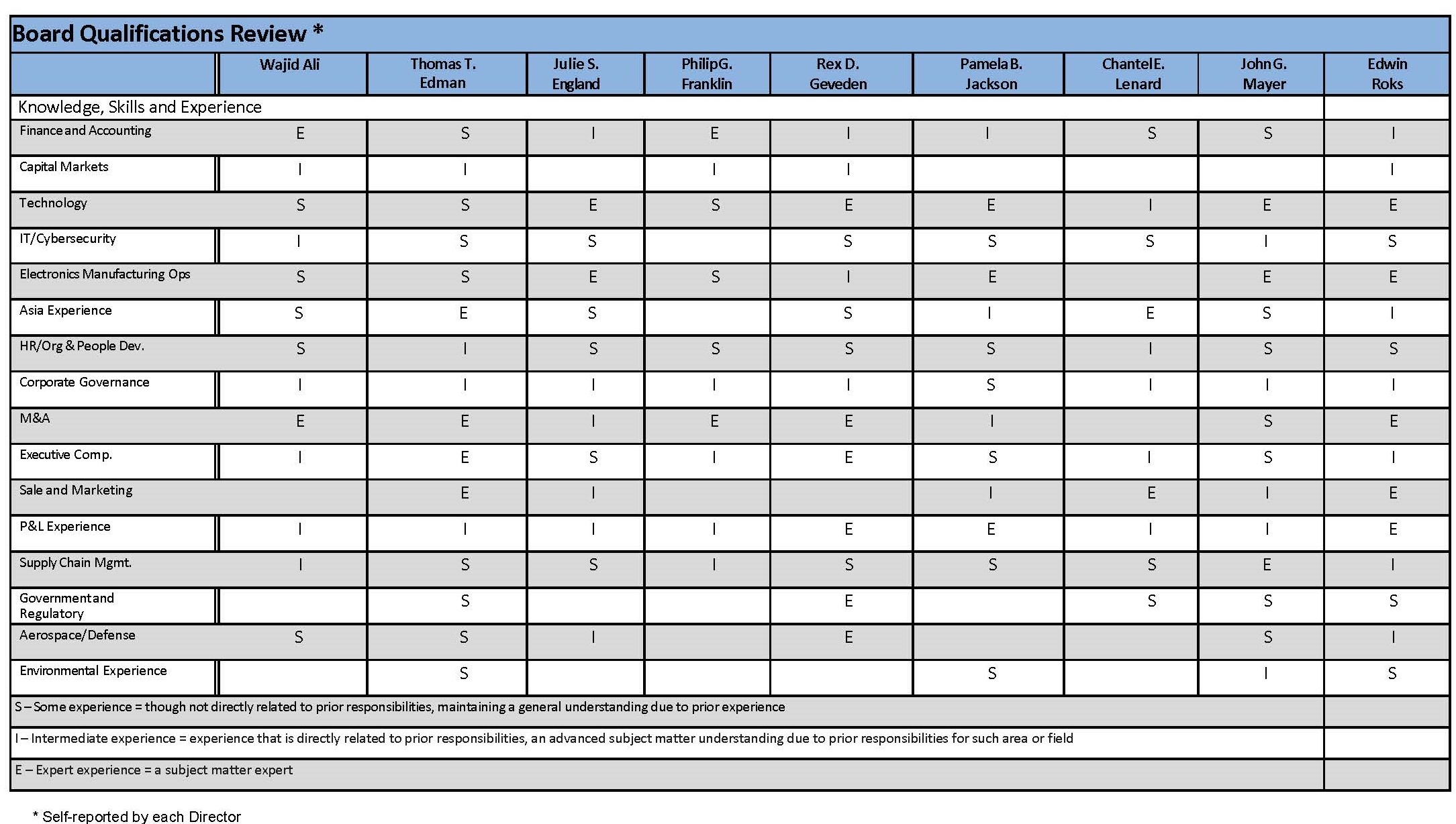
In evaluating Director candidates, our nominating and corporate governance committee bears in mind that the foremost responsibility of a director is to represent the interests of our stockholders as a whole. Directors are expected to exemplify the highest standards of personal and professional integrity and to constructively challenge management through their active participation and questioning. In consideration of these expectations, the nominating and corporate governance committee seeks directors with established strong professional reputations and expertise in areas relevant to the strategy and operations of our business. The activities and associations of candidates are reviewed for any legal impediment, conflict of interest, or other consideration that might prevent service on our Board of Directors.
When considering potential director nominees, the charter of the nominating and corporate governance committee provides that the committee shall take into account all factors it considers appropriate which may include strength of character, mature judgment, career specialization, relevant technical skills, diversity and the extent to which the candidate would fill a present need on the Board of Directors.
The current members of our nominating and corporate governance committee are Ms. England (chair) and Messrs. Ali, Geveden and Mayer (whose term of office will conclude at the 2026 annual meeting), each of whom is an independent director under NASDAQ listing standards as well as under SEC rules. The nominating and corporate governance committee held four meetings during 2025.
Our nominating and corporate governance committee has a written charter that delineates its responsibilities, a full copy of which is posted on our website at https://investors.ttm.com/corporate-governance.
Government Security Committee. As previously disclosed in our filings with the SEC, a portion of our business consists of manufacturing defense and defense-related items for various departments and agencies of the U.S. government, including the U.S. DoW, which requires that we maintain facility security clearances under the National Industrial Security Program (“NISP”). The NISP requires that a corporation maintaining a facility security clearance take steps to mitigate foreign ownership, control, or influence (referred to as FOCI). On February 1, 2023, our Board of Directors passed a Special Board Resolution (“SBR”), replacing the Special Security Agreement (“SSA”) that we entered into in with the Defense Counterintelligence and Security Agency (“DCSA”) in 2010. The replacement of the SSA with the SBR is a result of the significantly reduced foreign
TTM TECHNOLOGIES, INC. |
17 |
ownership of TTM. DCSA acknowledged the SBR and terminated the SSA on April 25, 2023. The SBR codifies and our bylaws require (during the period that the SBR is in effect), the maintenance of the Government Security Committee of the Board to oversee our compliance and cybersecurity efforts and to put into place best practices in our facilities in the U.S. and overseas to insure that we maintain robust security practices and policies as we serve the interests of our customers in the Aerospace and Defense market. Our Government Security Committee, consists of at least 3 Board members that hold a Personal Security Clearance, as required by our bylaws. The DCSA will continue to review TTM’s compliance with the terms of the SBR annually at each of TTM’s sites which operate under a U.S. DoW security clearance. In addition, all of TTM’s Board is currently comprised of U.S. citizens and per the terms of the SBR, in the future, no non-U.S. citizen will be allowed to sit on TTM’s Board. The current members of our Government Security Committee are Messrs. Geveden (chair) and Edman (whose term of office will conclude at the 2026 annual meeting,) and Ms. England. Our Government Security Committee held four meetings during 2025.
Board Leadership Structure. We believe it is our Chief Executive Officer’s responsibility to manage our Company’s operations and the Chair’s responsibility to lead our Board of Directors. Given the significant responsibilities with which our Chair is tasked and his active role in our governance, we believe it is beneficial to have an independent chair who is dedicated to leading the Board of Directors for the Company. To this end, our Corporate Governance Guidelines provide that our Chief Executive Officer may not be our Chair, and that our Chair will be selected from our independent directors. In making its decision to separate the Chief Executive Officer and Chair roles, our Board of Directors considered the time that Dr. Roks is required to devote to the Chief Executive Officer position, particularly given the demands imposed on our global Company. By segregating the role of the Chair, we reduce any duplication of effort between the Chief Executive Officer and the Chair. We believe this provides strong leadership for our Board of Directors, while also positioning our Chief Executive Officer as the leader of the Company in the eyes of our customers, employees, and other stakeholders.
Our Board of Directors currently has seven independent members and two non-independent members, specifically Dr. Roks, our President and Chief Executive Officer, and Mr. Edman, our former President and Chief Executive Officer (whose term of office will conclude immediately following the 2026 annual meeting). The Board of Directors has determined that Mr. Korte and Mr. McCarthy, who have been appointed to serve on the Board of Directors effective as of May 7, 2026, will each be an independent director. A number of our independent board members are currently serving or have served as members of senior management of other public companies or governmental agencies and have served as directors of other public companies. We believe that the number of independent, experienced directors that make up our board, along with the independent oversight of the Board of Directors by a non-executive chair, benefits our Company and our stockholders.
Both our bylaws and the SBR, as required by the DCSA, establishes certain criteria for the qualifications of our directors and the composition of our Board of Directors, and also requires that a certain number of directors maintain Personnel Security Clearances and that all Directors be U.S. citizens. Our current Board of Directors meets the composition criteria and our board has determined to maintain certain cleared members of the Board of Directors in part because of these critical requirements set by the government of the United States.
We believe that we have a strong corporate governance structure that ensures independent discussion among, evaluation of, and communication with and access to, senior management. With the exception of our Government Security Committee, of which Mr. Edman is a member, until his term of office concludes at the 2026 annual meeting, all of our board committees are composed solely of independent directors, which provide independent oversight of management. Also, our Corporate Governance Guidelines provide that our independent directors will have the opportunity to meet in executive session not less frequently than quarterly.
Risk Management and Oversight Process. While our management is primarily responsible for managing risk, our Board of Directors and each of its committees play a role in overseeing our risk management practices. Our full Board of Directors is ultimately responsible for risk oversight, and it discharges this responsibility by, among other things, receiving regular reports from our management, including an annual enterprise risk assessment conducted by our internal audit function based on the feedback received from our internal leadership team, concerning our business and the material risks that our Company faces. Our Board of Directors annually reviews key enterprise risks identified by management, such as financial, reputational, safety and security, cybersecurity, operational, revenue, social responsibility, environmental and compliance risks, and it monitors key risks through reports and discussions regarding key risk areas at meetings of our Board of Directors
TTM TECHNOLOGIES, INC. |
18 |
and in committee meetings. Our Board of Directors also focuses on specific strategic and emerging risks in periodic strategy reviews. Our Board of Directors annually reviews and approves our corporate strategy and goals and our capital budgets, and in connection with that review, it considers risks associated with our Company.
Our Board of Directors allocates responsibility for overseeing risk management for our Company among the full board and each of its committees. Specifically, the full board oversees significant risks primarily relating to operations, strategy, finance, cybersecurity, environmental, health and safety matters, liability insurance programs, and compliance with environmental legal and regulatory and social responsibility requirements. In addition, each of our committees considers risks within its area of responsibilities, as follows:
Through the activities of our audit, compensation, nominating and corporate governance, and government security committees, as well as the full Board of Directors’ interactions with management concerning our business and the material risks that may impact our Company, the Board of Directors and each respective committee is able to monitor our risk management process and offer critical insights to our management.
TTM TECHNOLOGIES, INC. |
19 |
We have adopted an Insider Trading Policy governing the purchase, sale, and/or other dispositions of our securities by directors, officers, and employees, which is reasonably designed to promote compliance with insider trading laws, rules and regulations, and applicable NASDAQ listing standards.
Related Person Transaction Policies and Procedures. It is the responsibility of our full Board of Directors and our audit committee to review and approve related party transactions. It is our management’s responsibility to bring such related party transactions to the attention of our Board of Directors and members of our audit committee. From time to time, our nominating and corporate governance committee, in accordance with its charter, will also review potential conflict of interest transactions involving members of our Board of Directors and our executive officers. In accordance with our Corporate Governance Guidelines, any monetary engagement (other than director or employee compensation or transactions which would not require disclosure under Item 404 of Regulation S-K) (a) between a director (including any entity of which the director is a director or executive officer and any member of a director’s family as defined in NASDAQ rules) and our Company or any of its affiliates or members of senior management or their families, and (b) between executive officers of our Company (as designated by our Board of Directors) and our Company or any of its affiliates, is subject to the approval of our audit committee or our independent directors. Each of our directors and executive officers must notify our Board of Directors in advance of entering into any such transaction.
Our Corporate Governance Guidelines task our Board of Directors, in consultation with our nominating and corporate governance committee, with reviewing annually the relationships that each director has with us, directly or indirectly. Further, our nominating and corporate governance committee is tasked with periodically reviewing the compensation arrangements and other business relationships between our directors and our Company in order to monitor the independence of our directors. Our Corporate Governance Guidelines also provide that if an actual or potential conflict of interest develops, a director should report the matter immediately to the full Board of Directors and our audit committee for evaluation and appropriate resolution. If a director has a personal interest in a matter before our Board of Directors, the director must disclose the interest to the full Board of Directors and our audit committee, must recuse themselves from participation in the related discussion, and must abstain from voting on the matter.
Stock Ownership Guidelines, and Hedging and Pledging Policies. Our Board of Directors recognizes that stock ownership by directors may strengthen their commitment to the long-term future of our Company and further align their interests with those of our stockholders. Within a five (5) year period after becoming a member of the Board of Directors, each member of the Board of Directors is required to beneficially own shares of our common stock (including shares owned outright, unvested shares, and restricted stock units), having a value of at least five times their annual cash retainer, and as our directors are subject to our insider trading policy, they are prohibited from pledging or hedging their shares. As of the date of this Proxy Statement, all of our current outside Board members meet the stock ownership guidelines as of the Record Date. In addition, the Company has adopted stock ownership guidelines for the Chief Executive Officer and his direct reports. For a full description of such guidelines, see page 44.
DIRECTOR COMPENSATION
Our non-employee directors receive the following cash compensation on an annual basis: a cash retainer that averages $82,500 annually among the non-employee directors, an annual cash retainer of $9,000 for each
TTM TECHNOLOGIES, INC. |
20 |
board committee of which such director is a member (except for the government security committee), and reimbursement of expenses relating to attendance at board and board committee meetings. In addition, the Chair of the Board receives an annual cash retainer of an additional $70,000, and the chairs of our various board committees receive annual cash retainers as follows: $25,000 to our audit committee chair, an average of $18,500 annually to our human capital and compensation committee chair, $15,000 to our government security committee chair, and an average of $18,500 annually to our nominating and corporate governance committee chair. Annually, our nominating and corporate governance committee, in consultation with our compensation consultant, reviews our board compensation against the board compensation of our peer companies to develop a reasonable board compensation package.
In addition, our non-employee directors are granted the following equity compensation on an annual basis: the Chair of the Board receives restricted stock units (“RSUs”) in the amount of $220,000 and each non-employee director receives restricted stock units in the amount of $170,000, and the number of shares granted in each case is based upon the average closing price of our common stock over the six-month period preceding the grant date. In the instance where a Board Member serves a portion of the year, the compensation granted is prorated for the time served that year. The RSUs awarded to the non-employee directors prior to 2026 vest in full on the first anniversary of the grant date; however, in an effort to further align Board Members’ interests with those of our stockholders, our current policy is for delivery of the shares of common stock underlying the RSUs to be deferred until retirement from the Board of Directors (or until one year after retirement in the case of certain prior grants).
Mr. Edman (whose term of office will conclude at the 2026 annual meeting) and Dr. Roks are not compensated for their service as directors. Dr. Roks's compensation as our President and Chief Executive Officer is described below under “Compensation Discussion and Analysis” and “Executive Compensation”.
Nonqualified Deferred Compensation. Our directors are permitted to defer 5% to 100% of annual director fees into our Executive and Director Deferred Compensation Plan. In 2025, none of our directors participated in the Executive and Director Deferred Compensation Plan.
Director Summary Compensation Table for Fiscal Year 2025
The following table sets forth the compensation earned by our non-employee directors in respect of their services as such during 2025.
Name |
|
Fees Earned or Paid in Cash (1) |
|
|
|
RSU Awards ($) (2) |
|
|
|
Total |
|
|
|||
Kenton K. Alder (3) |
|
$ |
37,500 |
|
|
|
$ |
— |
|
|
|
$ |
37,500 |
|
|
Wajid Ali |
|
$ |
96,000 |
|
|
|
$ |
210,842 |
|
|
|
$ |
306,842 |
|
|
Julie S. England |
|
$ |
110,000 |
|
|
|
$ |
210,842 |
|
|
|
$ |
320,842 |
|
|
Philip G. Franklin |
|
$ |
116,500 |
|
|
|
$ |
210,842 |
|
|
|
$ |
327,342 |
|
|
Rex D. Geveden |
|
$ |
176,500 |
|
|
|
$ |
272,844 |
|
|
|
$ |
449,344 |
|
|
Pamela B. Jackson |
|
$ |
100,500 |
|
|
|
$ |
210,842 |
|
|
|
$ |
311,342 |
|
|
Chantel E. Lenard |
|
$ |
114,500 |
|
|
|
$ |
210,842 |
|
|
|
$ |
325,342 |
|
|
John G. Mayer(4) |
|
$ |
100,500 |
|
|
|
$ |
210,842 |
|
|
|
$ |
311,342 |
|
|
TTM TECHNOLOGIES, INC. |
21 |
Outstanding Equity Awards Held by Non-Employee Directors at Fiscal 2025 Year End
|
|
|
|
|
|
|
|
|
|
|
|
|
Name |
RSUs Outstanding at Fiscal Year End |
Number of RSUs that Have Not Vested(1) |
Options Outstanding at Fiscal Year End(2) |
Number of Options that Have Not Vested |
||||||||
|
|
|
|
|
|
|
|
|
|
|
|
|
Kenton K. Alder (3) |
|
— |
|
|
— |
|
|
— |
|
|
0 |
|
Wajid Ali |
|
14,024 |
|
|
7,080 |
|
|
— |
|
|
0 |
|
Julie S. England |
|
90,325 |
|
|
7,080 |
|
|
— |
|
|
0 |
|
Philip G. Franklin |
|
144,914 |
|
|
7,080 |
|
|
— |
|
|
0 |
|
Rex D. Geveden |
|
92,480 |
|
|
9,162 |
|
|
20,000 |
|
|
0 |
|
Pamela B. Jackson |
|
47,690 |
|
|
7,080 |
|
|
— |
|
|
0 |
|
Chantel E. Lenard |
|
74,228 |
|
|
7,080 |
|
|
20,000 |
|
|
0 |
|
John G. Mayer(4) |
|
165,140 |
|
|
7,080 |
|
|
— |
|
|
0 |
|
Compensation Consultant and its Affiliates
Exequity was retained in 2024 by our human capital and compensation committee to provide an independent review of the Company’s executive compensation programs, including an analysis of the competitive market for 2025. In September 2025, the committee engaged FW Cook to replace Exequity and continue providing this independent guidance. Prior to the transition, Exequity assisted the human capital and compensation committee with its evaluation of the risks associated with our compensation programs and executive director compensation data services, which FW Cook now provides. During their respective engagement periods, both firms furnished the human capital and compensation committee with reports on peer company practices relating to the following matters: short-term and long-term compensation program design; equity compensation; vesting practices and ownership guidelines; target incentive opportunities; and compensation trends for board management and committee members. During 2025, the human capital and compensation committee also engaged AON Radford for services rendered in connection with the computation of total stockholder return (“TSR”) relative to our TSR Peer Group, and for compensation survey data. Our deferred compensation program continues to be managed by Fidelity.
Consultant |
|
|
Scope/Project |
|
|
2025 Fees |
|
|
|
|
|
|
|
|
|
|
|
|
|
Exequity |
|
|
Executive Compensation Consulting (Jan-Aug) |
|
|
$ |
92,871 |
|
|
FW Cook |
|
|
Executive Compensation Consulting (Sept-Dec) |
|
|
$ |
33,445 |
|
|
Aon/Radford |
|
|
Computation of total stockholder return (TSR) |
|
|
$ |
16,050 |
|
|
Fidelity |
|
|
Deferred Compensation Program Administration |
|
|
$ |
14,208 |
|
|
TTM TECHNOLOGIES, INC. |
22 |
SECURITY OWNERSHIP OF CERTAIN BENEFICIAL OWNERS AND MANAGEMENT
The following table shows the amount of each class of common stock beneficially owned as of March 11, 2026 by (a) each of our directors, nominees and named executive officers; (b) all of our directors, nominees and executive officers as a group; and (c) each person known by us to own beneficially more than five percent of our outstanding common stock.
|
|
|
Beneficial Ownership |
|||||
|
|
|
Number |
|
|
|
Percentage(2) |
|
Edwin Roks |
|
|
|
— |
|
|
|
* |
Thomas T. Edman(3) |
|
|
|
773,541 |
|
|
|
* |
Daniel L. Boehle |
|
|
|
22,792 |
|
|
|
* |
Catherine A. Gridley |
|
|
|
50,398 |
|
|
|
* |
Douglas L. Soder |
|
|
|
159,802 |
|
|
|
* |
Daniel J. Weber |
|
|
|
46,907 |
|
|
|
* |
Wajid Ali(4) |
|
|
|
10,000 |
|
|
|
* |
Julie S. England(5) |
|
|
|
16,216 |
|
|
|
* |
Philip G. Franklin(6) |
|
|
|
10,000 |
|
|
|
* |
Rex D. Geveden(7) |
|
|
|
20,000 |
|
|
|
* |
Pamela B. Jackson(8) |
|
|
|
— |
|
|
|
* |
Daniel G. Korte |
|
|
|
— |
|
|
|
* |
Chantel E. Lenard(9) |
|
|
|
20,000 |
|
|
|
* |
John G. Mayer(10) |
|
|
|
— |
|
|
|
* |
Ryan D. McCarthy |
|
|
|
— |
|
|
|
* |
All directors, nominees and executive officers as a group (24 persons) |
|
|
|
1,318,777 |
|
|
|
1.3% |
5% or Greater Beneficial Owners(11) |
|
|
|
|
|
|
|
|
BlackRock, Inc.(12) |
|
|
|
15,413,648 |
|
|
|
14.8% |
The Vanguard Group(13) |
|
|
|
13,547,047 |
|
|
|
13.0% |
Dimensional Fund Advisors, L.P.(14) |
|
|
|
5,799,488 |
|
|
|
5.6% |
* Represents less than 1% of our outstanding common stock.
TTM TECHNOLOGIES, INC. |
23 |
TTM TECHNOLOGIES, INC. |
24 |
EXECUTIVE OFFICERS
Biographical information regarding these officers is set forth below, except for Dr. Roks, whose biography is set forth above with our other directors.
Daniel L. Boehle, 54, became our Executive Vice President and Chief Financial Officer in September 2023 after having joined our company as Executive Vice President of Finance in August 2023. Mr. Boehle functions both as our Principal Financial Officer and our Principal Accounting Officer. From August 2020 to August 2023, Mr. Boehle served as Vice President and Chief Financial Officer for Aerojet Rocketdyne Holdings, Inc. (“Aerojet”), a manufacturer of rocket, hypersonic and electric propulsive systems. From August 2017 to July 2020, Mr. Boehle was Vice President, Controller, and Chief Accounting Officer for Aerojet. Before joining Aerojet, Mr. Boehle served in various leadership roles across corporate accounting, financial reporting, and financial planning and analysis at Northrop Grumman Corporation. Before joining Northrop Grumman Corporation, he held positions at KPMG LLP and KPMG Australia Ltd. Mr. Boehle joined the board of directors of Ducommun Incorporated (NYSE: DCO) in November 2024 and serves on its Audit and Innovation Committees. Mr. Boehle earned his Bachelor of Science in Accounting from Loyola Marymount University and a Master of Business Administration degree from the UCLA Anderson School of Management, and is a Certified Public Accountant.
Thomas Clapprood, 56, has served as the President of our Interconnect Solutions Business Unit since March 2025. Prior to that he served as the President of the Radar Systems and Sensors Business Unit for TTM Technologies Aerospace & Defense Sector from January 2023 through March 2025 and as the Vice President of Sales & Marketing for TTM's North America Business Unit from December 2010 to December 2022. From 1995 through 2004, Mr. Clapprood served as Regional Business Director for Northrop Grumman Corporation. Mr. Clapprood then joined Tyco Printed Circuit Group, now TTM Technologies, Inc., where he held several management positions including Director of Sales and Business Director for the Specialty Assembly group until 2012. Mr. Clapprood graduated from Elon University with a bachelor's degree in business management.
Robert Farrell, 54, has served as President of the Communication and Computing Business Unit since January 2023. From January 2020 to January 2023, Mr. Farrell served as our Vice President of Sales - Networking and Computing. Mr. Farrell joined TTM in September 2010 as South East Regional Sales Director. Since that time and prior to his current position, he also served as Senior Director of Sales for EMS and Vice President of Sales for Communication and Computing. Mr. Farrell has over 30 years of experience in the electronics industry. He held positions of New Account Development Manager and European Account Manager with Advance Circuits, Global Account Manager with Topsearch, and Senior Supply Chain Manager with Flex. Mr. Farrell holds a Bachelor Degree of Business Administration at Montreat College.
Gregory Fortier, 51, has served as Senior Vice President of the Integrated Electronics Business Unit since January 2026. Mr. Fortier served as Senior Vice President of the Army Aviation, Fires, and C5ISR Business Unit at Sciences Application International Corporation (SAIC) from February 2024 to December 2025, as Senior Vice President and Chief of Staff of the Army Business Unit at SAIC from June 2024 to November 2025 and as Vice President of the Army Aviation and Fires Account at SAIC from December 2021 to January 2024. Mr. Fortier received a Bachelor of Science Degree in Operations Research from the United States Military Academy at West Point, Master of Science in Industrial Engineering from the University of Central Florida and Master of Science in National Resource Strategy from the Eisenhower School. He is also a graduate of the United States Naval Test Pilot School.
Catherine A. Gridley, 57, has served as the Executive Vice President and President of the Aerospace & Defense Sector (“A&D”) since 2021. In January 2020, Ms. Gridley was promoted to Senior Vice President of A&D. She joined TTM in 2019 from Northrop Grumman Corporation, where she most recently served as the Vice President and General Manager of the Advanced Defense Services Division. Prior to Northrop Grumman, Catherine held P&L leadership positions with DynCorp International, GE Aviation Systems and Goodrich. She earned her Bachelor of Science degree in accounting from Ithaca College and a Master of Business Administration degree from Binghamton University.
TTM TECHNOLOGIES, INC. |
25 |
Dale Knecht, 63, has served as Senior Vice President of Global Information Technology since January 2014. From January 2007 to December 2013, Mr. Knecht served as our Vice President of Information Technology. Prior to joining TTM, Mr. Knecht served as Vice President of Information Technology for the Tyco Electronics Printed Circuit Group from 2001 to 2006. From 2003 to 2006, Mr. Knecht served in a dual role as Director of IT Regional Governance - North America for Tyco Electronics. Prior to that, Mr. Knecht served from 1998 to 2001 as Manager, SAP Global Support, and from 1993 to 1998 as Regional Systems Manager - Latin America & Canada for AMP Inc. Mr. Knecht holds a Bachelor of Science in mathematics from Lafayette College, and an executive master degree in cybersecurity from Brown University.
Shawn Powers, 52, has served as Executive Vice President and Chief Human Resources Officer since June 2021. From February 2015 to June 2021, Mr. Powers served as our Senior Vice President of Human Resources. Mr. Powers joined TTM in early 2014 as Vice President of Human Resources for our North America Business Unit. Prior to joining TTM, Mr. Powers was the Global Vice President of Human Resources with Kleinfelder, an engineering and sciences company, from 2012 to 2014. Before Kleinfelder, Mr. Powers was the Senior Director of Global Human Resources with IMI plc, a FTSE 100 manufacturing company, from 2006 to 2012. Mr. Powers began his career in the U.S. Military, serving as an Army Aviation Officer. Mr. Powers holds both a Master of International Affairs and a Bachelor of Science degree in biomedical science from Texas A&M University. Additionally, he has earned the Global Professional of Human Resources (GPHR) and the Society of Human Resources Professional - Senior Certified Professional (SCP) certifications.
Elizabeth Romo, 49, has served as our Chief Accounting Officer since February 2025. Ms. Romo served as Vice President of Internal Audit at Public Storage from October 2022 to January 2025. From October 2020 to September 2022, Ms. Romo was Vice President of Corporate Strategy and Development for Aerojet and Senior Director of Internal Audit for Aerojet. Before joining Aerojet, Ms. Romo served in various leadership roles across mergers & acquisition, internal audit and financial reporting at Northrop Grumman Corporation. Before joining Northrop Grumman Corporation, she held positions at Ernst & Young LLP and KPMG LLP. Ms. Romo holds a Bachelor of Science degree in accounting from Loyola Marymount University and a Master of Business Administration from the UCLA Anderson School of Management. Ms. Romo is a Certified Public Accountant.
Anthony J. Sandeen, 53, has served as our Senior Vice President of Automotive & Medical, Industrial & Instrumentation (AMI&I) and Global Sales since January 2024. He served as our President of AMI&I from June 2020 through January 2024. From May 2017 through May 2020, Mr. Sandeen served as Chief Commercial Officer for Beyonics Technology Ltd., Ying Shing Enterprises Limited, Ying Hao and Fischer Technology. Mr. Sandeen received a bachelor’s degree in English from St. John’s University in Collegeville, Minnesota.
Douglas L. Soder, 65, has served as our Executive Vice President and President of the Commercial Sector since July 2018. Mr. Soder joined TTM in November 2006 as Executive Vice President with responsibility for Global Sales. Since that time and prior to his current assignment, he also served as President of the North America Business Unit and President of the Communications & Computing Business Unit. Before joining our Company, Mr. Soder held the position of Executive Vice President for Tyco Electronics—Printed Circuit Group. During a 23-year career at Tyco Electronics, Mr. Soder served in a variety of sales, sales management, and business leadership positions at its AMP Incorporated and Tyco Printed Circuit Group (PCG) subsidiaries. Mr. Soder holds a Bachelor of Arts degree in political science from Dickinson College.
James P. Walsh, 56, has served as Chief Operating Officer since July 2025. From January 2025 until July 2025, Mr. Walsh served as the Company’s Senior Vice President of Operations (North America) & Global EHSSS. Mr. Walsh joined the Company in 2019 in a Senior Operations Leadership role and has held progressively expanding responsibilities since that time. Mr. Walsh has over 26 years of operations management experience. Mr. Walsh received his Bachelor of Science in Mechanical Engineering from Santa Clara University, Master of Science Degree in Mechanical Engineering from Stanford University and Master of Business Administration from University of California, Los Angeles.
TTM TECHNOLOGIES, INC. |
26 |
Daniel J. Weber, 54, has served as our Executive Vice President, Corporate Development, Government Relations, Chief Legal Officer and Secretary since December 2020. He started his employment with the Company in June 2015. Mr. Weber leads the Office of the General Counsel which includes the contracts and administration function and also is responsible for the Company's corporate development and government relations activities. The Company's corporate development organization manages the Company's mergers and acquisitions activities and the government relations organization manages the Company's political action committee and its government outreach and advocacy. Before joining TTM in 2015, Mr. Weber served as the General Counsel for Viasystems for approximately 11 years and had served as in-house counsel for Viasystems Group, Inc. for over 15 years. Mr. Weber previously also served as Vice President and General Counsel of Courtesy Corporation, a plastic molding manufacturer based in the United States, and as General Counsel of International Wire Group, Inc., a multinational insulated and bare copper wire manufacturer. Prior to embarking on his in-house legal career, Mr. Weber worked in private practice at Gallop, Johnson & Neuman, L.C. in the corporate and securities group. From January 2022 to December 2023, Mr. Weber served as the Chairman of the Government Relations Committee of the IPC, an electronics industries association. He currently serves as a member of the Government Relations Committee of the IPC. Mr. Weber is member of the Board of Directors of Encompass Digital Media Holdings, LLC, a global provider of media services. Mr. Weber completed his undergraduate work from the University of Kansas and received his law degree from St. Louis University.
DELINQUENT SECTION 16(a) REPORTS
Under U.S. securities laws, directors, certain officers and persons holding more than 10% of our common stock must report their initial ownership of our common stock and any changes in their ownership to the SEC. The SEC has designated specific due dates for these reports and we must identify in this Proxy Statement those persons who did not file these reports when due.
Based solely upon our review of the copies of such forms that we received during the fiscal year ended December 29, 2025, and written representations of our directors and officers that no other reports were required, we believe that each person who at any time during such year was a director, officer, or beneficial owner of more than 10% of our common stock complied with all Section 16(a) filing requirements during the fiscal year ended December 29, 2025, except that Steven Spoto filed one Form 4 seven business days late on March 13, 2025 with respect to Mr. Spoto’s sale of shares of our common stock in an open market transaction.
TTM TECHNOLOGIES, INC. |
27 |
COMPENSATION DISCUSSION AND ANALYSIS
The Compensation Discussion and Analysis, or CD&A, describes and analyzes our executive compensation philosophy and program in the context of the compensation paid during the last fiscal year to our named executive officers, or our NEOs. For the fiscal year 2025, our NEOs were:
Name |
Position(s) Held |
Edwin Roks(1) |
Chief Executive Officer, President and Director |
Thomas T. Edman (2) |
Former Chief Executive Officer, President and special advisor to the Chair of our Board of Directors; Director |
Daniel L. Boehle |
Executive Vice President and Chief Financial Officer |
Catherine A. Gridley |
Executive Vice President and President A&D Sector |
Douglas L. Soder |
Executive Vice President and President Commercial Sector |
Daniel J. Weber |
Executive Vice President, Chief Legal Officer and Secretary |
This CD&A is organized into four sections:
Compensation Overview – Alignment of Compensation and Performance
Our primary goal is to tie our Company Executives' compensation closely with performance. The information below provides an executive summary of our Company’s financial performance for fiscal year 2025 and how pay is aligned with performance.
KEY ACCOMPLISHMENTS IN 2025
TTM’s commitment to its strategy of diversification, differentiation and discipline led to TTM’s continued financial strength in 2025. We generated Non-GAAP net income of $259.0 million in 2025, which profitability was the result of revenue growth, improved operational execution, and prudent cost management. For an explanation of the use of Non-GAAP metrics, a presentation of comparable financial measures calculated and reported in accordance with GAAP, and a reconciliation to those audited GAAP metrics, see Annex A attached hereto.
PERFORMANCE HIGHLIGHTS
The Company achieved excellent financial performance in 2025.
TTM TECHNOLOGIES, INC. |
28 |
ALIGNMENT OF PAY AND PERFORMANCE
TTM’s executive compensation is strongly aligned to Company performance and measurable financial metrics. The following charts show improvement and continued excellence in metrics that we track related to our financial performance over the past five years, which we believe drove increases in realized officer compensation. (1)
|
|
|
|
|
|
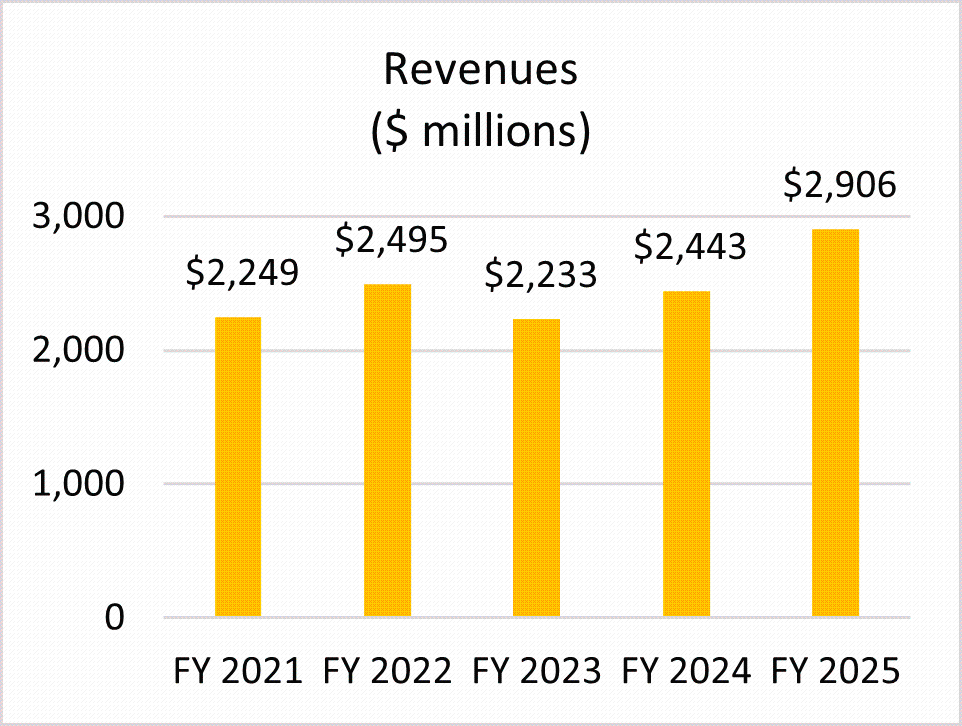
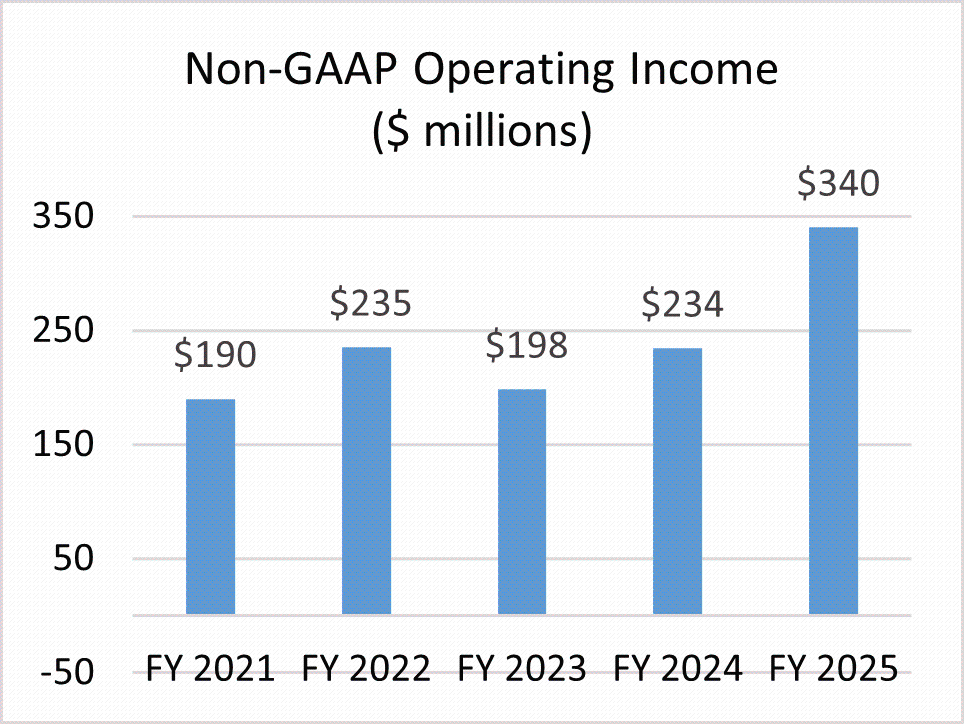
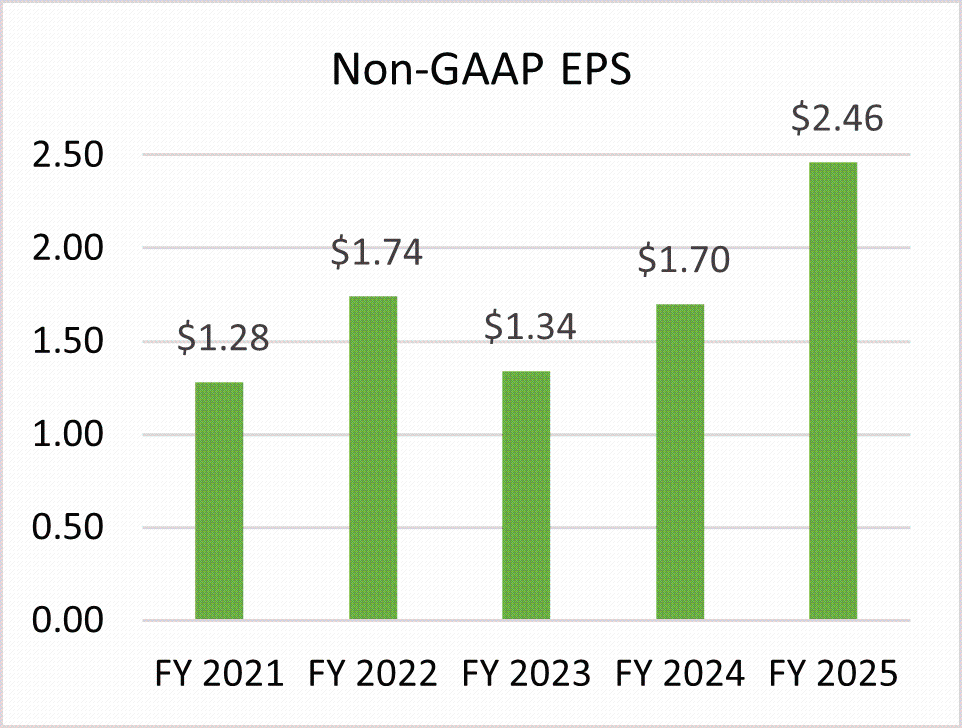
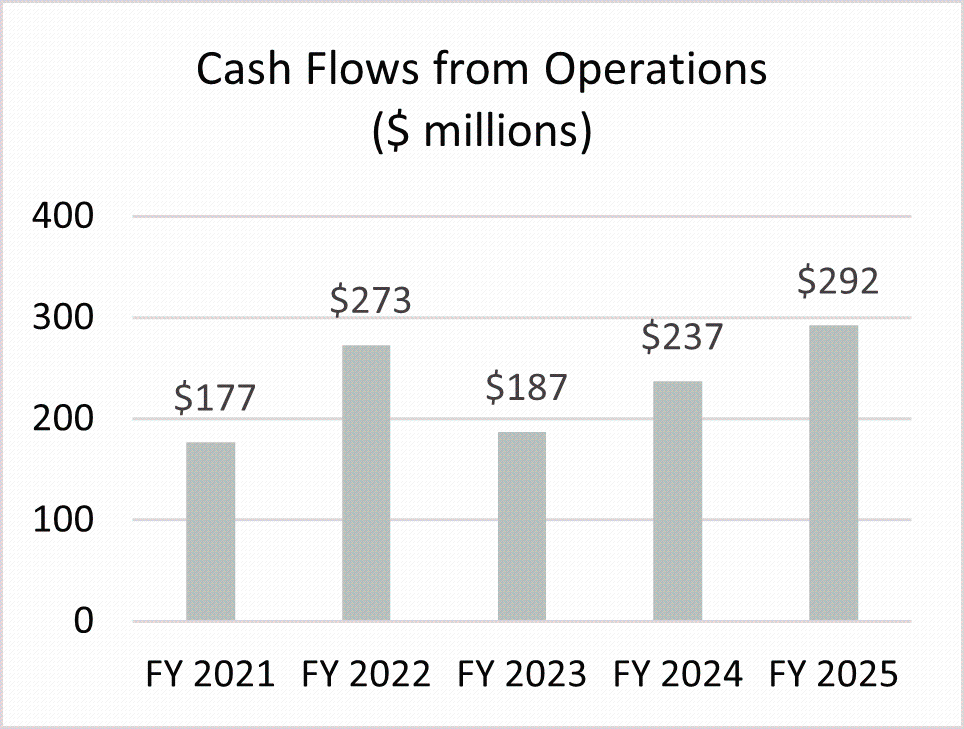
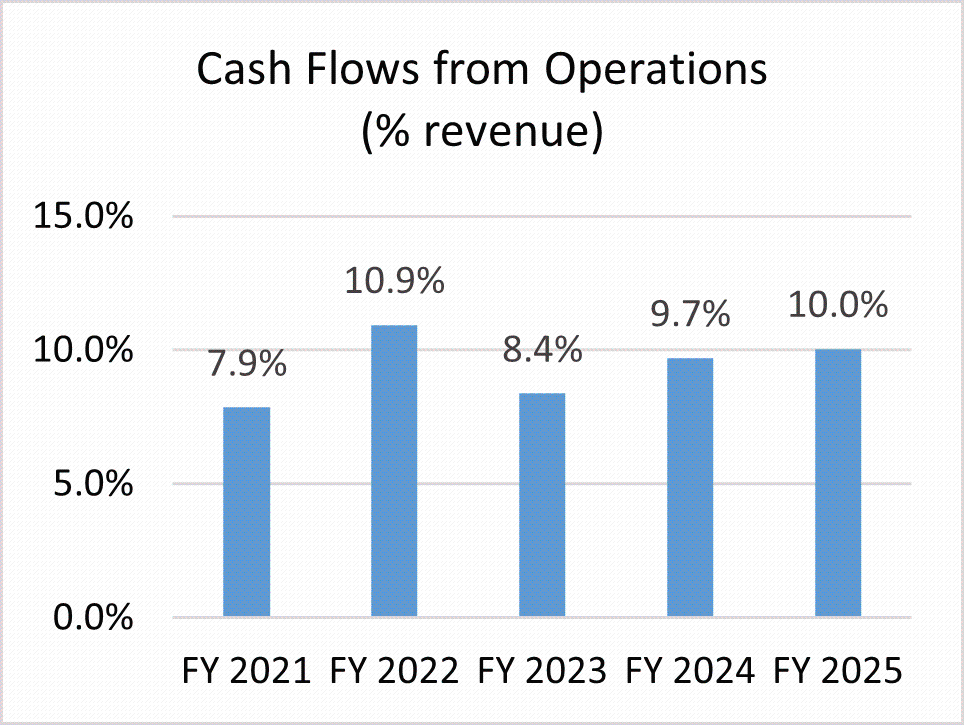
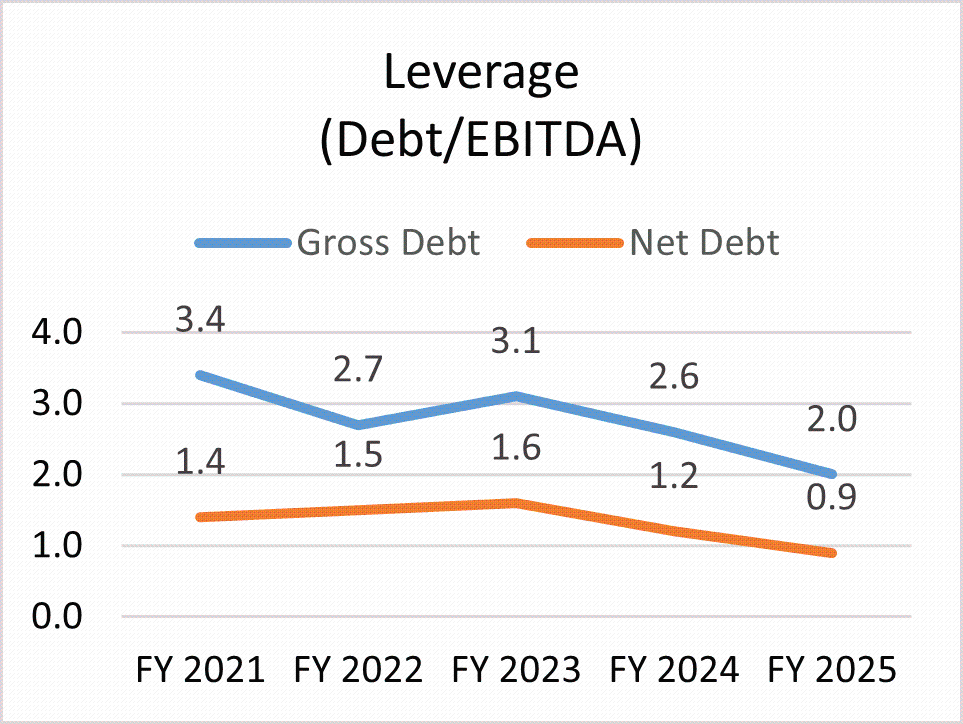
TTM TECHNOLOGIES, INC. |
29 |
The charts below measure the total compensation realized for the CEO and the average total compensation for our NEOs for the past three years (the amount depicted below is different than the amount shown in the Summary Compensation Table because the actual number of PRUs earned (0% up to the maximum level of 200%) will depend on the Company's future achievement of financial performance goals (80% weighting) and TSR (20% weighting) over a three year performance period).
|
|
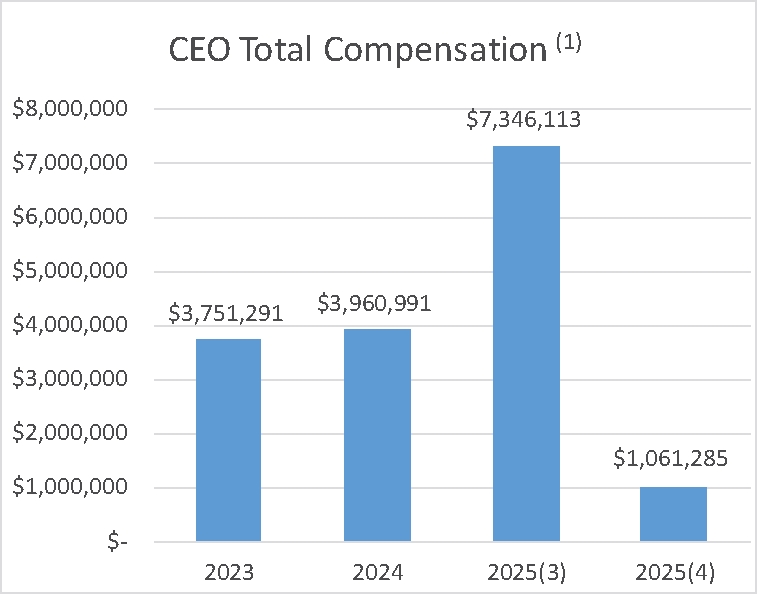
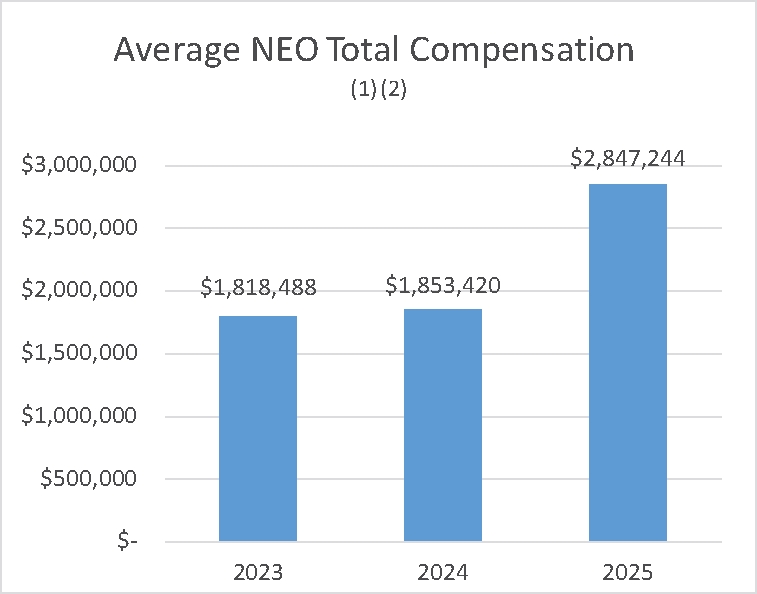
These charts demonstrate alignment in pay and performance as increases in realized officer compensation followed improving financial and stock price performance. The Company’s performance and the price of the Company’s common stock on the NASDAQ directly impacts total compensation realized by our executives.
2025 SAY ON PAY VOTE
At our 2025 annual meeting, our stockholders overwhelmingly approved, on an advisory basis, the compensation of our NEOs described in our 2025 proxy statement. Approximately 98.21% of the votes cast on the matter were voted “For” such advisory “Say-on-Pay” approval, thereby providing the human capital and compensation committee with verification that its compensation practices align the interests of the Company’s executives with those of the Company’s stockholders.
TTM TECHNOLOGIES, INC. |
30 |
COMPENSATION PRACTICES
We continually review the Company’s executive compensation program to maintain compensation practices that are in the best interests of our stockholders. Some of our key policies are summarized below:
WHAT WE DO: |
|
WHAT WE DON’T DO: |
• We tie a significant portion of NEO and other executive pay to performance through our performance-based annual bonus plan and our multi-year performance share unit program • We have double trigger in our change-in-control CIC severance and equity award vesting • We maintain stock ownership guidelines for our NEOs; five times annual salary (CEO) and three times annual salary (other NEOs) • We have a robust clawback policy • The human capital and compensation committee engages an independent compensation consultant • We conduct annual compensation risk assessments |
|
• We do not maintain executive pension plans or other executive retirement plans • We do not provide tax gross up payments for any amounts considered to be excess parachute payments • We do not allow hedging or pledging of our stock by executives • We do not permit the repricing of stock options without prior stockholder approval • We do not provide excessive perquisites • We do not have guaranteed bonus minimums or payouts
|
Executive Compensation Philosophy and Objectives
The objective of the human capital and compensation committee of our Board of Directors is to attract, motivate, and retain executives and reward the creation of stockholder value. We seek to provide executive compensation packages that are competitive with comparable companies and reward the achievement of short-term and long-term performance.
We use a combination of fixed and variable compensation programs to reward and incentivize strong performance, as well as to align the interests of our executives with those of our stockholders. We generally target total compensation around the 50th percentile of comparable companies. We believe that this philosophy will continue to enable us to remain competitive in attracting and retaining qualified executive officers while avoiding paying amounts in excess of what we believe is necessary to attract and retain such executive officers. However, our human capital and compensation committee’s decisions on target compensation for specific individuals are also influenced by a variety of additional factors, including compensation practices of businesses acquired by us, and Company and individual performance.
Each year our human capital and compensation committee, together with our senior management, establishes performance targets for short-term and long-term incentive plans that require the achievement of significant financial results. The committee determines compensation by assessing prior year performance against these established financial targets, as well as other factors such as the compensation paid by comparable companies, achievement of strategic objectives, and the professional development and potential of individual officers. Ultimately, the amount of compensation awarded to our executives is determined based on performance and what our human capital and compensation committee believes is in the best interests of our stockholders.
TTM TECHNOLOGIES, INC. |
31 |
We believe that our use of restricted stock units and performance-based restricted stock units, together with an annual incentive bonus program that is based on various combinations of global operating income, sector operating income, and global cash flow from operations as a percentage of revenue shows that we have closely linked executive officer pay to performance over multiple time periods to balance both short and long term focus. Our pay mix consists primarily of base salary, annual performance-based cash bonus, performance-based equity incentives and time-based equity incentives. We have no executive retirement plans except our 401(k) plan and deferred compensation plan available to U.S. employees, and the company does not contribute to the deferred compensation plan.
Role of the Human Capital and Compensation Committee
Our human capital and compensation committee, which is currently comprised of three independent members of our Board of Directors, as discussed in greater detail under “Information Relating to Corporate Governance and the Board of Directors,” is responsible for, among other things:
Our human capital and compensation committee, in consultation with the outside executive compensation consultant retained by our human capital and compensation committee, also helps analyze the reasonableness and effectiveness of our overall executive compensation packages.
While our Chief Executive Officer and other executive officers may attend meetings of the human capital and compensation committee or our Board of Directors from time to time, the ultimate decisions regarding executive officer compensation are made solely by the members of our human capital and compensation committee and, in the case of compensation decisions for our Chief Executive Officer, the non-employee members of our Board of Directors. These decisions are based not only on our human capital and compensation committee’s deliberations, but also on input requested from outside advisors, including our outside compensation consultant, with respect to, among other things, market data analyses. The final decisions relating to our Chief Executive Officer’s compensation have historically been based on recommendations of our human capital and compensation committee and included discussions with and approval by all of our non-employee directors without the presence of our Chief Executive Officer or other management. Our human capital and compensation committee always makes final decisions regarding his compensation when he is not present. Decisions regarding other executive officers have typically been made by our human capital and compensation committee after considering recommendations from our Chief Executive Officer.
Our human capital and compensation committee has historically engaged the services of an outside compensation consultant to provide independent advice in connection with making executive compensation determinations. The chair of our human capital and compensation committee, in consultation with other committee members, defines the scope of any consultant’s engagement and related responsibilities. These responsibilities may include, among other things, advising on issues of executive compensation and equity compensation structure and assisting in the preparation of compensation disclosure for inclusion in our SEC filings. In fulfilling its responsibilities, the outside compensation consultant may interact with management or our other outside advisors to the extent necessary or appropriate.
TTM TECHNOLOGIES, INC. |
32 |
More specifically, the Compensation Consultant evaluated our selected peer companies and provided competitive compensation data and analysis relating to the compensation of our Chief Executive Officer and our other senior officers. The Compensation Consultant also furnished the human capital and compensation committee with reports on peer company practices relating to the following matters: short-term and long-term compensation program design; equity compensation, vesting practices and ownership guidelines; retention value of current equity holdings; target incentive opportunities; and compensation trends for board and committee members. In addition, the Compensation Consultant assisted the human capital and compensation committee with its evaluation of the risks associated with our compensation programs and provided our nominating and corporate governance committee with an assessment of our directors’ compensation.
The Compensation Consultant provides analyses and advice that inform the committee’s decisions, but it does not decide or approve any compensation decisions. The Compensation Consultant reviews various proposals presented to the committee by management and provides updates on market trends and the regulatory environment as it relates to executive compensation. The Compensation Consultant reports directly to our human capital and compensation committee and not to management. Our human capital and compensation committee assessed the independence of the Compensation Consultant pursuant to SEC and NASDAQ rules and concluded that the Compensation Consultant is independent and that the work of the Compensation Consultant has not raised any conflicts of interest.
Compensation Levels and Benchmarking. Overall compensation levels for executive officers are determined based on one or more of the following factors: the individual’s duties and responsibilities within our global Company; the individual’s experience and expertise; the compensation levels for the individual’s peers within our Company; compensation levels for similar positions in the electronics industry or in the technology industry more generally; performance of the individual and our Company as a whole; and the levels of compensation necessary to recruit new executive officers. Our human capital and compensation committee reviewed the compensation of our officers and compared it with that of both our peer group companies and broader, composite global market survey data provided by our Compensation Consultant.
Compensation Peer Groups. To assess our executive compensation relative to the competitive market, the Human Capital and Compensation Committee evaluates the compensation levels and practices of a peer group consisting of companies that are similar in size and business focus and represent the organizations with which we compete for executive talent.
In developing the compensation peer group used to inform pay decisions for 2025, the following general screening criteria were used to identify comparable companies:
The Human Capital and Compensation Committee reviews our compensation peer group annually for continued appropriateness and makes adjustments as necessary. No changes were made to the peer group for 2025.
Our human capital and compensation committee believes that the selected Total Shareholder Return (TSR) Peer Group is more relevant for determining whether TSR under our PRU Program reflected high performance relative to global competitors. For a discussion regarding how the TSR Peer Group affects executive compensation, please see the “Long-Term Equity Awards” section on page 37.
TTM TECHNOLOGIES, INC. |
33 |
Members of our human resources and finance departments work with our Chief Executive Officer to recommend changes to existing compensation plans and programs, to define financial and other performance goals to be achieved under the incentive programs, and, ultimately, to implement the decisions.
Our Chief Executive Officer is actively engaged in setting compensation for other executives through a variety of means, including recommending for committee approval the financial goals, annual salaries, variable pay, and equity grants for members of the executive team. He works closely with other members of executive management in analyzing relevant market data to determine base salary and annual target bonus opportunities for senior management and to develop targets for our short-term and long-term incentive plans. Our Chief Executive Officer is generally subject to the same financial performance goals as our other executive officers, all of which are ultimately determined and approved by our human capital and compensation committee.
Compensation Structure
Although the final structure may vary from year to year and officer to officer, our human capital and compensation committee utilizes three main components for executive officer compensation: base salary, annual incentive bonus and long-term equity incentives.
In determining the allocation each year the committee considers the following factors: our short-term and long-term business objectives, competitive trends within our industry, and the importance of creating a performance-based environment that ties a significant portion of each executive officer’s compensation to the achievement of performance targets and corporate objectives. When considering a proposed compensation package for an executive officer, our human capital and compensation committee considers the compensation package as a whole, including each element of total compensation. We have no pre-established policy for allocating between either cash and non-cash or short-term and long-term compensation.
Our human capital and compensation committee believes that the particular elements of compensation identified above produce a well-balanced mix of stock-based compensation, retention value, and at-risk compensation that collectively provides each executive officer with both short-term and long-term performance incentives. Base pay provides the executive officer with a measure of security as to the minimum level of compensation while the annual and long-term incentive components motivate the executive officer to focus on the business metrics that will maximize company performance over the long term. Our human capital and compensation committee believes that this approach supports increasing stockholder value, rewards executive officers, and assists with long-term officer employment retention.
Salary, bonus, and long-term incentive compensation are emphasized differently based on employee's position and ability to impact financial results. In general, the amount of performance-based pay at-risk, increases with job responsibility. This is intended to offer an opportunity for gain in the event of successful performance, matched with the prospect of less compensation when performance falls short of established financial and/or stockholder return targets.
Base Salary. Base salaries for our executive officers are determined based on the level of the position within our Company, the individual’s performance in recent periods, and the executive’s potential for continued development within our global organization. The base salary levels, and any changes to those levels for each executive officer, are reviewed and approved each year by our human capital and compensation committee. However, there is no specific weighting applied to any one factor in setting the level of base salary, and the process ultimately relies on the human capital and compensation committee’s judgment. We believe that providing base salaries around the median of our peer group and the broader market survey provided by our Compensation Consultants will enable us to remain competitive for qualified executive officers.
Base Salaries for 2025. Our normal cadence for compensation review takes place on July 1 of each year.
The table below outlines the 2024 and 2025 base salaries for all of our fiscal year 2025 NEOs:
TTM TECHNOLOGIES, INC. |
34 |
|
|
|
Base Salary |
|||||||||
Name |
|
2024 |
|
2025 |
|
Y/Y Change |
||||||
Edwin Roks |
|
|
$— |
|
|
|
$1,000,000 |
|
|
|
N/A |
|
Thomas T. Edman |
|
|
$915,000 |
|
|
|
$960,000 |
|
|
|
5% |
|
Daniel L. Boehle |
|
|
$550,260 |
|
|
|
$570,000 |
|
|
|
4% |
|
Catherine A. Gridley |
|
|
$485,055 |
|
|
|
$510,000 |
|
|
|
5% |
|
Douglas L. Soder |
|
|
$540,109 |
|
|
|
$550,000 |
|
|
|
2% |
|
Daniel J. Weber |
|
|
$480,026 |
|
|
|
$505,000 |
|
|
|
5% |
|
Annual Incentive Bonus Plan. Our human capital and compensation committee believes that annual performance-based cash bonuses play an important role in providing incentives to our executive officers to achieve near-term financial metrics and individual goals. The financial metrics are 90% of each NEO's bonus and individual goals are 10%.
Executive officers are rewarded for company-wide performance in operating income and operating cash flow to support collaboration and overall accountability. Executives responsible for sector performance are also tied to sector performance in addition to Corporate performance to enhance line of sight. The human capital and compensation committee focuses on operating income and operating cash flow for measuring success in a manner that management can easily track and communicate. In addition, individual performance goals ensure that other important areas of our business are measured and emphasized.
In response to the recommendations of management, our human capital and compensation committee based the Company’s incentive bonus plan on several metrics that the committee believed most closely aligned the executive’s incentive pay with metrics that the executive is responsible for managing. For 2025, the below chart reflects the weight of each performance metric.
|
|
Global |
|
Global Cash |
|
Sector Operating |
|
Individual |
||||||||
Edwin Roks |
|
|
70% |
|
|
|
20% |
|
|
|
— |
|
|
|
10% |
|
Thomas T. Edman |
|
|
70% |
|
|
|
20% |
|
|
|
— |
|
|
|
10% |
|
Daniel L. Boehle |
|
|
70% |
|
|
|
20% |
|
|
|
— |
|
|
|
10% |
|
Catherine A. Gridley |
|
|
30% |
|
|
|
20% |
|
|
|
40% |
|
|
|
10% |
|
Douglas L. Soder |
|
|
30% |
|
|
|
20% |
|
|
|
40% |
|
|
|
10% |
|
Daniel J. Weber |
|
|
70% |
|
|
|
20% |
|
|
|
— |
|
|
|
10% |
|
TTM TECHNOLOGIES, INC. |
35 |
Each executive officer has a target annual incentive bonus opportunity, expressed as a percentage of base salary, with the ability to earn between zero and 200% of that target bonus based on our Company’s actual performance. The table below lists the 2025 base salaries and bonus levels for each of our current NEOs at the different potential goal achievement outcomes. This table includes both the financial metrics as well as the individual goals.
|
|
|
|
|
|
Annual Incentive Bonus Levels as % of Base Salary |
|||||||||||||
Name |
|
2025 |
|
0-59% of Target |
|
60% of Target |
|
100% of Target |
|
120% of Target(1) |
|||||||||
Edwin Roks |
|
|
$1,000,000 |
|
|
0% |
|
|
|
41% |
|
|
|
125% |
|
|
|
256% |
|
Thomas T. Edman |
|
|
$960,000 |
|
|
0% |
|
|
|
41% |
|
|
|
125% |
|
|
|
256% |
|
Daniel L. Boehle |
|
|
$570,000 |
|
|
0% |
|
|
|
30% |
|
|
|
80% |
|
|
|
152% |
|
Catherine A. Gridley |
|
|
$510,000 |
|
|
0% |
|
|
|
30% |
|
|
|
80% |
|
|
|
152% |
|
Douglas L. Soder |
|
|
$550,000 |
|
|
0% |
|
|
|
30% |
|
|
|
80% |
|
|
|
152% |
|
Daniel J. Weber |
|
|
$505,000 |
|
|
0% |
|
|
|
26% |
|
|
|
70% |
|
|
|
133% |
|
Annual Incentive Bonus for 2025. In February 2026, our human capital and compensation committee reviewed our 2025 performance relative to the 2025 operating income and cash flow from operations as a percentage of revenue goals. The performance was certified at 149.2% of the global operating income goal and 88.7% of our goal for global cash flow from operations as a percentage of revenue. The human capital and compensation committee also reviewed and assessed the performance achieved against the individual goals that had been established for each of the members of the Company’s executive team, including Messrs. Roks, Edman, Boehle, Soder, Weber, and Ms. Gridley. We use individual performance goals to ensure that other important areas of our business are measured and emphasized, which may include but are not limited to customer satisfaction, market positioning and growth, structural and organizational improvements, and critical projects and assignments. Performance goals do not payout unless our Company achieves its threshold financial performance metrics. As a result, our human capital and compensation committee authorized the payment of 2025 incentive bonuses as follows:
Name |
|
2025 Incentive Bonus |
|
Payout as % of Target |
||||
Edwin Roks |
|
|
$757,438 |
|
|
|
183% |
|
Thomas T. Edman |
|
|
$2,144,709 |
|
|
|
183% |
|
Daniel L. Boehle |
|
|
$769,082 |
|
|
|
171% |
|
Catherine A. Gridley |
|
|
$685,859 |
|
|
|
172% |
|
Douglas L. Soder |
|
|
$732,077 |
|
|
|
168% |
|
Daniel J. Weber |
|
|
$591,949 |
|
|
|
171% |
|
Because such a large percentage of executive officer compensation is performance-based, our human capital and compensation committee invests significant time determining the financial targets for our annual incentive bonus program. In general, management makes the initial recommendation for the financial target based upon our Company’s annual board-approved budget, as well as the bonus opportunity for each officer, and these recommendations are reviewed and discussed by the committee and its advisors. The major factors used in setting one or more targets for a particular year are the results for the most recently completed year and the budget for the current year. Other factors taken into account may include general economic and market conditions. Our human capital and compensation committee sets the final corporate performance goal during our first quarter, typically at a level our human capital and compensation committee believes is challenging, but reasonable, for management to achieve.
TTM TECHNOLOGIES, INC. |
36 |
At the end of each year, our human capital and compensation committee determines the level of achievement for the specified financial goal and awards credit for the achievement of the goal as a percentage of the target bonus. Final determinations as to bonus levels are then based on that percentage. Actual bonuses are paid to the executives in the first quarter of the subsequent year.
Long-Term Equity Awards. We believe that providing a significant portion of our executive officers’ total compensation package in equity awards aligns the incentives of our executives with the interests of our stockholders and with our long-term success. By compensating our executives with our equity, executives receive a stake in the Company’s financial future, and the gains realized in the long term depend on the executives’ ability to drive our financial performance after grant. Equity incentive awards are also a useful vehicle for attracting and retaining executive talent in a competitive market.
Our human capital and compensation committee develops its equity award determinations based on its judgment as to whether the total compensation packages provided to our executive officers, including prior equity awards and the level of vested and unvested equity awards then held by each participating officer, are sufficient to retain, motivate, and adequately reward the executive officers. This judgment is based in part on information provided by benchmark studies. In addition, our human capital and compensation committee considers the accounting costs that will be reflected in our financial statements when establishing the forms of equity to be granted and the size of the grants, as well as the potential dilution associated with the equity awards.
We currently grant equity awards from the TTM Technologies, Inc. 2023 Incentive Compensation Plan (“2023 Plan”), which was adopted by our Board of Directors and approved by our stockholders and permits the granting of stock options, stock appreciation rights, restricted stock, restricted stock units, performance shares, and other stock-based awards to our officers, directors, employees, and consultants. Historically, we have granted a mix of RSUs and PRUs to our CEO and NEOs in order to balance performance-contingent compensation for our executives.
Restricted Stock Units. RSUs are the right to receive one share of our common stock for each RSU upon the settlement date, which is the date on which certain conditions, such as continued employment with us for a pre- determined length of time, are satisfied. RSU awards reflect both increases and decreases in stock prices from the grant date market prices. RSUs further serve as a key retention vehicle as the award has retention value even during periods in which our trading price does not appreciate, supporting continuity among the senior management team.
The vesting schedule for RSUs granted to our executive officers and other employees provides that each award vests in three equal annual installments. Recipients may be entitled to a pro-rata amount of RSUs in the case of the recipient’s death, long term disability or “retirement” (voluntary termination by an employee who is at least 62 or government mandated retirement age, and has at least five years of continuous service).
Performance RSUs. In order to strengthen pay-for-performance, our human capital and compensation committee approved a long-term incentive program for our executive officers and certain other members of our senior management team. Our objective of this program is to incentivize performance against financial goals as well as long term total shareholder return.
Under the PRU Program, a target number of PRUs are awarded annually using a three-year performance period to encourage long-term retention of the executives of the Company. For the PRU awards, the number of shares of our common stock released at the end of the three-year period will range from zero to 2 times the target number of PRUs granted. The performance metrics of the PRU Program are (a) annual financial targets, which for each of the three years prior to the final vesting of the shares are based on total annual revenue and adjusted EBITDA (1), each of which is equally weighted, and (b), the three year TSR performance result, based on our Company's TSR over a three-year performance period relative to a TSR Peer Group of peer companies
TTM TECHNOLOGIES, INC. |
37 |
selected by our human capital and compensation committee each year, which will be an additive component to the Company’s financial results of the aggregated three year measurement period.

Recipients of PRU awards generally must remain employed by us on a continuous basis through the end of the relevant performance period of three years in order to receive shares of common stock at the end of the three-year performance period. Recipients may also be entitled to a pro-rata amount of PRUs in the case of the recipient’s death, disability or retirement.
The key financial metrics of total annual revenue and adjusted EBITDA are equally weighted under our PRU Program. The metric of adjusted EBITDA is generally intended to focus our executives on tangible growth and cost containment. Adjusted EBITDA is also a complementary metric to the total annual revenue metric in the PRU Program. The combination of the two performance metrics limits the ability of an executive to be rewarded for taking excessive risk on behalf of our Company by, for example, seeking high-cost revenue-enhancing opportunities at the expense of adjusted EBITDA, since performance is required on both metrics to maximize the issuance of common stock under the PRU Program.
The TSR adder is intended to ensure that shares of common stock issued at the end of the three-year period reflect both the Company's performance over the period as well as our stock performance for each three-year performance period. Additionally, the use of the TSR component as used on our PRU plans also is intended to enhance the award of common stock should our stock performance outperform the TSR Peer Group.
The PRU Recipient can earn the PRU based on the Company’s performance in (a) achieving annual financial performance goals established by the Committee, and (b) achieving a total stockholder return (“TSR”) over three successive fiscal years. The amount of the PRU Award will range from 0% to 200% of the annual target goals as determined after the end of each year based upon the Company’s performance against the annual financial performance goals and three-year TSR as reviewed and approved by the Committee. No PRU will be awarded if performance is below minimum levels.
The table below illustrates the multi-year components of the 2025 PRUs, including the weighting.
2023 Plan |
Revenue |
Adjusted EBITDA |
Relative TSR (3 year) |
Year 1 |
13.33% |
13.33% |
20% |
Year 2 |
13.33% |
13.33% |
|
Year 3 |
13.33% |
13.33% |
|
Totals |
40% |
40% |
20% |
At the Target Level, 13.33% of the Target Amount will vest based on the Company’s revenues, and 13.33% of the Target amount will vest based on the Company’s adjusted EBITDA in the first fiscal year of the program relative to the target milestone set forth by the Committee at the beginning of each year. Therefore, at the Target Levels, 26.67% of the Target Amount will be based on the Company’s financial performance with respect to one or more target milestones established by the Committee for each fiscal year.
As revenue and adjusted EBITDA goals are achieved, a portion of the Target Amount shall be credited in the Recipient’s PRU account. The amounts credited for each fiscal year in connection with each of the annual revenue goal and adjusted EBITDA goal as a percentage of 13.33% will be as follows: 0% if performance is below minimum level, 6.67% if performance is at minimum level of 60% of the annual goal (the “Minimum Level vs. the Goal”), 13.33% if performance is equal to the annual goal (the “Target Level”), and 26.67% if performance is at or above maximum level of 120% of the annual goal (the “Maximum Level vs. the Goal”). For performance between the Minimum Level and the Target Level, a proportionate percentage between 6.67% and 13.33% will be applied based on relative performance. For performance between the Target Level and the Maximum Level,
TTM TECHNOLOGIES, INC. |
38 |
a proportionate percentage between 13.33% and 26.67% will be applied based on relative performance between target and maximum. The PRUs earned for performance against the annual revenue and adjusted EBITDA goals vest at the end of three years.
The portion of the PRUs earned for relative TSR is weighted 20% of the total. The threshold level of TSR performance is at the 25th percentile of the TSR Peer Group at the end of the three year period (the “Minimum TSR Level”), the target level performance is the 50th percentile of the TSR Peer Group (the “Target Level”) and the maximum level of TSR performance shall be at or above the 75th percentile of the TSR Peer Group at the end of the three year period (the “Maximum TSR Level”). The TSR Component will be based on the Company’s fiscal three-year TSR as compared to the fiscal three-year TSR for each company listed in the TSR Peer Group over the same period. For performance between the Minimum TSR Level and the Target Level, a proportionate TSR Component percentage between 50% and 100% will be applied based on actual relative performance and for performance between the Target Level and the Maximum TSR Level, a proportionate TSR Component percentage between 100% and 200% will be applied based on actual relative performance. The TSR Component will be equal to zero if the Minimum TSR Level is not met, resulting in no payout for this stand-alone component of the PRU Program. The TSR Component is 20% of the Target Amount at the Target Level performance after the three-year period. The TSR Component is 40% of the Target Amount at or above the Maximum TSR Level performance at the end of the three-year period. The chart below illustrates the TSR Component with respect to the Company’s TSR performance relative to the TSR of the TSR Peer Group during the Performance Period:
Payout of Target Amount for Relative TSR to the Comparison Peer Group TSR |
||
Minimum |
Target |
Maximum |
(25thpercentile) |
(50thpercentile) |
(75thpercentile or above) |
50% |
100% |
200% |
Equity Award Mix in 2025. In determining the ratio between PRU and time-vested RSU awards, the human capital and compensation committee reviewed and took into consideration the desire to ensure that a significant portion of equity compensation be tied to our Company’s performance against our peers. Additionally, the human capital and compensation committee desired to ensure that its equity program was competitive, provided long-term retention of critical leadership talent, and best aligned pay practices with the interests of our stockholders. The following table sets forth the value of our 2025 equity awards and the number of time-vested RSUs and (at target) PRUs awarded to our NEOs for 2025.The RSUs and PRU grants are determined as a value, with a majority in PRUs. The number of shares is determined using the six-month simple average price to neutralize volatility. In 2025, the stock price was increasing, so the six-month average stock price was lower than the closing price on the date of grant. As a result, the equity compensation grant values approved by the human capital and compensation committee are lower than the amounts shown in the Grants of Plan-Based Award Table in this proxy statement. The table below shows both the approved grant value and the number of shares granted after considering the six-month trailing average stock price.
|
|
Dollar Value of Equity Grants |
|
Number of Shares of Equity Grants(1) |
|
||||||||||||||
Name |
|
Performance |
|
Time-Vested |
|
Total |
|
Performance |
|
Time-Vested(5) |
|
Total |
|
||||||
Edwin Roks(2) |
|
$ |
2,975,000 |
|
$ |
1,275,000 |
|
$ |
4,250,000 |
|
|
91,229 |
|
|
39,098 |
|
|
130,327 |
|
Thomas T. Edman(3) |
|
$ |
3,800,000 |
|
$ |
— |
|
$ |
3,800,000 |
|
|
149,312 |
|
|
— |
|
|
149,312 |
|
Daniel L. Boehle |
|
$ |
715,000 |
|
$ |
585,000 |
|
$ |
1,300,000 |
|
|
28,094 |
|
|
22,986 |
|
|
51,080 |
|
Catherine A. Gridley |
|
$ |
605,000 |
|
$ |
495,000 |
|
$ |
1,100,000 |
|
|
23,772 |
|
|
19,449 |
|
|
43,221 |
|
Douglas L. Soder(4) |
|
$ |
605,000 |
|
$ |
895,000 |
|
$ |
1,500,000 |
|
|
23,772 |
|
|
19,449 |
|
|
43,221 |
|
Daniel J. Weber |
|
$ |
605,000 |
|
$ |
495,000 |
|
$ |
1,100,000 |
|
|
23,772 |
|
|
19,449 |
|
|
43,221 |
|
TTM TECHNOLOGIES, INC. |
39 |
The annual financial performance goal or goals for future years will be established in the first quarter of each of those subsequent years. Whether any units credited under our future grants will be paid out in shares at the end of the applicable three-year period will depend on future results and our TSR during that period, neither of which is determinable until the end of the three-year period.
Settlement of PRUs for 2023-2025 Performance Period. The PRUs granted in 2023 have vested and resulted in the issuance of shares to some of our executive officers. The below charts detail the calculations of the PRUs that vested in 2025 and were released in 2026. The overall result was:
Name |
Original # Granted Shares |
# Shares ’23 Rev |
# Shares ’23 |
# Shares ’24 Rev |
# Shares ’24 |
# Shares ’25 Rev |
# Shares ’25 Adjusted EBITDA |
TSR Payout % |
Resultant / Final Shares Released |
% of Achievement vs Budget |
|
85.1% |
88.3% |
96.2% |
111.5% |
150.1% |
151.5% |
200.0% |
131.0% |
Thomas T. Edman |
111,918 |
15,879 |
16,471 |
17,952 |
20,798 |
27,998 |
28,259 |
19,298 |
146,655 |
Daniel L. Boehle |
13,157 |
1,866 |
1,936 |
2,111 |
2,445 |
3,292 |
3,322 |
2,269 |
17,241 |
Catherine A. Gridley |
35,973 |
5,104 |
5,294 |
5,770 |
6,686 |
9,000 |
9,082 |
6,202 |
47,138 |
Douglas L. Soder |
37,936 |
5,383 |
5,582 |
6,084 |
7,050 |
9,491 |
9,579 |
6,541 |
49,710 |
Daniel J. Weber |
33,938 |
4,816 |
4,994 |
5,443 |
6,308 |
8,491 |
8,569 |
5,850 |
44,471 |
The following chart lists each of the companies that have been included by our human capital and compensation committee in the Executive Compensation Peer Group and TSR Peer Groups for 2024 and 2025:
|
Executive Compensation Peer Group |
TSR Peer Group |
|
|
2024 and 2025 |
2024 |
2025 |
AAR Corp. |
✓ |
|
|
Amphenol Corporation |
|
✓ |
✓ |
AT & S Austria Technologie & Systemtechnik Aktiengesellschaft |
|
✓ |
✓ |
BAE Systems plc |
|
✓ |
✓ |
Benchmark Electronics, Inc. |
✓ |
✓ |
✓ |
Celestica Inc. |
✓ |
✓ |
✓ |
Chin-Poon Industrial Co., Ltd. |
|
✓ |
✓ |
Crane Company |
✓ |
✓ |
✓ |
Curtiss-Wright Corporation |
✓ |
|
✓ |
Daeduck Co.,Ltd. |
|
✓ |
✓ |
Fabrinet |
✓ |
|
|
Firan Technology Group Corporation |
|
✓ |
✓ |
TTM TECHNOLOGIES, INC. |
40 |
|
Executive Compensation Peer Group |
TSR Peer Group |
|
|
2024 and 2025 |
2024 |
2025 |
Flex Ltd. |
|
✓ |
✓ |
Gold Circuit Electronics Ltd. |
|
✓ |
✓ |
Hensoldt AG |
|
✓ |
✓ |
Hexcel Corporation |
✓ |
|
|
IPG Photonics Corporation |
✓ |
|
|
ISU Petasys Co., Ltd. |
|
✓ |
✓ |
Jabil Inc. |
|
✓ |
✓ |
Kimball Electronics, Inc. |
✓ |
|
|
L3Harris Technologies, Inc. |
|
✓ |
✓ |
Leidos Holdings, Inc. |
|
✓ |
✓ |
Leonardo DRS, Inc. |
|
✓ |
✓ |
Littelfuse, Inc. |
✓ |
|
|
Mercury Systems, Inc. |
✓ |
✓ |
✓ |
Methode Electronics, Inc. |
✓ |
|
|
Moog Inc. |
✓ |
|
|
Plexus Corp. |
✓ |
✓ |
✓ |
Sanmina Corporation |
✓ |
✓ |
✓ |
Teledyne Technologies Incorporated |
✓ |
|
|
Trimble Inc. |
✓ |
|
|
Tripod Technology Corporation |
|
✓ |
✓ |
Triumph Group, Inc. |
✓ |
|
|
Vishay Intertechnology, Inc. |
✓ |
|
|
WUS Printed Circuit Co., Ltd. |
|
✓ |
✓ |
Zebra Technologies Corporation |
✓ |
|
|
Zhen Ding Technology Holding Limited |
|
✓ |
✓ |
The peer groups are not used for the stock price performance graph included in our Annual Report on Form 10-K for the year ended December 29, 2025. That Form 10-K performance graph compares the cumulative total stockholder return on our common stock against the cumulative total return on the NASDAQ Composite Index and the Dow Jones U.S. Electrical Components & Equipment Index.
Exequity recommended the use of proxy peer group data (where available) combined with data obtained from a broader compensation survey conducted by AON Radford (the “AON Radford Survey”) for comparing compensation of our executive officers. Exequity recommended the use of the AON Radford Survey for companies in the semiconductor, computer storage and peripherals, and communications equipment industries with approximate annual revenues between $1.0 billion and $5.0 billion, in order to align with the criteria used to select our 2025 Peer Group.
TTM TECHNOLOGIES, INC. |
41 |
Our compensation philosophy generally targets compensation levels near the 50th percentile of comparable officers at comparable companies, as derived from both peer group data and broader composite survey data. However, this target is not utilized in a literal manner without considering the executive officer’s job performance, skill set, level of responsibilities, scope, performance, prior compensation and business conditions. The compensation for our executive officers discussed herein for 2025 falls generally within this targeted range and tends to be below the median.
Our human capital and compensation committee intends to continue its practice of retaining consultants from time to time, as it deems appropriate, to advise it with respect to its policies and to provide compensation data from comparable companies.
Risk Management Considerations. Our human capital and compensation committee believes that our performance-based bonus and equity programs for all eligible employees, including our executive officers, provide incentives to create long-term stockholder value. Several elements of the programs are also designed to discourage behavior that leads to excessive risk:
TTM TECHNOLOGIES, INC. |
42 |
Other Compensation Elements
Nonqualified Deferred Compensation. We have a deferred compensation plan that allows our directors, executive officers and other eligible employees to voluntarily defer receipt, on a pre-tax basis, of some of the compensation they have earned. This plan allows eligible employees to defer more compensation than they otherwise would be permitted to defer under our 401(k) savings plan. Our human capital and compensation committee approved the deferred compensation plan as a competitive practice to help us attract and retain top talent, and we expect to re-evaluate the plan from time to time. Amounts credited under the plan are credited with deemed earnings, but we do not provide matching or other employer contributions under this plan. Due to its conservative design, the benefits provided under our deferred compensation plan are not considered a material element of an executive officer’s overall compensation package.
Other Compensation. All of our executive officers are eligible to participate in our employee benefit plans, including medical, dental, life insurance, and 401(k) plans. These plans are available to all of our U.S. employees and do not discriminate in favor of executive officers. It is generally our policy to not extend significant perquisites to executives that are not broadly available to our other employees. In designing these elements, we seek to provide an overall level of benefits that is competitive with that offered by similarly situated companies in the markets in which we operate based upon our general understanding of industry practice. These benefits are not considered by our human capital and compensation committee in determining the compensation of our executive officers.
Severance Payments and Accelerated Vesting of Equity Awards Upon Termination and/or a Change in Control.
All Employees.
We provide, in the event of a voluntary termination of employment in connection with retirement, our termination of a retirement-eligible employee without cause, or termination by reason of death or disability, for the acceleration of vesting of a pro-rated amount of RSUs based upon the number of months the retired, retirement-eligible, deceased or disabled employee was employed with us during the vesting period. In all other terminations of employment, including termination without cause, all unvested RSUs will be forfeited.
Executive Officers and Certain Senior Officers.
Our Board of Directors has approved Executive Change in Control Severance Agreements (“Severance Agreements”) for each of our executive officers. Each of the Severance Agreements include “double trigger” Change in Control severance which provide that, subject to our Company receiving a general release of claims from the executive, in the event the executive’s employment is terminated (i) by our Company without “Cause” during a “Pending Change in Control” (as such terms are defined in the Severance Agreement) or within 12 months following a “Change in Control” (as defined in the Severance Agreement) or (ii) by the executive for
TTM TECHNOLOGIES, INC. |
43 |
“Good Reason” (as defined in the Severance Agreement) within 12 months following a Change in Control, the executive will be entitled to receive payments without gross-ups as set forth in the disclosure provided on the Potential Payments Upon Change in Control or Termination chart on page 52.
The incentive equity agreements provided to each executive that has received RSUs and PRUs provide that upon a change in control, so long as the acquiring entity assumes the equity awards, the executives continue to vest in their previously granted equity awards. However, if upon a change in control the executive’s employment is terminated within twelve months of the change in control or, if the acquiring entity does not assume the equity awards granted to executives prior to the change in control, the unvested awards of RSUs and PRUs then outstanding would immediately vest, in full and at target, at the time of the change in control.
Calculations of the payments due to our NEOs upon certain terminations of employment and/or in connection with a change in control are set forth under “Potential Payments Upon Change in Control or Termination.”
Other Arrangements
Director and Officer Indemnification Agreement. We have entered into an amended and restated indemnification agreement with each of our directors and an indemnification agreement with certain of our corporate officers, including all of our NEOs. Pursuant to this indemnification agreement, each director or officer that is a party thereto will be indemnified to the fullest extent permitted by applicable law against all expenses, judgments, penalties, fines, and amounts paid in settlement actually and reasonably incurred by such director or officer, or on such director or officer’s behalf, arising out of service as a director or officer. The indemnification agreement further provides procedures for the determination of an indemnitee’s right to receive indemnification and the advancement of expenses.
Prohibitions on Hedging and Pledging of Shares. Among other things, our insider trading policy prohibits our executive officers from engaging in put, call, derivative or short sale transactions, as well as pledging our securities as collateral for a loan.
Stock Ownership Guidelines. In January 2019, our board amended its stock ownership guidelines for our Chief Executive Officer and adopted new stock ownership guidelines for our Chief Executive Officer’s direct reports. Those guidelines provide that within a period of five years, the Chief Executive Officer is to attain stock ownership with a value of five times his base salary and the direct reports to the Chief Executive Officer are to attain stock ownership with a value of three times base salary.
Clawback Policy. In 2023, our board reviewed and revised its existing clawback policy to require the adjustment or recovery of incentive-based awards or payments if the relevant performance measures upon which they are based are restated or otherwise adjusted in a manner that would reduce the size of an award or payment. In the event the Company is required to prepare an accounting restatement with any reporting requirement under U.S. Federal Securities law, the human capital and compensation committee will recoup any and all covered compensation issued to the covered executive. In the event of a material violation of the Company's Code of Conduct by a covered executive, the human capital and compensation committee may require, as and to the extent it deems appropriate at the sole and absolute discretion of the human capital and compensation committee, the reimbursement or forfeiture of all types of compensation received by the covered executive during the three completed fiscal years immediately preceding the date of the material and intentional violation of the Company’s Code of Conduct. In addition, the Company may take such other disciplinary action against any covered executive as it deems necessary and appropriate, including termination of employment. A copy of the Clawback Policy is available to view on the Company’s website.
Approval Process for Equity Grants
Executives and other employees currently receive long-term equity awards pursuant to the terms of our 2023 Plan. Awards may also be granted outside of the 2023 Plan to the extent those grants are permitted by the NASDAQ rules. Our human capital and compensation committee administers the 2023 Plan and establishes the rules for all awards granted thereunder, including grant guidelines, vesting schedules, and other provisions. The human capital and compensation committee reviews these rules from time to time and considers, among other things, the interests of our stockholders, market conditions, information provided by our compensation
TTM TECHNOLOGIES, INC. |
44 |
consultant and legal advisor, performance objectives, and recommendations made by our Chief Executive Officer.
Our human capital and compensation committee reviews equity awards for all employees. The human capital and compensation committee has established a process to review the recommendations of our Chief Executive Officer for executives (other than himself) and other employees, modify the proposed grants in certain circumstances, and approve the awards effective as of the date of its approval.
Impact of Tax and Accounting
As a general matter, our human capital and compensation committee takes into account the various tax and accounting implications of the compensation vehicles employed by us. However, while structuring compensation programs that result in more favorable tax and financial reporting treatment is a general principle, our human capital and compensation committee balances these goals with other business needs that may be inconsistent with obtaining the most favorable tax and accounting treatment for each component of compensation.
Under the Tax Cuts and Jobs Act and subject to certain grandfathering rules, the performance-based compensation exception has been eliminated and the definition of “covered employee” has been expanded. As a result, the Company generally will not be able to obtain a tax deduction for compensation paid to a covered employee in excess of $1 million. However, in establishing the cash and equity incentive compensation programs for our executive officers, our human capital and compensation committee believes that the potential deductibility of the compensation payable under those programs should be only one of a number of relevant factors taken into consideration, and not the sole or primary factor. The human capital and compensation committee believes that cash and equity incentive compensation must be maintained at the requisite level to attract and retain the executive officers essential to our financial success, even if all or part of that compensation may not be deductible by reason of the limitations of Section 162(m) of the Code.
Tax Implications for Officers. Certain types of deferred compensation for executive officers that do not comply with Section 409A of the Code may be subject to additional income taxes. We attempt in good faith to structure compensation so that it either conforms to the requirements of, or qualifies for an exception under Code Section 409A. Section 280G of the Code imposes an excise tax on payments to executives of severance or change in control compensation that exceed the levels specified in the Section 280G rules. Our executive officers could receive the amounts shown in the section entitled “Potential Payments Upon Change in Control or Termination” below as severance or change in control payments that could trigger this excise tax. We do not offer our officers as part of their change in control benefits any gross ups related to this excise tax under Code Section 4999.
Accounting Considerations. When determining amounts of long-term incentive grants to executives and employees, our human capital and compensation committee examines the accounting cost associated with the grants. Under ASC Topic 718, Compensation – Stock Compensation, grants of stock options and restricted stock units result in an accounting charge equal to the grant date fair value of those securities. For time-vested RSUs, the accounting cost is generally equal to the fair market value of the underlying shares of common stock on the grant date of the award. The cost is then amortized over the requisite service period. For PRUs, the accounting cost is calculated using a Monte Carlo simulation model. Our human capital and compensation committee believes that the many advantages of equity compensation, as discussed above, more than compensate for the non-cash accounting expense associated with them.
TTM TECHNOLOGIES, INC. |
45 |
HUMAN CAPITAL AND COMPENSATION COMMITTEE REPORT
The material in the following report of the human capital and compensation committee is not “soliciting material”, is not deemed “filed” with the SEC, and is not to be incorporated by reference into any filing of the company under the Securities Act of 1933, as amended, or the Securities Exchange Act of 1934, as amended.
Our human capital and compensation committee has reviewed and discussed with management the Compensation Discussion and Analysis included in this proxy statement. Based on such review and discussion, the human capital and compensation committee recommended to our Board of Directors, and our Board of Directors approved, that the Compensation Discussion and Analysis be included in this proxy statement.
Chantel E. Lenard, Chair
Julie S. England
Pamela B. Jackson
Human Capital and Compensation Committee Interlocks and Insider Participation
The members of the human capital and compensation committee during 2025 were Mses. Lenard (Chair), England and Jackson. None of these individuals have been officers of the Company in the past or had any contractual or other relationships with us during 2025 except as directors. In addition, during 2025, none of our executive officers served on a board of directors or compensation committee of any other entity that has or has had one or more executive officers who served as a member of our Board of Directors or our human capital and compensation committee.
TTM TECHNOLOGIES, INC. |
46 |
EXECUTIVE COMPENSATION
Fiscal Year 2025 Summary Compensation Table
The following table sets forth compensation information for NEOs.
Name and Principal Position |
Year |
Salary |
|
Stock Awards |
|
Non- Equity Incentive Plan Compensation |
|
All Other Compensation |
|
Total |
|
|||||
Edwin Roks(4) |
2025 |
$ |
303,846 |
|
$ |
4,059,493 |
|
$ |
757,438 |
|
$ |
— |
|
$ |
5,120,777 |
|
President, Chief Executive |
|
|
|
|
|
|
|
|
|
$ |
— |
|
||||
Officer |
|
|
|
|
|
|
|
|
|
$ |
— |
|
||||
|
|
|
|
|
|
|
|
|
|
|
|
|||||
Thomas T. Edman(5)(6) |
2025 |
$ |
937,500 |
|
$ |
5,688,747 |
|
$ |
2,144,709 |
|
$ |
14,000 |
|
$ |
8,784,956 |
|
Former President, Chief Executive Officer and special |
2024 |
$ |
907,500 |
|
$ |
3,293,662 |
|
$ |
1,199,249 |
|
$ |
13,800 |
|
$ |
5,414,211 |
|
advisor to the Chair of the Board of Directors |
2023 |
$ |
852,000 |
|
$ |
2,299,024 |
|
$ |
1,022,976 |
|
$ |
13,200 |
|
$ |
4,187,200 |
|
|
|
|
|
|
|
|
|
|
|
|
|
|||||
Daniel L. Boehle |
2025 |
$ |
560,130 |
|
$ |
2,080,866 |
|
$ |
769,082 |
|
$ |
14,000 |
|
$ |
3,424,078 |
|
Executive Vice President & |
2024 |
$ |
545,130 |
|
$ |
1,184,883 |
|
$ |
458,623 |
|
$ |
13,800 |
|
$ |
2,202,436 |
|
Chief Financial Officer |
2023 |
$ |
186,923 |
|
$ |
533,827 |
|
$ |
148,855 |
|
$ |
— |
|
$ |
869,605 |
|
|
|
|
|
|
|
|
|
|
|
|
|
|||||
Catherine A. Gridley |
2025 |
$ |
497,528 |
|
$ |
2,006,155 |
|
$ |
685,859 |
|
$ |
14,000 |
|
$ |
3,203,542 |
|
Executive Vice President & |
2024 |
$ |
477,535 |
|
$ |
1,334,821 |
|
$ |
545,526 |
|
$ |
13,800 |
|
$ |
2,371,682 |
|
President, A&D Sector |
2023 |
$ |
456,155 |
|
$ |
936,517 |
|
$ |
479,539 |
|
$ |
13,200 |
|
$ |
1,885,411 |
|
|
|
|
|
|
|
|
|
|
|
|
|
|||||
Douglas L. Soder |
2025 |
$ |
545,054 |
|
$ |
2,628,119 |
|
$ |
732,077 |
|
$ |
12,222 |
|
$ |
3,917,473 |
|
Executive Vice President & |
2024 |
$ |
535,073 |
|
$ |
1,364,078 |
|
$ |
418,858 |
|
$ |
13,800 |
|
$ |
2,331,809 |
|
President Commercial Sector |
2023 |
$ |
516,157 |
|
$ |
1,012,964 |
|
$ |
374,328 |
|
$ |
53,208 |
|
$ |
1,956,657 |
|
|
|
|
|
|
|
|
|
|
|
|
|
|||||
Daniel J. Weber |
2025 |
$ |
492,513 |
|
$ |
1,985,604 |
|
$ |
591,949 |
|
$ |
14,295 |
|
$ |
3,084,361 |
|
Executive Vice President & |
|
|
|
|
|
|
|
|
|
$ |
— |
|
||||
General Counsel |
|
|
|
|
|
|
|
|
|
$ |
— |
|
||||
TTM TECHNOLOGIES, INC. |
47 |
Performance Stock Units Value at Max Performance
|
|
|
Value at Max Performance |
||||||
Name |
|
|
2025 |
|
|
2024 |
|
|
2023 |
Edwin Roks(4) |
|
|
$8,203,312 |
|
|
-- |
|
|
-- |
Thomas T. Edman |
|
|
$11,308,891 |
|
|
$4,125,565 |
|
|
$3,109,082 |
Daniel L. Boehle |
|
|
$2,127,840 |
|
|
$1,620,754 |
|
|
$386,290 |
Catherine A. Gridley |
|
|
$1,800,491 |
|
|
$1,350,628 |
|
|
$999,330 |
Douglas L. Soder |
|
|
$1,800,491 |
|
|
$1,350,628 |
|
|
$1,053,861 |
Daniel J. Weber |
|
|
$1,800,491 |
|
|
-- |
|
|
-- |
TTM TECHNOLOGIES, INC. |
48 |
GRANTS OF PLAN-BASED AWARDS
Fiscal Year 2025 Grants of Plan-Based Awards
The following table provides information on awards granted under our annual management incentive plan for fiscal year 2025 and awards of PRUs and awards of time-based RSUs granted as part of 2025 long-term incentive compensation.
Name |
Award Type |
Grant Date |
Estimated Future Payouts Under Non-Equity Incentive Plan Award (1) |
Estimated Future Payouts Under Equity Incentive Plan Award (2) |
All Other Stock Awards: # of shares of stocks or units(3) |
FV of Stock Awards ($/Sh) |
Grant Date FV of Stock Awards (4) |
||||
|
|
|
Threshold |
Target |
Maximum |
Threshold |
Target |
Maximum |
|
|
|
Edwin Roks |
Incentive Bonus |
|
$406,250 |
$1,250,000 |
$2,562,538 |
|
|
|
|
|
|
|
PRU |
9/2/2025 |
|
|
|
45,615 |
91,229 |
182,458 |
|
$49.21 |
$4,489,197 |
|
RSU |
9/2/2025 |
|
|
|
|
|
|
39,098 |
$44.96 |
$1,757,846 |
|
|
|
|
|
|
|
|
|
|
|
|
Thomas T. Edman |
Incentive Bonus |
|
$390,000 |
$1,200,000 |
$2,460,036 |
|
|
|
|
|
|
|
PRU |
6/24/2025 |
|
|
|
74,656 |
149,312 |
298,624 |
|
$43.54 |
$6,500,447 |
|
RSU |
6/24/2025 |
|
|
|
|
|
|
-- |
$37.87 |
$— |
|
|
|
|
|
|
|
|
|
|
|
|
Daniel L. Boehle |
Incentive Bonus |
|
$168,720 |
$456,000 |
$866,400 |
|
|
|
|
|
|
|
PRU |
6/24/2025 |
|
|
|
14,047 |
28,094 |
56,188 |
|
$43.54 |
$1,223,100 |
|
RSU |
6/24/2025 |
|
|
|
|
|
|
22,986 |
$37.87 |
$870,480 |
|
|
|
|
|
|
|
|
|
|
|
|
Catherine A. Gridley |
Incentive Bonus |
|
$150,960 |
$408,000 |
$775,200 |
|
|
|
|
|
|
|
PRU |
6/24/2025 |
|
|
|
11,886 |
23,772 |
47,544 |
|
$43.54 |
$1,034,938 |
|
RSU |
6/24/2025 |
|
|
|
|
|
|
19,449 |
$37.87 |
$736,534 |
|
|
|
|
|
|
|
|
|
|
|
|
Douglas L. Soder |
Incentive Bonus |
|
$162,800 |
$440,000 |
$836,000 |
|
|
|
|
|
|
|
PRU |
6/24/2025 |
|
|
|
11,886 |
23,772 |
47,544 |
|
$43.54 |
$1,034,938 |
|
RSU |
6/24/2025 |
|
|
|
|
|
|
19,449 |
$37.87 |
$736,534 |
|
RSU |
11/12/2025 |
|
|
|
|
|
|
8,541 |
$70.50 |
$602,141 |
|
|
|
|
|
|
|
|
|
|
|
|
Daniel J. Weber |
Incentive Bonus |
|
$130,795 |
$353,500 |
$671,650 |
|
|
|
|
|
|
|
PRU |
6/24/2025 |
|
|
|
11,886 |
23,772 |
47,544 |
|
$43.54 |
$1,034,938 |
|
RSU |
6/24/2025 |
|
|
|
|
|
|
19,449 |
$37.87 |
$736,534 |
TTM TECHNOLOGIES, INC. |
49 |
Outstanding Equity Awards at Fiscal Year-End
The following table sets forth the outstanding equity awards held by our NEOs as of December 29, 2025.
|
|
|
|
|
|
|
Equity |
|||||
|
|
|
|
|
|
|
Incentive |
|||||
|
|
|
|
|
|
Equity |
Plan |
|||||
|
|
|
|
|
|
Incentive |
Awards: |
|||||
|
|
|
|
|
Market |
Plan |
Market |
|||||
|
|
|
|
|
Value of |
Awards: |
Value of |
|||||
|
|
|
|
|
Shares |
Number of |
Unearned |
|||||
|
|
|
|
|
or Units |
Unearned |
Shares, |
|||||
|
|
Number of |
of |
Shares, Units |
Units or |
|||||||
|
|
Shares or |
Stock |
or Other |
Other |
|||||||
|
|
Units of Stock |
that |
Rights that |
Rights that |
|||||||
|
Grant |
that Have Not |
Have Not |
Have Not |
Have Not |
|||||||
Name |
Date |
Vested |
Vested(1) |
Vested |
Vested(1) |
|||||||
Edwin Roks |
9/2/2025 |
|
39,098 |
(2) |
|
$2,784,169 |
|
106,676 |
(9) |
|
$7,596,398 |
|
|
|
|
|
|
|
|
|
|
|
|
|
|
Thomas T. Edman(3) |
6/24/2025 |
|
-- |
|
|
$— |
|
174,595 |
(9) |
|
$12,432,910 |
|
|
6/21/2024 |
|
30,379 |
(5) |
|
$2,163,289 |
|
125,707 |
(10) |
|
$8,951,595 |
|
|
6/22/2023 |
|
15,988 |
(6) |
|
$1,138,505 |
|
127,357 |
(11) |
|
$9,069,092 |
|
|
|
|
|
|
|
|
|
|
|
|
|
|
Daniel L. Boehle |
6/24/2025 |
|
22,986 |
(4) |
|
$1,636,833 |
|
32,851 |
(9) |
|
$2,339,320 |
|
|
6/21/2024 |
|
22,784 |
(5) |
|
$1,622,449 |
|
49,384 |
(10) |
|
$3,516,635 |
|
|
8/21/2023 |
|
10,701 |
(7) |
|
$762,018 |
|
14,972 |
(11) |
|
$1,066,156 |
|
|
|
|
|
|
|
|
|
|
|
|
|
|
Catherine A. Gridley |
6/24/2025 |
|
19,449 |
(4) |
|
$1,384,963 |
|
27,797 |
(9) |
|
$1,979,424 |
|
|
6/21/2024 |
|
18,987 |
(5) |
|
$1,352,064 |
|
41,154 |
(10) |
|
$2,930,576 |
|
|
6/22/2023 |
|
9,811 |
(6) |
|
$698,641 |
|
40,936 |
(11) |
|
$2,915,053 |
|
|
|
|
|
|
|
|
|
|
|
|
|
|
Douglas L. Soder |
11/12/2025 |
|
8,541 |
(8) |
|
$608,205 |
|
-- |
|
|
$— |
|
|
6/24/2025 |
|
19,449 |
(4) |
|
$1,384,963 |
|
27,797 |
(9) |
|
$1,979,424 |
|
|
6/21/2024 |
|
18,987 |
(5) |
|
$1,352,064 |
|
41,154 |
(10) |
|
$2,930,576 |
|
|
6/22/2023 |
|
10,368 |
(6) |
|
$738,305 |
|
43,169 |
(11) |
|
$3,074,064 |
|
|
|
|
|
|
|
|
|
|
|
|
|
|
Daniel J. Weber |
6/24/2025 |
|
19,449 |
(4) |
|
$1,384,963 |
|
27,797 |
(9) |
|
$1,979,424 |
|
|
6/21/2024 |
|
18,987 |
(5) |
|
$1,352,064 |
|
41,154 |
(10) |
|
$2,930,576 |
|
|
6/22/2023 |
|
9,278 |
(6) |
|
$660,686 |
|
38,620 |
(11) |
|
$2,750,130 |
|
TTM TECHNOLOGIES, INC. |
50 |
Stock Vested In Fiscal Year 2025
The following table sets forth information concerning the value realized by each of our NEOs upon the vesting of stock awards during Fiscal Year 2025.
|
|
|
Stock Awards |
|||||
|
|
|
|
|
||||
Name |
|
Number of Shares |
|
Value Realized |
||||
Edwin Roks |
|
|
-- |
|
|
|
$— |
|
Thomas T. Edman |
|
|
143,611 |
|
|
|
$4,263,904 |
|
Daniel L. Boehle |
|
|
22,095 |
|
|
|
$854,437 |
|
Catherine A. Gridley |
|
|
59,970 |
|
|
|
$1,875,864 |
|
Douglas L. Soder |
|
|
64,076 |
|
|
|
$1,998,099 |
|
Daniel J. Weber |
|
|
57,002 |
|
|
|
$1,786,382 |
|
2025 Nonqualified Deferred Compensation Table
Under our nonqualified deferred compensation plan, our NEOs are permitted to defer up to 90% of annual incentive bonuses received in a particular plan year. Interest on contributions is based on the valuation funds selected by our human capital and compensation committee and subsequently chosen by the participant. Funds held under the plan are paid out six months following the separation of any participant from service with our Company. The payout term will be in the form selected by the individual participant, unless the participant’s separation from service with our Company is prior to retirement (which is considered under the plan to be on or after attainment of age 62 with at least five years of continuous service with our Company). If separation occurs prior to retirement or the participant’s account balance is under $25,000, the payout will be made in the form of a lump sum.
TTM TECHNOLOGIES, INC. |
51 |
The following table sets forth information concerning our NEOs’ contributions, earnings, and balances under our nonqualified deferred compensation plan for the fiscal year 2025. We do not contribute to the deferred compensation plan.
Name |
Aggregate |
|
Executive |
|
Employer |
|
Aggregate |
|
Aggregate |
|
Aggregate |
|
Edwin Roks |
— |
|
— |
|
— |
|
— |
|
— |
|
— |
|
Thomas T. Edman |
$5,287,235 |
|
$1,079,324 |
|
— |
|
$614,240 |
|
— |
|
$6,980,799 |
|
Daniel L. Boehle |
— |
|
— |
|
— |
|
— |
|
— |
|
— |
|
Catherine A. Gridley |
— |
|
— |
|
— |
|
— |
|
— |
|
— |
|
Douglas L. Soder |
$1,651,916 |
|
$208,679 |
|
— |
|
$417,123 |
|
— |
|
$2,277,718 |
|
Daniel J. Weber |
— |
|
— |
|
— |
|
— |
|
— |
|
— |
|
Potential Payments Upon Change in Control or Termination
We have entered into “Severance Agreements” with each of Messrs. Roks, Edman, Boehle, Soder, Weber and Ms. Gridley. Each Severance Agreement provides that, in the event the executive’s employment is terminated by (1) our Company without cause during a pending change in control or within 12 months following a change in control, or (2) by the executive for good reason within 12 months following a change in control, the executive will be entitled to receive a lump sum in cash equal to two times the sum of (a) the executive’s annual base salary and (b) the amount of the executive’s annual target bonus for the fiscal year during which the executive is terminated assuming the achievement of 100% of the performance target levels associated with such annual target bonus. In addition, the unvested portions of all of such executive’s RSUs and PRUs then outstanding would immediately vest, in full, as of the date of termination. The Severance Agreements also provide for a twelve-month non-solicitation covenant and customary confidentiality obligations. The change in control severance payments and accelerated vesting of equity awards are intended to provide a level of transition assistance in the event of an involuntary termination of employment and to keep our executives focused on our business rather than their personal circumstances. Our human capital and compensation committee believes these provisions are fair and reasonable based on its understanding of market practices among industry competitors and within the broader environment of technology companies and similarly sized businesses. We believe that it is appropriate to require a termination of employment within one year following a change in control before full vesting is accelerated and the cash severance amounts become payable. We presume that such a termination would likely be due to the change in control and not the employee’s performance. For executives not terminated within one year of a change in control, as long as the acquiring entity assumes such awards, the executives would continue to vest in their awards as they contribute to the success of the surviving company. We also believe these severance benefits are an essential element of our compensation package for executive officers and assist us in recruiting and retaining talented individuals. If upon a change in control the acquiring entity does not assume the equity awards granted to executives prior to the change in control, the unvested awards of RSUs and PRUs then outstanding would immediately vest at the time of the change in control. With respect to PRU vesting, the recipient would be eligible to receive the greater of: (i) the target amount of shares subject to the PRU Award, or (ii) the calculation of the PRU that would have been granted if the financial results and TSR results were measured as such results were at the time of the Change in Control on a pro-forma basis plus the remainder of the target amount of shares that would have vested.
TTM TECHNOLOGIES, INC. |
52 |
In the event of a termination “without cause” and if such recipient satisfies certain conditions for early retirement (as such term is defined in the form of RSU Agreement), the Agreement provides for the acceleration of vesting of a number of RSUs equal to the product obtained by multiplying the number of unvested RSUs that would vest in the 12-month period commencing on the date of grant, or if later occurring, the most recent anniversary of the date of grant, by a fraction, the numerator of which is the number of whole months since the date of grant, or if later occurring, the most recent anniversary of the date of grant, and the denominator of which is 12 months, rounded down to the nearest whole share.
In the event of a termination “without cause” as defined in the PRU Agreement after a change in control, the recipient would be eligible to receive, the greater of: (i) the target amount of shares subject to the PRU Award, or (ii) in the event of a change in control the calculation of the PRU that would have been granted if the financial results and TSR results were measured as such results were at the time of the change in control on a pro-forma basis, prorated for the amount of the performance period elapsed plus the remainder of the target amount of shares that would have vested.
The following tables set forth certain information regarding potential payments and other benefits that would be payable to each of our NEOs upon a change in control of our Company and/or upon a termination of our NEO's employment. In the case of retirement, death or long term disability, this will result in a pro-rated award for equity and a pro-rated annual cash incentive. The tables below assume that the termination or change in control event took place on December 29, 2025.
Name |
Executive Benefits(1) |
Termination Without Cause |
|
Change in Control (No Termination) (2) |
|
Change in Control (No Termination) (3) |
|
Termination Without Cause Pending a Change in Control |
|
Termination Without Cause or for Good Reason, each Within 12 Months Following a Change in Control (3) |
|
|||||
Edwin Roks |
Accelerated RSUs(4) |
|
— |
|
$ |
2,784,169 |
|
|
— |
|
$ |
2,784,169 |
|
$ |
2,784,169 |
|
|
Accelerated PRUs(4) |
|
— |
|
$ |
6,496,417 |
|
|
— |
|
|
— |
|
$ |
6,496,417 |
|
|
Severance(5) |
|
— |
|
|
— |
|
|
— |
|
$ |
4,500,000 |
|
$ |
4,500,000 |
|
|
|
|
|
|
|
|
|
|
|
|
|
|||||
Thomas T. Edman |
Accelerated RSUs(4) |
|
— |
|
|
— |
|
|
— |
|
|
— |
|
|
— |
|
|
Accelerated PRUs(4) |
|
— |
|
|
— |
|
|
— |
|
|
— |
|
|
— |
|
|
Severance(5) |
|
— |
|
|
— |
|
|
— |
|
|
— |
|
|
— |
|
|
|
|
|
|
|
|
|
|
|
|
|
|||||
Daniel L. Boehle |
Accelerated RSUs(4) |
|
— |
|
$ |
4,021,300 |
|
|
— |
|
$ |
4,021,300 |
|
$ |
4,021,300 |
|
|
Accelerated PRUs(4) |
|
— |
|
$ |
5,912,068 |
|
|
— |
|
|
— |
|
$ |
5,912,068 |
|
|
Severance(5) |
|
— |
|
|
— |
|
|
— |
|
$ |
2,052,000 |
|
$ |
2,052,000 |
|
|
|
|
|
|
|
|
|
|
|
|
|
|||||
Catherine A. |
Accelerated RSUs(4) |
|
— |
|
$ |
3,435,669 |
|
|
— |
|
$ |
3,435,669 |
|
$ |
3,435,669 |
|
Gridley |
Accelerated PRUs(4) |
|
— |
|
$ |
6,733,262 |
|
|
— |
|
|
— |
|
$ |
6,733,262 |
|
|
Severance(5) |
|
— |
|
|
— |
|
|
— |
|
$ |
1,836,000 |
|
$ |
1,836,000 |
|
|
|
|
|
|
|
|
|
|
|
|
|
|||||
Douglas L. Soder |
Accelerated RSUs(4) |
|
— |
|
$ |
4,083,537 |
|
|
— |
|
$ |
4,083,537 |
|
$ |
4,083,537 |
|
|
Accelerated PRUs(4) |
|
— |
|
$ |
6,873,047 |
|
|
— |
|
|
— |
|
$ |
6,873,047 |
|
|
Severance(5) |
|
— |
|
|
— |
|
|
— |
|
$ |
1,980,000 |
|
$ |
1,980,000 |
|
|
|
|
|
|
|
|
|
|
|
|
|
|||||
Daniel J. Weber |
Accelerated RSUs(4) |
|
— |
|
$ |
3,397,714 |
|
|
— |
|
$ |
3,397,714 |
|
$ |
3,397,714 |
|
|
Accelerated PRUs(4) |
|
— |
|
$ |
6,588,349 |
|
|
— |
|
|
— |
|
$ |
6,588,349 |
|
|
Severance(5) |
|
— |
|
|
— |
|
|
— |
|
$ |
1,717,000 |
|
$ |
1,717,000 |
|
TTM TECHNOLOGIES, INC. |
53 |
CEO Pay Ratio
In determining the CEO pay ratio for the Company, it is important to note that the Company has approximately 18,200 total employees around the world, and approximately 11,600 of such employees reside in Asia with pay that is generally lower than the pay of our North American based employees.
Asia v. Worldwide Employees
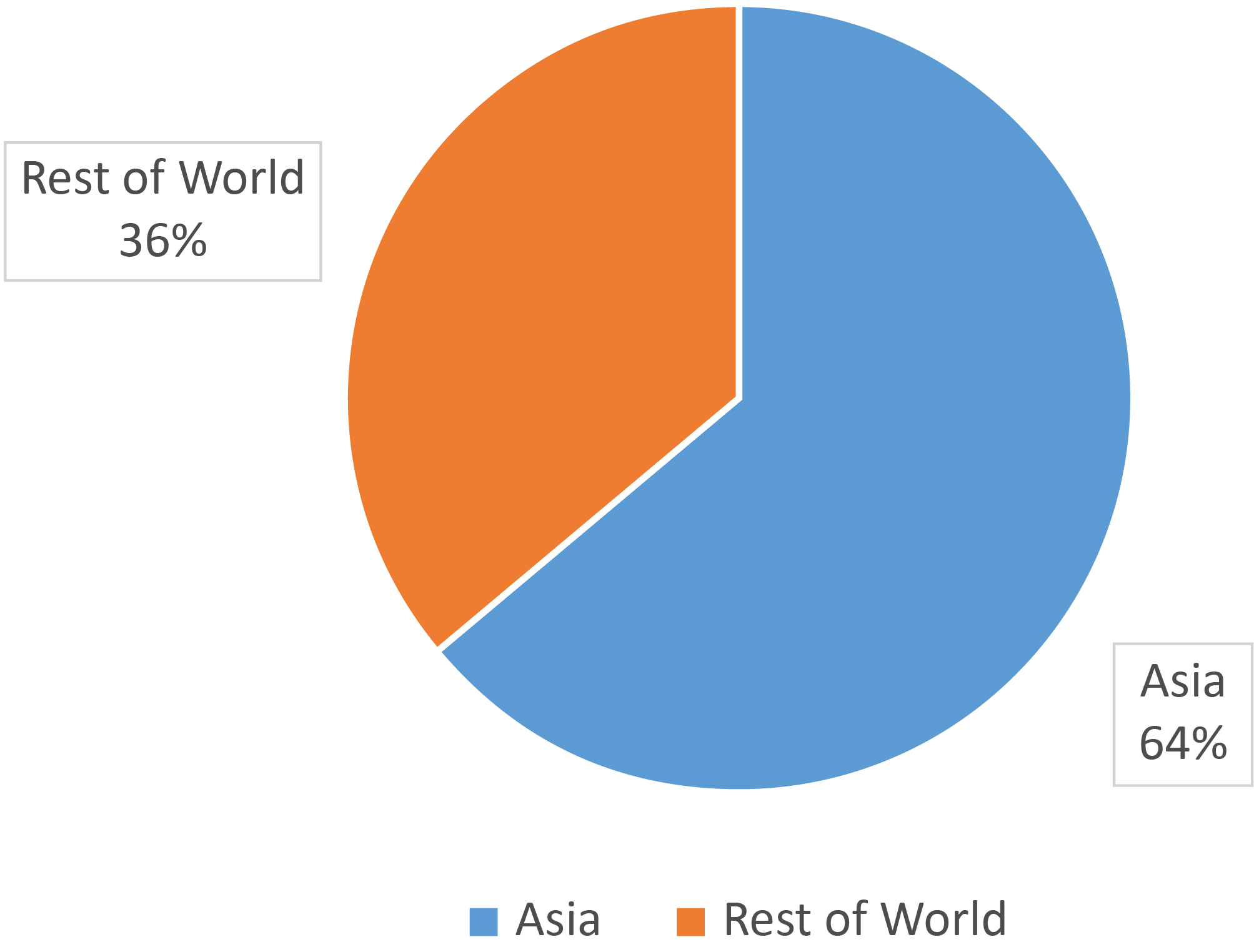
As required by the Dodd-Frank Wall Street Reform and Consumer Protection Act, and Item 402(u) of Regulation S-K, we are providing the following information about the relationship of the total annual compensation of our median employee and the total annual compensation of our President and CEO for 2025:
TTM TECHNOLOGIES, INC. |
54 |
We used the following methodology and material assumptions, adjustments, and estimates to identify the median employee and determine our median employee’s total annual compensation:
The pay ratio is a reasonable estimate calculated in a manner consistent with SEC rules. The SEC rules for identifying the median employee, and calculating the pay ratio based on that employee’s annual total compensation, allow companies to adopt a variety of methodologies, to apply certain exclusions, and to make reasonable estimates and assumptions that reflect their compensation practices. As such, the pay ratio reported by other companies may not be comparable, as other companies may have different employment and compensation practices and may utilize different methodologies, exclusions, estimates and assumptions in calculating their own pay ratios.
PAY VERSUS PERFORMANCE
As required by applicable SEC rules, we are providing the following tables and narratives which set forth additional compensation information for our principal executive officer ("PEO") and non-PEO NEOs, including the "compensation actually paid" ("CAP") to our PEO and Average CAP to our non-PEO NEOs, each as determined in accordance with SEC rules; total shareholder return ("TSR"); net income; and operating income for our fiscal years 2025, 2024, 2023, 2022, and 2021.
The amounts reported in the "Compensation Actually Paid to PEO" and “Average Compensation Actually Paid to Non-PEO NEOs” columns does not represent the value actually realized by the PEO or the Non-PEO NEOs. For further information about compensation decisions, see "Compensation Discussion and Analysis" section above.
|
|
|
|
|
|
|
Value of Initial Fixed $100 |
|
|
|
Year |
Summary Compensation Table Total for PEO 1: Thomas Edman(A) |
Summary Compensation Table Total for PEO 2: Edwin Roks(A) |
Compensation Actually Paid to PEO 1: Thomas Edman(A) |
Compensation Actually Paid to PEO 2: Edwin Roks(A) |
Average Summary Compensation Table Total for Non-PEO NEOs(A) |
Average Compensation Actually Paid to Non-PEO NEOs(A) |
Total Shareholder Return(B) |
Peer Group Total Shareholder Return(B) |
Net Income |
|
2025 |
$ |
$ |
$ |
$ |
$ |
$ |
$ |
$ |
$ |
$ |
2024 |
$ |
-- |
$ |
-- |
$ |
$ |
$ |
$ |
$ |
$ |
2023 |
$ |
-- |
$ |
-- |
$ |
$ |
$ |
$ |
$( |
$ |
2022 |
$ |
-- |
$ |
-- |
$ |
$ |
$ |
$ |
$ |
$ |
2021 |
$ |
-- |
$ |
-- |
$ |
$ |
$ |
$ |
$ |
$ |
TTM TECHNOLOGIES, INC. |
55 |
2025 |
2024 |
2023 |
2022 |
2021 |
Daniel L. Boehle |
Daniel L. Boehle |
Daniel L. Boehle |
Catherine A. Gridley |
Todd B. Schull |
Catherine A. Gridley |
Catherine A. Gridley |
Todd B. Schull |
Todd B. Schull |
Douglas L. Soder |
Douglas L. Soder |
Douglas L. Soder |
Catherine A. Gridley |
Douglas L. Soder |
Phillip Titterton |
Daniel J. Weber |
Philip Titterton |
Douglas L. Soder |
Phillip Titterton |
Daniel J. Weber |
|
|
Phillip Titterton |
|
|
The following adjustments were made to the amounts reported in the Total column of the SCT (SCT Total Compensation), which are reported in columns (b), to derive the CAP reported in columns (c):
PEO 1: SCT Total Compensation to CAP Reconciliation
Year |
Total Compensation Reported in SCT |
Equity Awards Reported in SCT(1)(2) |
Adjusted Equity Awards Included in CAP(3) |
CAP |
2025 |
$ |
$( |
$ |
$ |
2024 |
$ |
$( |
$ |
$ |
2023 |
$ |
$( |
$ |
$ |
2022 |
$ |
$( |
$ |
$ |
2021 |
$ |
$( |
$ |
$ |
PEO 2: SCT Total Compensation to CAP Reconciliation
Year |
Total Compensation Reported in SCT |
Equity Awards Reported in SCT(1)(2) |
Adjusted Equity Awards Included in CAP(3) |
CAP |
2025 |
$ |
$( |
$ |
$ |
PEO 1: Equity Award Values Included in CAP
Year |
Year End Value of Equity Awards Granted During the Covered Year(i) |
Change in Fair Value of Outstanding and Unvested Equity Awards(ii) |
Value of Awards Granted During the Covered Year Vesting During the Covered Year(iii) |
Change in Fair Value Between Prior Year-End and Vest Date of Equity Awards Vested in the Covered Year(iv) |
Value of Awards Granted in Prior Years that Fail to Meet Applicable Vesting Conditions During the Covered Year(v) |
Adjusted Equity Award Values Included in CAP |
2025 |
$ |
$ |
$ |
$ |
-- |
$ |
2024 |
$ |
$ |
-- |
$ |
$( |
$ |
2023 |
$ |
$ |
-- |
$( |
-- |
$ |
2022 |
$ |
$( |
-- |
$( |
$( |
$ |
2021 |
$ |
$ |
-- |
$ |
$( |
$ |
PEO 2: Equity Award Values Included in CAP
Year |
Year End Value of Equity Awards Granted During the Covered Year(i) |
Change in Fair Value of Outstanding and Unvested Equity Awards(ii) |
Value of Awards Granted During the Covered Year Vesting During the Covered Year(iii) |
Change in Fair Value Between Prior Year-End and Vest Date of Equity Awards Vested in the Covered Year(iv) |
Value of Awards Granted in Prior Years that Fail to Meet Applicable Vesting Conditions During the Covered Year(v) |
Adjusted Equity Award Values Included in CAP |
2025 |
$ |
-- |
-- |
-- |
-- |
$ |
TTM TECHNOLOGIES, INC. |
56 |
There was no dollar value of dividends or other earnings paid on equity awards in the applicable year that is not otherwise reflected in the fair value of such award. The value of equity awards included in CAP, as reported in column (c), is impacted by changes in our stock price. Our fiscal year end stock price was $71.21 for 2025, $24.70 for 2024, $15.81 for 2023, $15.08 for 2022, $15.14 for 2021 and $13.75 in 2020.
The following adjustments were made to the amounts reported in the Total column of the SCT (SCT Total Compensation), which are reported in column (d), to derive the CAP reported in column (e):
Average Non-PEO NEOs: SCT Total Compensation to CAP Reconciliation
Year |
Average Total Compensation Reported in SCT |
Average Equity Awards Reported in SCT(1)(2) |
Average Adjusted Equity Award Values Included in CAP(3) |
Average CAP |
2025 |
$ |
$( |
$ |
$ |
2024 |
$ |
$( |
$ |
$ |
2023 |
$ |
$( |
$ |
$ |
2022 |
$ |
$( |
$ |
$ |
2021 |
$ |
$( |
$ |
$ |
Average Non-PEO NEOs: Equity Award Values Included in CAP
Year |
Average Year End Value of Equity Awards Granted During the Covered Year(i) |
Average Change in Fair Value of Outstanding and Unvested Equity Awards(ii) |
Value of Awards Granted During the Covered Year Vesting During the Covered Year(iii) |
Average Change in Fair Value Between Prior Year-End and Vest Date of Equity Awards Vested in the Covered Year(iv) |
Average Value of Awards Granted in Prior Years that Fail to Meet Applicable Vesting Conditions During the Covered Year(v) |
Average Adjusted Equity Award Values Included in CAP |
2025 |
$ |
$ |
$ |
$ |
-- |
$ |
2024 |
$ |
$ |
-- |
$ |
$( |
$ |
2023 |
$ |
$ |
-- |
$( |
-- |
$ |
2022 |
$ |
$( |
-- |
$( |
$( |
$ |
2021 |
$ |
$ |
-- |
$ |
$( |
$ |
TTM TECHNOLOGIES, INC. |
57 |
There was no dollar value of dividends or other earnings paid on equity awards in the applicable year that is not otherwise reflected in the fair value of such award. The value of Equity Awards included in CAP, as reported in "Average Compensation Actually Paid to Non-PEO" columns, is impacted by changes in our stock price. Our fiscal year-end stock price was $71.21 for 2025, $24.70 for 2024, $15.81 for 2023, $15.08 for 2022, $15.14 for 2021, and $13.75 for 2020.
Pay Versus Performance Graphs (Relationships of Information Presented in the Pay Versus Performance Table)
The graphs below compare (i) the relationship between PEO 1 CAP, PEO 2 CAP and average Non-PEO NEO CAP with our TSR as well as the relationship between our TSR and our Peer Group TSR (defined as the “Executive Compensation Peer Group” on page 40), (ii) the relationship between PEO 1 CAP, PEO 2 CAP and average Non-PEO NEO CAP and net income, and (iii) the relationship between PEO 1 CAP, PEO 2 CAP and average Non-PEO NEO CAP and operating income, in each case, for fiscal year 2025 and, to the same extent except without PEO 2 CAP, for fiscal years 2024, 2023, 2022, and 2021. TSR amounts reported in the graph assume an initial fixed investment of $100 at market close 12/28/2020 in stock or index.
Relationship Between PEO 1 CAP, PEO 2 CAP and Average Non-PEO NEO CAP and Net Income
The following chart sets forth the relationship between CAP to our PEO 1, CAP to our PEO 2 (only with respect to fiscal year 2025), the average of CAP to our Non-PEO NEOs, and our net income during fiscal years 2021 through 2025, each as set forth in the table above.
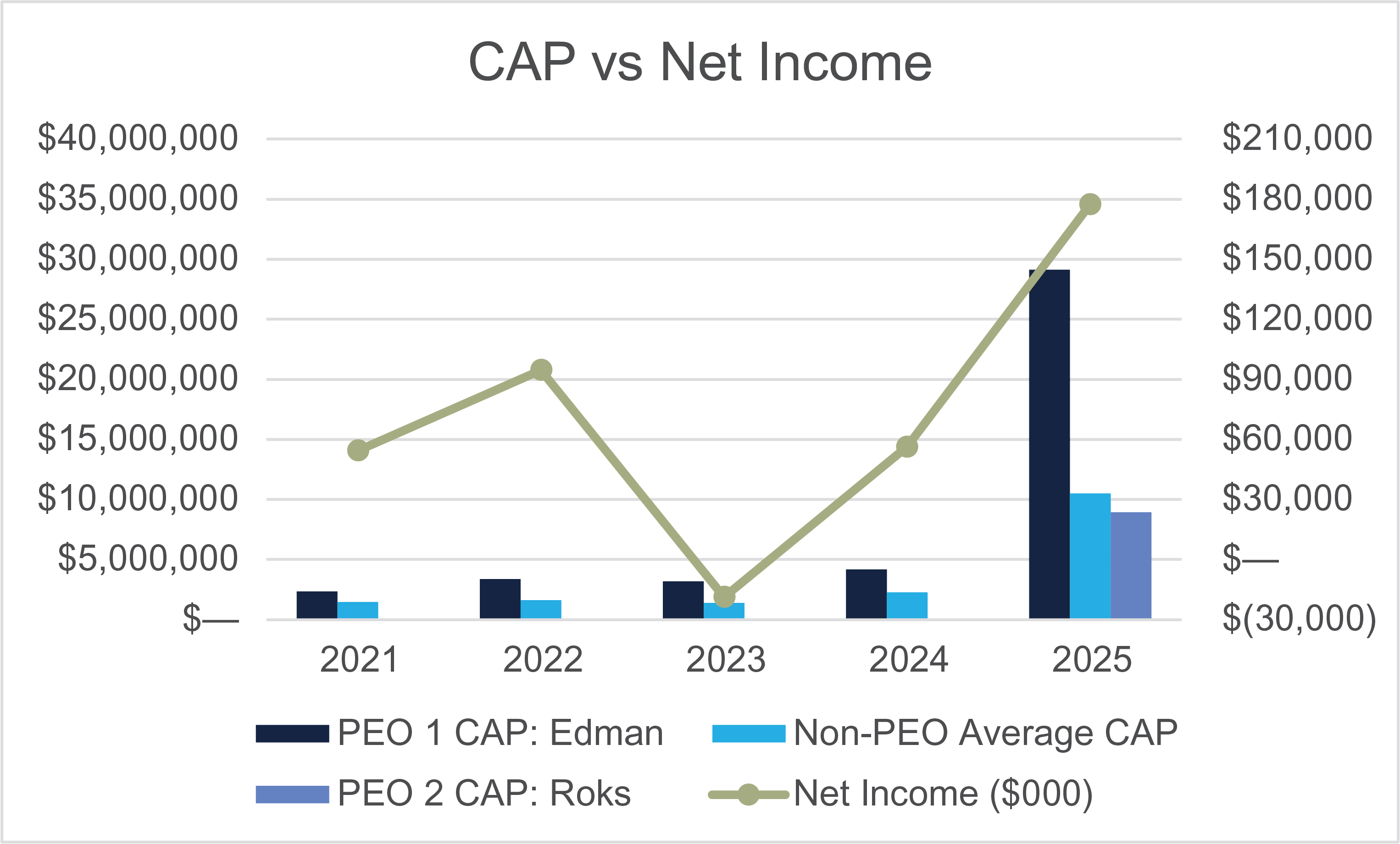
TTM TECHNOLOGIES, INC. |
58 |
Relationship Between PEO 1 CAP, PEO 2 CAP and Average Non-PEO NEO CAP and Operating Income
The following chart sets forth the relationship between CAP to our PEO 1, CAP to our PEO 2 (only with respect to fiscal year 2025), the average of CAP to our Non-PEO NEOs, and our operating income during fiscal years 2021 through 2025 , each as set forth in the table above.
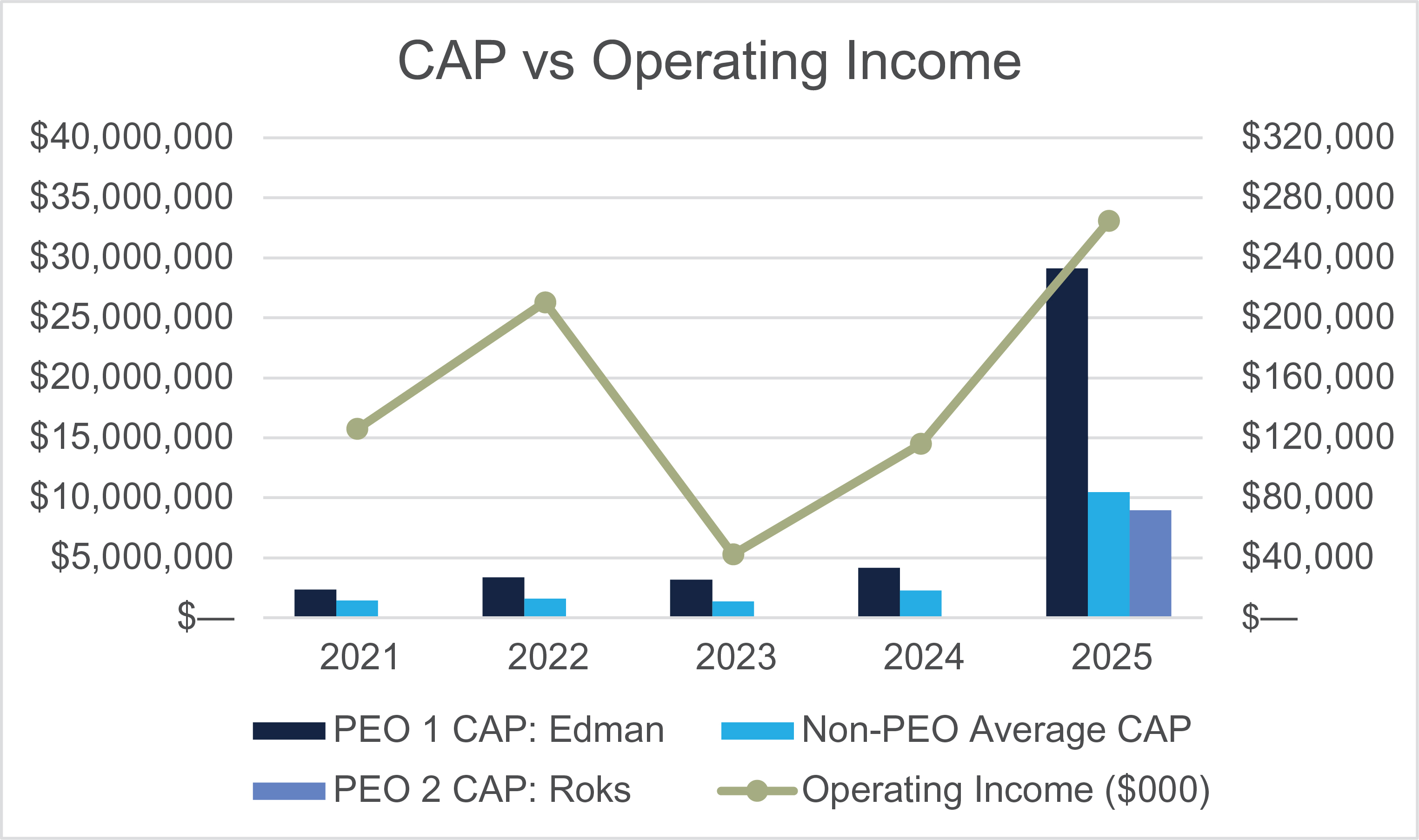
TTM TECHNOLOGIES, INC. |
59 |
Relationship Between PEO 1 CAP, PEO 2 CAP and Average Non-PEO NEO CAP and Our TSR and Relationship Between Our TSR and Peer Group TSR
The following chart sets forth the relationship between CAP to our PEO 1, CAP to our PEO 2 (only with respect to fiscal year 2025) the average of CAP to our Non-PEO NEOs, each as set forth in the Table above, and our cumulative TSR over the five-year period from fiscal years 2021 through 2025. The following chart also compares our cumulative TSR over the five-year period from fiscal years 2021 through 2025 to that of our Peer Group (defined as the “Executive Compensation Peer Group” on page 40) over the same time period.
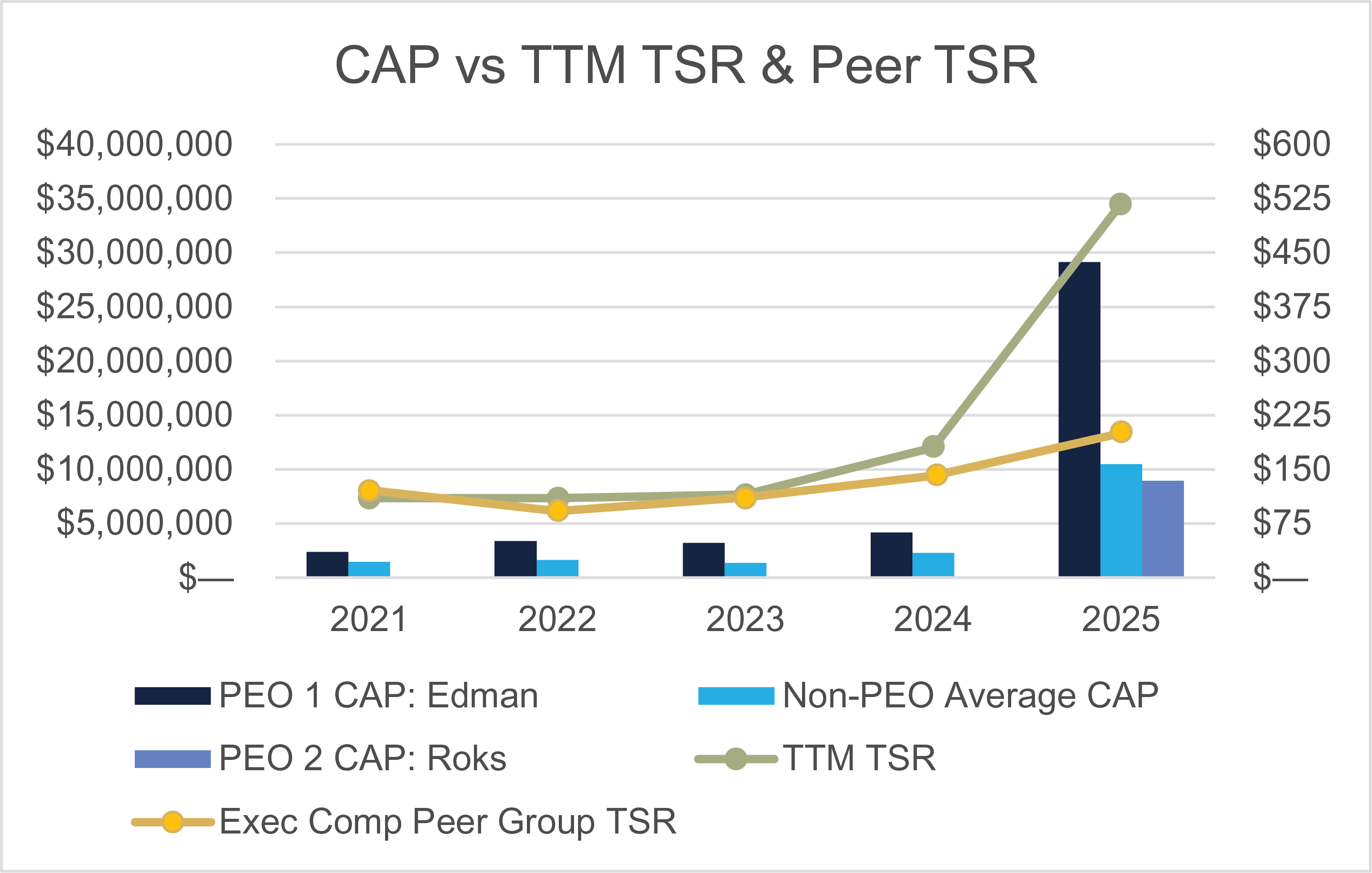
* Assumes $100 invested at market close of 12/28/2020 in stock or index
Financial Performance Measures
We believe that a significant portion of the NEOs’ target total compensation should be dependent upon performance. At TTM, we use corporate, business unit and individual performance components to link compensation actually paid (as defined by SEC rules) to the NEOs for the most recently completed fiscal year. The Company’s performance metric targets include the following:
Our human capital and compensation committee believes that the selected TSR Peer Group is more appropriate for determining TSR under our PRU Program as it provides a comparison of our Company’s stock price performance against our global competitors. For a discussion regarding how the TSR Peer Group affects executive compensation, please see the “Long-Term Equity Awards” section on page 37.
TTM TECHNOLOGIES, INC. |
60 |
EQUITY COMPENSATION PLAN INFORMATION
The following table sets forth information with respect to our common stock that may be issued upon the exercise of stock options, warrants, and rights under our 2006 Incentive Compensation Plan, our TTM Technologies, Inc. 2014 Incentive Compensation Plan, and our TTM Technologies, Inc. 2023 Incentive Compensation Plan as of December 29, 2025.
Plan Category |
(a) Number of Securities to be Issued Upon Exercise of Outstanding Options, Warrants, and Rights(1) |
(b) Weighted Average Exercise Price of Outstanding Options, Warrants, and Rights(2) |
(c) Number of Securities Remaining Available for Future Issuance Under Equity Compensation Plans (Excluding Securities Reflected in Column (a)) |
||||||
Equity Compensation Plans Approved by Stockholders |
|
4,534,761 |
|
|
$15.57 |
|
|
1,966,330 |
|
Equity Compensation Plans Not Approved by Stockholders |
|
— |
|
|
— |
|
|
— |
|
Total |
|
4,534,761 |
|
|
$15.57 |
|
|
1,966,330 |
|
TTM TECHNOLOGIES, INC. |
61 |
PROPOSAL TWO – APPROVAL OF
THE TTM TECHNOLOGIES, INC. EQUITY ADVANTAGE MATCH PLAN
We are asking our stockholders to approve adoption of the proposed TTM Technologies, Inc. Equity Advantage Match Plan (the “Purchase and Match Plan”). Subject to stockholder approval, the Board of Directors adopted the Purchase and Match Plan on February 11, 2026, upon the recommendation of our human capital and compensation committee.
There are two components to the Purchase and Match Plan: a purchase component and a matching component. Under the purchase component, employees of our company and its subsidiaries may purchase shares of our common stock for the closing trading price of our common stock on the date of purchase. Under the matching component, we will match each share of our common stock purchased by our and our subsidiaries’ employees under the purchase component with a matching share of our common stock that is subject to vesting no earlier than the six-month anniversary of the purchase of the corresponding share purchased under the purchase component.
Our Board of Directors believes that implementing the Purchase and Match Plan encourages our employees to acquire shares of our common stock, thereby fostering broad alignment of employees’ interests with the interests of our stockholders; fosters good employee relations; and provides us with a tool to recruit, retain, and reward employees in an extremely competitive environment. In order to allow employees to participate and benefit from the Purchase and Match Plan, we are asking shareholders to approve adoption of the Purchase and Match Plan.
Key Features of the Purchase and Match Plan
As described further below, the Purchase and Match Plan:
TTM TECHNOLOGIES, INC. |
62 |
Summary of Material Provisions of the Purchase and Match Plan
A summary of the material terms of the Purchase and Match Plan is set forth below. This summary is qualified in its entirety by the full text of the Purchase and Match Plan, a copy of which is filed as Annex B to this proxy statement and which is incorporated by reference into this Proposal Two. We encourage stockholders to read and refer to the complete plan document in Annex B for a more complete description of the Purchase and Match Plan.
Overview. Under the purchase component of the Purchase and Match Plan, eligible Employees purchase our common stock through accumulated payroll deductions, and for each share of our common stock purchased, we will issue an additional matching share under the matching component of the Purchase and Match Plan at no cost to the Employee, subject to the matching component limit described below.
Interpretation. The Purchase and Match Plan is not intended to qualify as an “employee stock purchase plan” under Section 423 of the Internal Revenue Code of 1986, as amended (the “Code”).
Share Reserve. Subject to adjustment upon changes in the capitalization of TTM, the maximum number of shares of our common stock that may be issued in the aggregate under the Purchase and Match Plan will be 500,000 shares. Shares available for issuance under either component of the Purchase and Match Plan may be authorized but unissued shares or reacquired shares.
Administration. The Purchase and Match Plan shall be administered by the human capital and compensation committee of the Board of Directors of TTM Technologies, Inc. or another committee or subcommittee of the Board of Directors or the human capital and compensation committee (the “Committee”), which Committee, unless otherwise determined by the Board of Directors, shall consist solely of two or more members of the Board of Directors, each of whom is intended to qualify as a “non-employee director” as defined by Rule 16b-3 promulgated under the Exchange Act and an “independent director” under the applicable exchange rules. The Committee has broad authority to construe the Purchase and Match Plan and to make determinations with respect to the terms of each Offering Period under the Purchase and Match Plan, awards, designated participating subsidiaries and other matters pertaining to plan administration.
Eligibility. Any Employee who is customarily employed by TTM or any participating subsidiary for at least twenty hours per week and for more than five months per calendar year may participate in the Purchase and Match Plan. However, the following Employees are ineligible to participate in the Purchase and Match Plan: (i) TTM’s Chief Executive Officer, (ii) each senior management employee who reports directly to the Chief Executive Officer, (iii) each employee that is a Section 16 officer of TTM, (iv) each other senior management employee as determined in writing by the Purchase and Match Plan’s administrator, and (v) all employees classified by TTM or any participating subsidiary as an intern, co-op or temporary employee. A participant’s right to purchase shares under the applicable Offering Period will automatically terminate upon such participant’s ceasing to be an eligible Employee, including as a result of termination of participant’s employment.
As of March 11, 2026, we had 5,920 employees who are eligible to participate in the Purchase and Match Plan. None of our executive officers are eligible to participate in the Purchase and Match Plan. In addition, consultants and non-employee directors are not eligible to participate in the Purchase and Match Plan.
Participation Election. An eligible Employee shall be eligible to participate on the first day of each Offering Period after the Employee’s first date of employment with TTM or a participating subsidiary (as such term is defined in the Purchase and Match Plan) by properly completing and delivering to TTM an enrollment form designating payroll deduction authorization by the deadline prescribed by TTM. Participation in the Purchase and Match Plan is voluntary.
TTM TECHNOLOGIES, INC. |
63 |
By enrolling in the Purchase and Match Plan, a participant is deemed to have elected to (a) purchase the maximum number of shares of common stock that can be purchased under the purchase component with the compensation withheld during each Offering Period for which the participant is enrolled and (b) acquire an equal number of shares of our common stock under the matching component that are subject to a risk of forfeiture in the event the participant ceases to constitute an Employee under the Purchase and Match Plan within no less than the six month period immediately following the date corresponding shares are purchased under the purchase component (the “Matching Shares”). A participant holding Matching Shares: (i) will not be entitled to any dividends paid until after the risk of forfeiture thereon lapses and (ii) will not be entitled to credit or payment for any dividends paid prior to the date the risk of forfeiture lapses with respect to the Matching Shares. The administrator can, in its discretion, extend the risk of forfeiture to a period that is longer, but never shorter, than six months. If a participant ceases to constitute an Employee under the Purchase and Match Plan for any reason during an Offering Period, the participant will be deemed to have elected to withdraw from the purchase component of the Purchase and Match Plan and any amounts credited to the participant’s account will be returned to the participant or the participant’s beneficiary, in the event of his or her death. If a participant ceases to constitute an Employee under the Purchase and Match Plan during the six-month period following an Exercise Date, he or she will retain each share purchased under the purchase component but each Matching Share acquired on the Exercise Date under the matching component will be forfeited.
An Employee who does not become a participant on the first day of an Offering Period but is otherwise eligible may thereafter become a participant on the Enrollment Date of the next Offering Period by properly completing and delivering to TTM an election form by the deadline prescribed by TTM.
Payroll Deductions. Payroll deductions for a participant shall commence on the first payroll date following the first day of an Offering Period and shall end on the last payroll date of such Offering Period, unless sooner terminated as provided in the Purchase and Match Plan.
The payroll deductions made under the purchase component of the Purchase and Match Plan for each participant may be not less than 1% nor more than 25% of a participant’s compensation as of each payday during the applicable Offering Period (which deductions may be elected as a percentage or a fixed dollar amount, as determined by the administrator). Compensation is defined in the Purchase and Match Plan and generally includes the regular straight-time earnings, base salary, cash bonuses (e.g., quarterly or annual bonuses or other corporate bonuses), commissions, vacation pay, holiday pay, jury duty pay, funeral leave pay or military pay paid to the Employee from TTM or any participating subsidiary or any affiliate on each payday as compensation for services to TTM or any participating subsidiary or any affiliate, before certain deductions and subject to exclusions as set forth in the Purchase and Match Plan. A participant may not increase or decrease his or her payroll deduction authorization during an Offering Period (other than a full withdrawal from the Purchase and Match Plan in accordance with the plan’s terms). If a participant wishes to increase or decrease the rate of payroll withholding, he or she may do so, effective for the next Offering Period, by submitting a new election with respect to such successive Offering Period. The Employee contribution shall not exceed the Employee’s total net earnings for the pay period.
Exercise Date; Purchase of Stock. The “Exercise Date” of each Offering Period under the purchase component occurs on the last trading day of each Offering Period, other than in the event of certain corporate transactions involving the Company, as set forth in the Purchase and Match Plan and described further below. On the Exercise Date, without any further action from any participant, accumulated payroll deductions for each participant will be used to (i) purchase shares of common stock under the purchase component at a purchase price equal to the fair market value of our common stock on the Exercise Date (the “Purchased Shares”) and (ii) we will issue an equal number of Matching Shares under the matching component, up to and subject to the Matching Component Limit, in each case which may include the issuance of fractional shares. The “Matching Component Limit” means, (i) with respect to Technical Employees (as such term is defined in the Purchase and Match Plan), $4,000 per calendar year and (ii) with respect to all other Employees, $2,000 per calendar year.
TTM TECHNOLOGIES, INC. |
64 |
The fair market value of a share of our common stock for purposes of the Purchase and Match Plan will generally be the closing trading price per share of our common stock on the date of purchase, as reported on NASDAQ. On March 11, 2026, the closing price of our common stock on NASDAQ was $95.44 per share. If insufficient shares remain under the Purchase and Matching Plan on any Exercise Date to cover issuances of either Purchased Shares or Matching Shares, the administrator will make a pro rata allocation of the shares available, in accordance with the terms of the Purchase and Matching Plan.
A participant may cancel his or her payroll deduction authorization and elect to withdraw from the Purchase and Match Plan by delivering written notice of such election to TTM in such form and at such time prior to the Exercise Date for such Offering Period as may be established by the administrator. Upon cancellation, the participant may elect either to withdraw all of the funds then credited to his or her Purchase and Match Plan account and withdraw from the Purchase and Match Plan or have the balance of his or her account applied to the purchase of Purchased Shares under the purchase component and acquisition of Matching Shares under the matching component for the Offering Period in which his or her cancellation is effective (with any remaining Purchase and Match Plan account balance returned to the participant). A participant who ceases contributions to the Purchase and Match Plan during any Offering Period shall not be permitted to resume contributions to the Purchase and Match Plan during the same Offering Period.
Unless a participant has previously canceled the participant’s participation in the Purchase and Match Plan in accordance with the terms of the Purchase and Match Plan, the participant will be deemed to have exercised the participant’s right to purchase and acquire shares in full as of each Exercise Date.
Offering Periods. Unless otherwise determined by the Committee, the Purchase and Match Plan will have four Offering Periods, which will each be three months in duration, with the first such Offering Period beginning on January 1 and ending on March 31, the second such Offering Period beginning on April 1 and ending on June 30, the third such Offering Period beginning on July 1 and ending on September 30, and the fourth such Offering Period beginning on October 1 and ending on December 31, provided that the first offering period under the Purchase and Match Plan is expected to commence on January 1, 2027 and expected to end on March 20, 2027.
Termination of Participation. A participant may withdraw from the Purchase and Match Plan by properly completing and submitting a written or electronic notice of such withdrawal election to us. As further discussed above, a participant will automatically be withdrawn by us from an Offering Period under the Purchase and Match Plan upon a termination of employment with us or a participating affiliate.
Transferability. No rights under the Purchase and Match Plan are transferable (other than by will or the applicable laws of descent and distribution).
Corporate Transactions. If the number of outstanding shares of our common stock is increased or decreased or the shares are changed into or exchanged for a different number or kind of our shares or other securities by reason of any stock split, reverse stock split, stock dividend, combination, or reclassification of our common stock, or other increase or decrease in shares of our common stock effected without receipt of consideration by us, the number and kinds of shares that have been authorized for issuance under the Purchase and Match Plan but not yet purchased or issued will be adjusted proportionately.
In the event of a proposed liquidation or dissolution of TTM, the Offering Period then in progress will be shortened by setting a new Exercise Date to occur prior to the consummation of the proposed liquidation or dissolution and will terminate immediately prior to such consummation.
In the event of a proposed merger or asset sale, each outstanding right to purchase shares and to be issued Matching Shares will be assumed or substituted by the successor corporation or a parent or subsidiary thereof. In the event that the rights are not assumed or substituted, any Offering Period then in progress will be shortened by setting a new Exercise Date to occur prior to the date of the proposed sale or merger.
Term. Subject to approval by our stockholders at the Annual Meeting, the effective date of the Purchase and Match Plan will be May 7, 2026.
TTM TECHNOLOGIES, INC. |
65 |
Amendment or Termination. The Board of Directors may, in its sole discretion, at any time and from time to time, amend, suspend, or terminate the Purchase and Match Plan without notice; provided, however, that without stockholder approval given within 12 months before or after action by the Board of Directors, the Purchase and Match Plan may not be amended to increase the maximum number of shares of common stock subject to the Purchase and Match Plan or in any other manner that requires stockholder approval under applicable law or applicable stock exchange rules. Without stockholder approval and without regard to whether any participant’s rights may be considered to have been “adversely affected,” the Board of Directors or the Committee may: (i) change the terms of an Offering Period, (ii) limit the frequency and/or number of changes in the amount withheld during an Offering Period, (iii) permit payroll withholding in excess of the amount designated by a participant in order to adjust for delays or mistakes in TTM’s processing of properly completed withholding elections, (iv) establish reasonable waiting and adjustment periods and/or accounting and crediting procedures to ensure that amounts applied toward the purchase of shares for each participant properly correspond with amounts withheld from the participant’s compensation, and (v) establish such other limitations or procedures as the Board of Directors or the Committee, as applicable, determines in its sole discretion advisable which are consistent with the Purchase and Match Plan.
Certain U.S. Federal Income Tax Consequences
The Purchase and Match Plan is not intended to qualify as an “employee stock purchase plan” under Section 423 of the Code. Accordingly, certain tax benefits available to participants in a Section 423 plan are not available under our Purchase and Match Plan.
For federal income tax purposes, a participant generally will not recognize taxable income on the grant of the right to purchase and acquire shares under the Purchase and Match Plan, nor will TTM be entitled to any deduction at that time. Upon the purchase of shares under the purchase component of the Purchase and Match Plan, a participant generally will not recognize taxable income and instead will recognize ordinary income in the amount equal to the fair market value of the Matching Shares issued under the matching component when the risk of forfeiture on the Matching Shares lapses. TTM will be entitled to a corresponding deduction when the risk of forfeiture on the Matching Shares lapses. A participant’s basis in Purchased Shares, for purposes of determining the participant’s gain or loss on subsequent disposition of such shares of common stock, generally, will be equal to the purchase price paid for such shares. A participant’s basis in Matching Shares, for purposes of determining the participant’s gain or loss on subsequent disposition of such shares of common stock, generally, will be the fair market value of the shares of common stock on the date the risk of forfeiture on such Matching Shares lapses.
Upon the subsequent sale of the shares acquired under the Purchase and Match Plan, the participant will recognize capital gain or loss (long-term or short-term, depending on how long the shares were held following the date of purchase for Purchased Shares and the lapse of the risk of forfeiture for Matching Shares prior to disposing of them).
The above is a general summary under current law of the material federal income tax consequences to an employee who participates in the Purchase and Match Plan. This summary deals with the general federal income tax principles that apply and is provided only for general information. Some kinds of taxes, such as state, local and foreign income taxes and federal employment taxes, are not discussed. Tax laws are complex and subject to change and may vary depending on individual circumstances and from locality to locality. The summary above does not discuss all aspects of federal income taxation that may be relevant in light of a participant’s personal circumstances. Further, this summarized tax information is not tax advice and a participant in the Purchase and Match Plan should rely on the advice of his or her legal and tax advisors.
TTM TECHNOLOGIES, INC. |
66 |
New Plan Benefits
Because the number of shares of our common stock that may be purchased under the Purchase and Match Plan will depend on each participant’s voluntary election to participate and on the fair market value of the shares at various future dates, the actual number of shares that may be purchased by any individual under the purchase component and acquired by such individual under the matching component cannot be determined in advance. No shares of our common stock have been issued under the Purchase and Match Plan as of the date of this proxy statement, and no shares will be issued under the Purchase and Match Plan prior to approval of the Purchase and Match Plan by our stockholders.
Registration with the SEC
If the Purchase and Match Plan is approved by our stockholders and becomes effective, we intend to file a registration statement on Form S-8 registering the shares reserved for issuance under the Purchase and Match Plan as soon as reasonably practicable after the Annual Meeting.
Our Board of Directors recommends a vote “FOR” the approval of the TTM Technologies, Inc. Equity Advantage Match Plan.
TTM TECHNOLOGIES, INC. |
67 |
PROPOSAL THREE – ADVISORY APPROVAL OF
NAMED EXECUTIVE OFFICER COMPENSATION
In accordance with Section 14A of the Exchange Act, we are asking our stockholders to provide an advisory, non-binding vote to approve the compensation of our NEOs. This proposal, commonly known as a “Say-on-Pay” proposal, gives our stockholders the opportunity to express their views on the compensation of our NEOs by voting on the non-binding resolution below. Unless our Board of Directors modifies its policy of holding an advisory say-on-pay vote on an annual basis, the next advisory say-on-pay vote will be held at our 2027 annual meeting.
As described in detail in the Compensation Discussion and Analysis section of this proxy statement, our executive compensation program, which is established by our human capital and compensation committee and Board of Directors, is intended to attract, motivate, and retain executives and key employees and reward the creation of stockholder value. We seek to provide executive compensation packages that are competitive with other similarly situated companies in our industry and reward the achievement of short-term and long-term performance goals.
We are asking our stockholders to indicate their support for our NEO compensation. We believe that the information we have provided in this proxy statement demonstrates that our executive compensation program was designed appropriately and is working to ensure that management’s interests are aligned with our stockholders’ interests to support long-term value creation.
At our 2025 annual meeting, our stockholders overwhelmingly approved, on an advisory basis, the compensation of our NEOs described in our 2025 proxy statement. Approximately 98.21% of the votes cast on the matter were voted “For” such advisory “Say-on-Pay” approval. Based in part on the overwhelming approval of the compensation paid to NEOs for 2024, the Company continued its compensation structure for its NEOs for fiscal year 2025.
Stockholders are urged to read the Compensation Discussion and Analysis section of this proxy statement and the tabular disclosure regarding NEO compensation (together with the accompanying narrative disclosure) in this proxy statement, which discusses how our compensation policies and procedures implement our compensation philosophy. Our human capital and compensation committee and Board of Directors believe that these policies and procedures are effective in implementing our compensation philosophy and in achieving its goals.
Our Board of Directors believes that the compensation of our NEOs is appropriate and recommends a vote “FOR” the following advisory resolution, which will be submitted for a stockholder vote at the annual meeting:
“RESOLVED, that the stockholders approve, on an advisory basis, the compensation of the Company’s named executive officers, as disclosed pursuant to the compensation disclosure rules of the SEC, including the Compensation Discussion and Analysis, the compensation tables, narrative discussion and related matters.”
You may vote “for” or “against” the foregoing resolution, or you may “abstain.” This vote is not intended to address any specific item of compensation, but rather the overall compensation of our NEOs and the philosophy, policies, and procedures described in this proxy statement.
While the advisory vote is non-binding, the human capital and compensation committee and our Board of Directors will review the results of the vote and take the concerns of our stockholders into account in future determinations concerning our executive compensation program. Our Board of Directors therefore recommends that you indicate your support for the compensation policies and procedures for our NEOs, as outlined in the above resolution.
TTM TECHNOLOGIES, INC. |
68 |
PROPOSAL FOUR – ADVISORY VOTE ON THE FREQUENCY OF
FUTURE ADVISORY VOTES TO APPROVE NAMED EXECUTIVE OFFICER COMPENSATION
In accordance with Section 14A of the Exchange Act, we are seeking an advisory, non-binding vote on how frequently the advisory vote described under Proposal Three (the “Advisory Approval of Named Executive Officer Compensation”) should be presented to stockholders. Stockholders may indicate their preference to have the advisory vote to approve named executive compensation held every year, every two years, or every three years, or stockholders may abstain from voting on this proposal.
Currently, the Company’s stockholders have the opportunity to cast an advisory vote to approve named executive compensation every year. After careful consideration, the Board has determined that an advisory vote to approve named executive compensation that occurs every year (an annual vote) is the most appropriate alternative for the Company, and therefore recommends that stockholders vote for a one-year interval for the stockholder advisory vote to approve named executive compensation. It provides the most consistent and clear communication channel for stockholders to express their views and provide direct and immediate feedback on our executive compensation program every year.
Approval of Proposal Four requires the affirmative vote of a majority of the shares of our common stock present in person or represented by proxy at the Annual Meeting and entitled to vote on the proposal. The option of one year, two years or three years that receives such a majority will be deemed to be the frequency preferred by the stockholders for future advisory, non-binding votes to approve the compensation of the Company's named executive officers. If none of the frequency alternatives (one year, two years, or three years) receives a majority vote, we will consider the frequency that receives the highest number of votes by stockholders to be the frequency that has been selected by stockholders, on an advisory basis.
After careful consideration of this proposal, our Board of Directors recommends that you vote to select a frequency of ONE year, or an annual vote, to hold an advisory vote on the compensation of our named executive officers.
While the advisory vote described in this Proposal Four is non-binding, and even though our Board of Directors has determined that providing stockholders with the advisory vote to approve named executive compensation once every year is advisable, our Board of Directors will review the results of the vote and consider our stockholders’ concerns when determining the frequency of holding the “Say-on-Pay” vote. We currently intend to provide a “Say-on-Pay” proposal every year. Stockholders are not voting to approve or disapprove the Board’s recommendation.
TTM TECHNOLOGIES, INC. |
69 |
PROPOSAL FIVE – RATIFICATION OF APPOINTMENT OF
INDEPENDENT REGISTERED PUBLIC ACCOUNTING FIRM
Current independent registered public accounting firm
We have appointed KPMG LLP to serve as our independent registered public accounting firm for the fiscal year ending December 28, 2026 and recommend that stockholders vote in favor of the ratification of such appointment as a matter of good corporate governance. In the event of a negative vote on such ratification, our Board of Directors will reconsider its selection. We anticipate that representatives of KPMG LLP will attend the annual meeting, will have the opportunity to make a statement if they desire, and will be available to respond to appropriate questions.
Audit Fees
The following is a summary of fees, all of which were approved by our audit committee, for audit and other professional services performed by KPMG LLP during the fiscal years ended December 29, 2025 and December 30, 2024:
|
|
2025 |
|
2024 |
Audit fees |
|
$3,105,673 |
|
$3,208,160 |
Tax fees |
|
427,257 |
|
219,815 |
Total |
|
$3,532,930 |
|
$3,427,975 |
“Audit fees” include fees paid for the audits of our consolidated financial statements and of internal control over financial reporting included in our Annual Report on Form 10-K, selected statutory audits, fees related to consents and fees related to reviews of interim financial statements included in Form 10-Q.
“Tax fees” include fees paid for assistance provided with respect to transfer pricing and other studies, compliance services and consulting.
Pre-Approval Policy for Independent Registered Public Accounting Firm’s Fees
In 2003, our audit committee adopted a formal policy concerning pre-approval of all services to be provided by our independent registered public accounting firm. The policy requires that all proposed services to be provided by our independent registered public accounting firm must be pre-approved by our audit committee before any services are performed. This policy includes all audit, audit-related, tax, and other services that our independent registered public accounting firm may provide to our Company. In evaluating whether to engage our independent registered public accounting firm for non-audit services, our audit committee considers whether the performance of services other than audit services is compatible with maintaining the independence of our independent registered public accounting firm. All of the services provided by KPMG LLP described in the table above were approved by our audit committee pursuant to our audit committee’s pre-approval policies.
Our Board of Directors recommends a vote “FOR” the ratification of KPMG LLP as our independent registered public accounting firm for the fiscal year ending December 28, 2026.
In the event of a negative stockholder vote on the ratification of KPMG LLP as our Company's independent registered public accounting firm, our audit committee will reconsider its selection.
TTM TECHNOLOGIES, INC. |
70 |
REPORT OF THE AUDIT COMMITTEE OF THE BOARD OF DIRECTORS
The material in the following report of the audit committee is not “soliciting material”, is not deemed “filed” with the SEC, and is not to be incorporated by reference into any filing of the company under the Securities Act of 1933, as amended, or the Securities Exchange Act of 1934, as amended.
Our Board of Directors has appointed an audit committee consisting of four independent directors. All members of our audit committee are able to read and understand fundamental financial statements, including our balance sheet, statement of operations, statement of comprehensive income, and statement of cash flows. Most members of our audit committee have past employment experience in finance or accounting, requisite professional certification in accounting, or other comparable experience or background which results in each individual’s financial sophistication, including being or having been a Chief Executive Officer, Chief Financial Officer, or other senior officer with financial oversight responsibility. Our Board of Directors has determined that Messrs. Ali, Franklin and Mayer and Ms. Jackson are independent directors, as defined by NASDAQ Marketplace Rule 5605(a)(2), and that Mr. Franklin qualifies as an “audit committee financial expert.”
The primary responsibility of our audit committee is to assist our Board of Directors in fulfilling its responsibility to oversee management’s conduct of our financial reporting process, including overseeing the financial reports and other financial information provided by us to governmental or regulatory bodies (such as the SEC), the public, and other users thereof; our systems of internal accounting and financial controls; and the annual independent audit of our consolidated financial statements.
Management has the responsibility for our consolidated financial statements and the reporting process, including the systems of internal controls. Our independent registered public accounting firm engaged to conduct the audit of our 2025 consolidated financial statements, KPMG LLP, was responsible for auditing our consolidated financial statements, expressing an opinion on the conformity of those audited consolidated financial statements with U.S. generally accepted accounting principles, and for expressing an opinion on the Company’s internal control over financial reporting.
In fulfilling its oversight responsibilities, our audit committee reviewed our consolidated audited financial statements with management and the independent registered public accounting firm. Our audit committee discussed with the independent registered public accounting firm the matters required to be discussed by Auditing Standard No. 1301, Communications with Audit Committees. This included a discussion of the independent registered public accounting firm’s judgments as to the quality, not just the acceptability, of our accounting principles and such other matters as are required to be discussed with our audit committee under generally accepted auditing standards. In addition, our audit committee received from the independent registered public accounting firm written disclosures required by applicable requirements of the Public Company Accounting Oversight Board regarding the independent registered public accounting firm’s independence. Our audit committee also discussed with the independent registered public accounting firm their independence from management and our Company, including the matters covered by the written disclosures provided by the independent registered public accounting firm. Our audit committee has concluded that KPMG LLP is independent from our Company and management.
Our audit committee discussed with the independent registered public accounting firm the overall scope and plans for its audits. Our audit committee met with the independent registered public accounting firm, with and without management present, to discuss the results of its audit, the internal controls of our Company, and the overall quality of our financial reporting. Our audit committee held four meetings during the fiscal year ended December 29, 2025.
Based on the reviews and discussions referred to above, our audit committee recommended to our Board of Directors, and our Board of Directors approved, that our audited consolidated financial statements be included in our Annual Report on Form 10-K for the fiscal year ended December 29, 2025 for filing with the SEC.
Our Board of Directors has adopted a written charter for our audit committee that reflects, among other things, requirements of the Sarbanes-Oxley Act of 2002, rules adopted by the SEC, and rules of NASDAQ.
TTM TECHNOLOGIES, INC. |
71 |
This report has been furnished by our audit committee to our Board of Directors.
Philip G. Franklin, Chair
Wajid Ali
Pamela B. Jackson
John G. Mayer
CERTAIN RELATIONSHIPS AND RELATED TRANSACTIONS
Since December 31, 2024, the first day of our last fiscal year, there were no transactions or series of similar transactions to which we were or are a party that involved an amount exceeding $120,000 and in which any of our directors, executive officers, nominees for director, holders of more than 5% of any class of our voting securities, or any member of the immediate family of any of the foregoing persons, had or will have a direct or indirect material interest.
ELECTRONIC AVAILABILITY OF PROXY STATEMENT AND 2025 ANNUAL REPORT
As permitted by SEC rules, we are making this proxy statement and our Annual Report on Form 10-K for 2025 available to stockholders electronically via the Internet on our website at https://investors.ttm.com/news-events/annual-stockholders-meeting. On or about March 19, 2026, we began mailing to our stockholders a notice containing instructions on how to access this proxy statement and our annual report and how to vote online. If you received that notice, you will not receive a printed copy of the proxy materials unless you request it by following the instructions for requesting such materials contained on the notice or set forth in the following paragraph.
If you received a paper copy of this proxy statement by mail and you wish to receive a notice of availability of next year’s proxy statement either in paper form or electronically via e-mail, you can elect to receive a paper notice of availability by mail or an e-mail that will provide a link to these documents on our website. By opting to receive the notice of availability and accessing your proxy materials online, you will save our Company the cost of printing and mailing documents to you, reduce the amount of mail you receive, speed your ability to access the proxy materials and our annual report, and help preserve environmental resources. We encourage you to sign up for electronic proxy and annual report access or a paper notice of availability for future annual meetings. Stockholders may elect to receive electronic access or a paper notice by registering electronically on our website at https://investors.ttm.com/news-events/annual-stockholders-meeting. If you received electronic or paper notice of availability of these proxy materials and wish to receive paper delivery of a full set of future proxy materials, you may do so at the same location.
Our Annual Report on Form 10-K for 2025, available on our website at https://investors.ttm.com, contains financial and other information about our Company, but is not incorporated into this proxy statement and is not to be considered a part of these proxy soliciting materials or subject to Regulations 14A or 14C or to the liabilities of Section 18 of the Exchange Act. The information contained in the “Human Capital and Compensation Committee Report” and “Report of the Audit Committee of the Board of Directors” shall not be deemed “filed” with the SEC or subject to Regulations 14A or 14C or to the liabilities of Section 18 of the Exchange Act. If a stockholder received a paper copy of our annual report and does not wish to access our annual report through our website but rather requires an additional paper copy of our Annual Report on Form 10-K, we will provide one, without charge, on the written request of any such stockholder addressed to our corporate secretary at 200 East Sandpointe, Suite 400, Santa Ana, California 92707.
TTM TECHNOLOGIES, INC. |
72 |
STOCKHOLDER PROPOSALS
If any stockholder intends to present a proposal to be considered for inclusion in our proxy material for the 2027 annual meeting of stockholders, the proposal must comply with the requirements of Rule 14a-8 of Regulation 14A of the Exchange Act and must be submitted in writing by notice delivered to our corporate secretary at 200 East Sandpointe, Suite 400, Santa Ana, California 92707. Any such proposal must be received by the Company no later than 5:00 p.m. Pacific Time, November 19, 2026, which is 120 calendar days prior to the anniversary of this year’s mailing date, unless the date of our 2027 annual meeting is changed by more than 30 days from May 6, 2027, in which case, the proposal must be received a reasonable time before we begin to print and mail our proxy materials.
In addition, our bylaws establish certain requirements for proposals a stockholder wishes to make from the floor of the 2027 annual meeting of stockholders. If the proposal is for a matter other than the nomination of a director for election at the meeting, the proposal must be written and delivered to our corporate secretary at the address set forth above not less than 90 days (by February 6, 2027) nor more than 120 days (January 7, 2027) prior to the first anniversary of the 2026 annual meeting; provided, however, that in the event that the date of the 2027 annual meeting is more than 30 days before or after such anniversary date, notice by the stockholder must be so delivered not earlier than the close of business 120 days prior to such annual meeting and not later than the close of business on the later of (a) 90 days prior to such annual meeting or (b) five days following the day on which public announcement of the date of such meeting is first made by our Company. Our bylaws provide that a stockholder’s notice of a proposal of business must set forth certain information relating to the proposed business desired to be brought before the meeting and the proposal itself, and information relating to the stockholder making the proposal.
If the proposal is for the nomination of a director for election at the 2027 meeting, the nomination must be delivered to our corporate secretary at the address listed above not less than 90 days (by February 6, 2027) and not more than 120 days (January 7, 2027) prior to the first anniversary of the 2026 annual meeting; provided, however, that in the event that the date of the 2027 annual meeting is more than 30 days before or after such anniversary date, notice by the stockholder must be so delivered not earlier than the close of business 120 days prior to such annual meeting and not later than the close of business on the later of (a) 90 days prior to such annual meeting or (b) five days following the day on which we make the first public announcement of the date of such meeting. However, in the event that the number of directors to be elected to our Board of Directors at an annual meeting of stockholders is increased and there is no public announcement by us naming the nominees for the additional directorships at least 100 days prior to the first anniversary of the date of the 2026 annual meeting, the stockholder’s notice will also be considered timely, but only with respect to nominees for the additional directorships, if it is delivered to our corporate secretary at the address listed above not later than the close of business five days following the day on which we first make a public announcement of additional directorships. Our bylaws provide that a stockholder's notice of a nomination of a director for election at the annual meeting must set forth specific information relating to, and representations and agreements from, the proposed nominee, and information relating to the stockholder making the nomination.
In addition, to comply with the universal proxy rules, our bylaws also provide that stockholders who intend to solicit proxies in support of director nominees other than the Company’s nominees must provide notice that sets forth the information required by Rule 14a-19 under the Exchange Act and must also comply with all other requirements of Rule 14a-19 under the Exchange Act.
TTM TECHNOLOGIES, INC. |
73 |
OTHER MATTERS
As of the date of this proxy statement, we know of no matter that will be presented for consideration at the annual meeting other than those in the accompanying Notice of Annual Meeting of Stockholders and described in this Proxy Statement. If, however, any other matter should properly come before the annual meeting for action by stockholders, the persons named as proxy holders will vote in accordance with the recommendation of the Board of Directors or, in the absence of such a recommendation, in accordance with the best judgment of the proxy holder.
By Order of the Board of Directors |
|
Daniel J. Weber, Secretary |

Santa Ana, California
March 19, 2026
TTM TECHNOLOGIES, INC. |
74 |
[THIS PAGE INTENTIONALLY LEFT BLANK]
ANNEX A
RECONCILIATIONS1
|
|
Full Year |
||
|
|
2025 |
|
2024 |
Non-GAAP gross profit reconciliation2: |
|
|
|
|
GAAP gross profit |
|
$601,686 |
|
$477,375 |
Add back item: |
|
|
|
|
Amortization of definite-lived intangibles |
|
9,343 |
|
9,342 |
Stock-based compensation |
|
12,866 |
|
9,342 |
Unrealized (gain) loss on commodity hedge |
|
(5,879) |
|
370 |
Other charges |
|
— |
|
709 |
Non-GAAP gross profit |
|
$618,016 |
|
$497,138 |
Non-GAAP gross margin |
|
21.3% |
|
20.4% |
|
|
|
|
|
Non-GAAP operating income reconciliation3: |
|
|
|
|
GAAP operating income |
|
$264,684 |
|
$116,043 |
Add back items: |
|
|
|
|
Amortization of definite-lived intangibles |
|
36,897 |
|
44,892 |
Stock-based compensation |
|
41,668 |
|
29,780 |
(Gain) loss on sale of property, plant and equipment |
|
— |
|
(15,669) |
Unrealized (gain) loss on commodity hedge |
|
(5,879) |
|
370 |
Impairment, restructuring, acquisition-related and other charges |
|
3,044 |
|
58,324 |
Non-GAAP operating income |
|
$340,414 |
|
$233,740 |
Non-GAAP operating margin |
|
11.7% |
|
9.6% |
|
|
|
|
|
Non-GAAP net income and EPS reconciliation4: |
|
|
|
|
GAAP net income |
|
$177,448 |
|
$56,299 |
Add back items: |
|
|
|
|
Amortization of definite-lived intangibles |
|
36,897 |
|
44,892 |
Stock-based compensation |
|
41,668 |
|
29,780 |
Non-cash interest expense |
|
2,157 |
|
2,042 |
(Gain) loss on sale of property, plant and equipment |
|
— |
|
(15,669) |
Unrealized (gain) loss on commodity hedge |
|
(5,879) |
|
370 |
Unrealized (gain) loss on foreign exchange |
|
14,629 |
|
(1,039) |
Impairment, restructuring, acquisition-related and other charges |
|
3,044 |
|
58,324 |
Income taxes5 |
|
(10,994) |
|
2,481 |
Non-GAAP net income |
|
$258,970 |
|
$177,480 |
Non-GAAP earnings per diluted share |
|
$2.46 |
|
$1.70 |
|
|
|
|
|
Adjusted EBITDA reconciliation6: |
|
|
|
|
GAAP net income |
|
$177,448 |
|
$56,299 |
Add back items: |
|
|
|
|
Income tax provision |
|
32,889 |
|
27,650 |
Interest expense |
|
45,334 |
|
47,515 |
Amortization of definite-lived intangibles |
|
36,897 |
|
44,892 |
Depreciation expense |
|
110,274 |
|
105,233 |
Stock-based compensation |
|
41,668 |
|
29,780 |
TTM TECHNOLOGIES, INC. |
A-1 |
(Gain) loss on sale of property, plant and equipment |
|
— |
|
(15,669) |
Unrealized (gain) loss on commodity hedge |
|
(5,879) |
|
370 |
Unrealized (gain) loss on foreign exchange |
|
14,629 |
|
(1,039) |
Impairment, restructuring, acquisition-related and other charges |
|
3,044 |
|
56,439 |
Adjusted EBITDA |
|
$456,304 |
|
$351,470 |
Adjusted EBITDA margin |
|
15.7% |
|
14.4% |
|
|
|
|
|
Free cash flow reconciliation: |
|
|
|
|
Operating cash flow |
|
$291,882 |
|
$236,894 |
Capital expenditures, net |
|
(273,940) |
|
(152,871) |
Free cash flow |
|
$17,942 |
|
$84,023 |
(1) This information provides a reconciliation of non-GAAP gross profit, non-GAAP operating income, non-GAAP net income, non-GAAP EPS, and adjusted EBITDA to the financial information in our consolidated condensed statements of operations. As previously disclosed, prior year results have been revised to exclude the impact of unrealized (gain) loss on foreign exchange from non-GAAP net income, non-GAAP EPS, and adjusted EBITDA - refer to the Company's Form 8-K furnished on February 5, 2025 for further information.
(2) Non-GAAP gross profit and gross margin measures exclude amortization of definite-lived intangibles, stock-based compensation, unrealized (gain) loss on commodity hedge, and other charges.
(3) Non-GAAP operating income and operating margin measures exclude amortization of definite-lived intangibles, stock-based compensation, (gain) loss on sale of property, plant, and equipment, unrealized (gain) loss on commodity hedge, impairment, restructuring, acquisition-related, and other charges.
(4) This information provides non-GAAP net income and non-GAAP EPS, which are non-GAAP financial measures. Management believes that both measures — which add back amortization of definite-lived intangibles, stock-based compensation, non-cash interest expense, (gain) loss on sale of property, plant, and equipment, unrealized (gain) loss on commodity hedge, unrealized (gain) loss on foreign exchange, impairment, restructuring, acquisition-related, and other charges as well as the associated tax impact of these charges and discrete tax items — provide additional useful information to investors regarding the Company’s ongoing financial condition and results of operations.
(5) Income tax adjustments reflect the difference between income taxes based on a non-GAAP tax rate and a forecasted annual GAAP tax rate.
(6) Adjusted EBITDA is defined as earnings before income taxes provision, interest expense, amortization of definite-lived intangibles, depreciation expense, stock-based compensation, (gain) loss on sale of property, plant, and equipment, unrealized (gain) loss on commodity hedge, unrealized (gain) loss on foreign exchange, impairment, restructuring, acquisition-related, and other charges. We present adjusted EBITDA to enhance the understanding of our operating results, and it is a key measure we use to evaluate our operations. In addition, we provide our adjusted EBITDA because we believe that investors and securities analysts will find adjusted EBITDA to be a useful measure for evaluating our operating performance and comparing our operating performance with that of similar companies that have different capital structures and for evaluating our ability to meet our future debt service, capital expenditures, and working capital requirements. However, adjusted EBITDA should not be considered as an alternative to cash flows from operating activities as a measure of liquidity or as an alternative to net income as a measure of operating results in accordance with accounting principles generally accepted in the United States of America.
TTM TECHNOLOGIES, INC. |
A-2 |
ANNEX B
TTM TECHNOLOGIES, INC.
EQUITY ADVANTAGE MATCH PLAN
ARTICLE I.
PURPOSE, SCOPE AND COMPONENTS OF THE PLAN
1.1 Purpose and Scope. The purpose of the TTM Technologies, Inc. Equity Advantage Match Plan (as amended from time to time, the “Plan”) is to assist employees of TTM Technologies, Inc., a Delaware corporation (the “Company”) and its Participating Subsidiaries in acquiring a stock ownership interest in the Company pursuant to a plan which is intended to help such employees provide for their future security and to encourage them to remain in the employment of the Company and its Subsidiaries. The Plan is not intended to qualify as an “employee stock purchase plan” under Section 423 of the Code. In the event the Company’s stockholders fail to approve the Plan as set forth herein at the annual meeting of the Company’s stockholders in 2026, then this Plan shall be deemed void ab initio.
1.2 Components. The Plan consists of two components: the Purchase Component and the Matching Component. The Purchase Component permits Eligible Employees to purchase shares of Common Stock for a purchase price equal to Fair Market Value on the date of purchase. The Matching Component provides for Eligible Employee to receive matching shares of Common Stock based on purchases made under the Purchase Component.
ARTICLE II.
DEFINITIONS
2.1 “Agent” means the brokerage firm, bank or other financial institution, entity or person(s), if any, engaged, retained, appointed or authorized to act as the agent of the Company or an Employee with regard to the Plan.
2.2 “Administrator” shall mean the Committee, or such individuals to which authority to administer the Plan has been delegated under Section 8.1 hereof.
2.3 “Affiliate” shall mean the Company and any Parent or Subsidiary.
2.4 “Code” shall mean the Internal Revenue Code of 1986, as amended.
2.5 “Committee” shall mean the Human Capital and Compensation Committee of the Board, or another committee or subcommittee of the Board or the Human Capital and Compensation Committee described in Article 8 hereof.
2.7 “Compensation” of an Employee shall mean, unless otherwise determined by the Administrator, the regular straight-time earnings, base salary, cash bonuses (e.g., quarterly or annual bonuses or other corporate bonuses), commissions, vacation pay, holiday pay, jury duty pay, funeral leave pay or military pay paid to the Employee from the Company or any Participating Subsidiary or any Affiliate on each Payday as compensation for services to the Company or any Participating Subsidiary or any Affiliate before deduction for any salary deferral contributions made by the Employee to any tax-qualified or nonqualified deferred compensation plan of the Company, any Participating Subsidiary or any Affiliate, but excluding overtime, shift differential payments, fringe benefits (including, without limitation, employer gifts), education or tuition
TTM TECHNOLOGIES, INC. |
B-1 |
reimbursements, imputed income arising under any Company, Participating Subsidiary or Affiliate group insurance or benefit program, travel expenses, business and moving reimbursements, income received in connection with any stock options, stock appreciation rights, restricted stock, restricted stock units or other compensatory equity awards and all contributions made by the Company, any Participating Subsidiary or any Affiliate for the Employee’s benefit under any employee benefit plan now or hereafter established. Notwithstanding the foregoing, Compensation for purposes of payroll deductions under the Plan shall be limited to the amount of such Compensation remaining after (i) all mandatory withholdings and deductions required by law (including, but not limited to, federal, state, and local taxes, Social Security, and Medicare), (ii) contributions and deductions made pursuant to the terms of any health and welfare plan, including any cafeteria plan under Section 125 of the Code, any qualified or nonqualified deferred compensation plan of the Company, any Participating Subsidiary or any Affiliate, and (iii) other mandatory deductions required by the policy of the Company or any Participating Subsidiary or any Affiliate or court order. No payroll deduction under the Plan shall be made from amounts not constituting the Employee’s net pay after such deductions or made to the extent not permissible in accordance with applicable law. For the avoidance of doubt, Compensation shall be deemed reduced, and payroll deductions under the Plan shall be reduced or suspended, to the extent necessary to ensure compliance with all applicable wage-payment, minimum-wage, and deduction-limitation laws.
2.8 “Effective Date” shall mean the date the Plan is adopted by the Board of Directors of the Company, subject to approval of the Plan by the Company’s stockholders.
2.9 “Eligible Employee” means an Employee of the Company or any Participating Subsidiary (i) who is customarily employed for at least twenty (20) hours per week and (ii) who is customarily employed for more than five (5) months per calendar year; but excluding (a) the Company’s Chief Executive Officer, (b) each senior management Employee who reports directly to the Company’s Chief Executive Officer, (c) each Employee that is a Section 16 officer, as determined by the Company in accordance with Rule 16a-1(f) of the Securities Exchange Act of 1934, as amended, (d) each other senior management Employee as identified in writing by the Administrator as being ineligible for the Plan and (e) all Employees classified by the Company or any Participating Subsidiary as an intern, co-op or temporary Employee.
2.10 “Employee” shall mean any person who renders services to the Company or a Participating Subsidiary in the status of an employee within the meaning of Section 3401(c) of the Code. “Employee” shall not include any director of the Company or a Participating Subsidiary who does not render services to the Company or a Participating Subsidiary in the status of an employee within the meaning of Section 3401(c) of the Code.
2.11 “Enrollment Date” shall mean the first date of each Offering Period.
2.12 “Exercise Date” shall mean the last trading day of each Offering Period, except as provided in Section 6.2 hereof.
2.13 “Exchange Act” shall mean the Securities Exchange Act of 1934, as amended.
2.14 “Fair Market Value” shall mean, as of any date, the value of a Share determined as follows:
(a) If the Common Stock is (i) listed on any established securities exchange (such as the New York Stock Exchange, the NASDAQ Global Market and the NASDAQ Global Select Market), (ii) listed on any national market system or (iii) listed, quoted or traded on any automated quotation system, its Fair Market Value shall be the closing sales price for a Share as quoted on such exchange or system for such date or, if there is no closing sales price for a Share on the date in question, the closing sales price for a Share on the last preceding date for which such quotation exists, as reported in The Wall Street Journal or such other source as the Administrator deems reliable.
TTM TECHNOLOGIES, INC. |
B-2 |
(b) If the Common Stock is not listed on an established securities exchange, national market system or automated quotation system, but the Common Stock is regularly quoted by a recognized securities dealer, its Fair Market Value shall be the mean of the high bid and low asked prices for such date or, if there are no high bid and low asked prices for a Share on such date, the high bid and low asked prices for a Share on the last preceding date for which such information exists, as reported in The Wall Street Journal or such other source as the Administrator deems reliable; or
(c) If the Common Stock is neither listed on an established securities exchange, national market system or automated quotation system nor regularly quoted by a recognized securities dealer, its Fair Market Value shall be established by the Administrator in good faith.
2.15 “Matching Component” means the component of Plan under which Matching Shares are issued in accordance with Article V of the Plan.
2.16 “Matching Component Limit” means, (i) with respect to Technical Employees who are Participants in the Plan, $4,000 per calendar year and (ii) with respect to all other Employees who are Participants in the Plan, $2,000 per calendar year.
2.17 “New Exercise Date” shall have such meaning as set forth in Section 6.2(b) hereof.
2.18 “Offering Period” shall mean, unless otherwise determined by the Administrator, the three (3)-month periods commencing on (i) January 1 and ending on March 31; (ii) April 1 and ending on June 30; (iii) July 1 and ending on September 30; and (iv) October 1 and ending on December 31 of each year.
2.19 “Parent” shall mean any entity (other than the Company), whether domestic or foreign, in an unbroken chain of entities ending with the Company if each of the entities other than the Company beneficially owns, at the time of the determination, securities or interests representing more than fifty percent (50%) of the total combined voting power of all classes of securities or interests in one of the other entities in such chain.
2.20 “Participant” shall mean any Eligible Employee who elects to participate in the Plan.
2.21 “Participating Subsidiary” shall mean each Subsidiary that has been designated by the Board or Committee from time to time in its sole discretion as eligible to participate in the Plan in accordance with Section 8.2 hereof, in each case, including any Subsidiary in existence on the Effective Date and any Subsidiary formed or acquired following the Effective Date.
2.22 “Payday” shall mean the standard established day for payment of Compensation to an Employee of the Company or any Participating Subsidiary.
2.23 “Plan Account” shall mean a bookkeeping account established and maintained by the Company in the name of each Participant.
2.24 “Purchase Component” means the component of the Plan pursuant to which Shares are purchased in accordance with Article IV on each Exercise Date.
TTM TECHNOLOGIES, INC. |
B-3 |
2.26 “Subsidiary” shall mean (a) a corporation, association or other business entity of which fifty percent (50%) or more of the total combined voting power of all classes of capital stock is owned, directly or indirectly, by the Company and/or by one or more Subsidiaries, (b) any partnership or limited liability company of which fifty percent (50%) or more of the equity interests are owned, directly or indirectly, by the Company and/or by one or more Subsidiaries, and (c) any other entity not described in clauses (a) or (b) above of which fifty percent (50%) or more of the ownership and the power (whether voting interests or otherwise), pursuant to a written contract or agreement, to direct the policies and management or the financial and the other affairs thereof, are owned or controlled by the Company and/or by one or more Subsidiaries.
2.27 “Technical Employee” means an Employee who hold a position with the Company or any Participating Subsidiary that has a job profile in the Company’s HCM system as being in a “Technical Career Track”.
2.28 “Withdrawal Election” shall have such meaning as set forth in Section 7.1(a) hereof.
ARTICLE III.
PARTICIPATION IN PURCHASE COMPONENT
3.1 Eligibility. Any Eligible Employee who shall be employed by the Company or a Participating Subsidiary on a given Enrollment Date for an Offering Period under the Purchase Component shall be eligible to participate in the Purchase Component of the Plan during such Offering Period, subject to the requirements of Articles IV, V and VI hereof.
3.2 Election to Participate; Payroll Deductions.
(a) Except as provided in Section 3.3 hereof, an Eligible Employee may become a Participant in the Purchase Component of the Plan only by means of payroll deduction. Each individual who is an Eligible Employee as of the Enrollment Date of the applicable Offering Period may elect to participate in such Offering Period and the Purchase Component of the Plan by delivering to the Company an enrollment form for the Plan designating payroll deduction authorization by such date specified by the Company.
(b) Payroll deductions under the Purchase Component with respect to an Offering Period (i) shall be equal to at least one percent (1%) of the Participant’s Compensation as of each Payday during the applicable Offering Period, but not more than twenty-five percent (25%) of the Participant’s Compensation as of each Payday during the applicable Offering Period. The employee contribution shall not exceed the employee’s total net earnings for the pay period, and (ii) may be expressed either as (A) a whole number percentage or (B) a fixed dollar amount (as determined by the Administrator). Amounts deducted from a Participant’s Compensation with respect to an Offering Period under the Purchase Component pursuant to this Section 3.2 shall be deducted each Payday through payroll deduction and credited to the Participant’s Plan Account.
(c) A Participant may not increase or decrease (other than a full withdrawal in accordance with Section 7.1) the amount deducted from such Participant’s Compensation during an Offering Period.
(d) Notwithstanding the foregoing, upon the completion of an Offering Period under the Purchase Component, each Participant in such Offering Period shall automatically participate in the Offering Period that commences immediately following the completion of such Offering Period at the same payroll deduction percentage or fixed amount as in effect at the completion of the prior Offering Period, unless such Participant delivers to the Company a different election with respect to the
TTM TECHNOLOGIES, INC. |
B-4 |
successive Offering Period in accordance with Section 3.1 hereof, or unless such Participant becomes ineligible for participation in the Plan.
(e) Leave of Absence. During leaves of absence approved by the Company meeting the requirements of Treasury Regulation Section 1.421-1(h)(2) under the Code, an individual shall be treated as an Employee of the Company or Participating Subsidiary that employs such individual immediately prior to such leave.
ARTICLE IV.
MATCHING SHARES UNDER THE MATCHING COMPONENT
4.2 Risk of Forfeiture. The risk of forfeiture on the Matching Shares shall automatically lapse on the six-month anniversary of the Exercise Date, subject to the Participant continuing to be an Employee through such date, unless otherwise determined by the Administrator to apply a risk of forfeiture longer (and in no event shorter) than six months.
ARTICLE V.
SHARE ISSUANCES, TRANSFERABILITY AND LIMITATIONS
TTM TECHNOLOGIES, INC. |
B-5 |
5.2 Transferability. No rights under the Plan shall be transferable, other than by will or the applicable laws of descent and distribution, and shall be exercisable during the Participant’s lifetime only by the Participant. No interest or right under the Plan shall be available to pay off any debts, contracts or engagements of the Participant or his or her successors in interest or shall be subject to disposition by pledge, encumbrance, assignment or any other means whether such disposition be voluntary or involuntary or by operation of law by judgment, levy, attachment, garnishment or any other legal or equitable proceedings (including bankruptcy), and any attempt at disposition of such right or interest shall have no effect.
ARTICLE VI.
PROVISIONS RELATING TO COMMON STOCK
6.1 Common Stock Reserved. Subject to adjustment as provided in Section 6.2 hereof, the maximum number of Shares that shall be made available for sale under the Purchase Component and Matching Component of the Plan from and after the Effective Date shall be five hundred thousand (500,000) Shares. Shares made available for sale under the Purchase Component of the Plan may be authorized but unissued shares or reacquired shares reserved for issuance under the Plan. The Administrator may decrease or increase the number of Shares available for issuance under the Plan in its discretion, provided that any increase thereof shall be subject to stockholder approval within twelve (12) months following the Administrator’s approval of such increase.
6.2 Adjustments Upon Changes in Capitalization, Dissolution, Liquidation, Merger or Asset Sale.
(a) Changes in Capitalization. Subject to any required action by the stockholders of the Company, the number of Shares which have been authorized for issuance under the Plan but not yet purchased or issued shall be proportionately adjusted for any increase or decrease in the number of issued Shares resulting from a stock split, reverse stock split, stock dividend, combination or reclassification of the Common Stock or any other increase or decrease in the number of Shares effected without receipt of consideration by the Company; provided, however, that conversion of any convertible securities of the Company shall not be deemed to have been “effected without receipt of consideration.” Such adjustment shall be made by the Administrator, whose determination in that respect shall be final, binding and conclusive. Except as expressly provided herein, no issuance by the Company of shares of stock of any class, or securities convertible into shares of stock of any class, shall affect, and no adjustment by reason thereof shall be made with respect to, the number or price of Shares subject to purchase or issuance.
(b) Dissolution or Liquidation. In the event of the proposed dissolution or liquidation of the Company, the Offering Period then in progress under the Purchase Component shall be shortened by setting a new Exercise Date (the “New Exercise Date”), and such Offering Period shall terminate immediately prior to the consummation of such proposed dissolution or liquidation, unless provided otherwise by the Administrator. The New Exercise Date shall be before the date of the Company’s proposed dissolution or liquidation. The Administrator shall notify each Participant in writing, at least ten (10) business days prior to the New Exercise Date, that the next Exercise Date for the Participant has been changed to the New Exercise Date and that the Participant shall automatically purchase Shares under the Purchase Component and be issued Matching Shares under the Matching Component on the New Exercise Date, unless prior to such date the Participant has withdrawn from the Offering Period as provided in Section 7.1(a)(i) hereof or the Participant has ceased to be an Eligible Employee as provided in Section 7.2 hereof.
(c) Merger or Asset Sale. In the event of a proposed sale of all or substantially all of the assets of the Company, or the merger of the Company with or into another corporation, each outstanding right to purchase Shares under the Purchase Component and be issued Matching Shares
TTM TECHNOLOGIES, INC. |
B-6 |
under the Matching Component shall be assumed or an equivalent right substituted by the successor corporation or a Parent or Subsidiary of the successor corporation. In the event that the rights are not assumed or substituted, any Offering Periods then in progress shall be shortened by setting a New Exercise Date and any Offering Period then in progress shall end on the New Exercise Date. The New Exercise Date shall be before the date of the Company’s proposed sale or merger. The Administrator shall notify each Participant in writing, at least ten (10) business days prior to the New Exercise Date, that the next Exercise Date has been changed to the New Exercise Date and that the Participant shall automatically purchase Shares under the Purchase Component and be issued Matching Shares under the Matching Component on the New Exercise Date, unless prior to such date the Participant has withdrawn from the Offering Period as provided in Section 7.1(a)(i) hereof or the Participant has ceased to be an Eligible Employee as provided in Section 7.2 hereof.
6.4 Rights as Stockholders. With respect to Shares subject to purchase under the Purchase Component or issuance under the Matching Component, a Participant shall not be deemed to be a stockholder of the Company and shall not have any of the rights or privileges of a stockholder. A Participant shall have the rights and privileges of a stockholder of the Company when, but not until, Shares have been deposited in the designated brokerage account following purchase under the Purchase Component or issuance under the Matching Component. Notwithstanding the foregoing, the Participant holding Matching Shares will not be entitled to any dividends paid until after the risk of forfeiture thereon lapses and a Participant will not be entitled to credit or payment for any dividends paid prior to the date the risk of forfeiture lapses with respect to the Matching Shares.
ARTICLE VII.
TERMINATION OF PARTICIPATION
7.1 Cessation of Contributions; Voluntary Withdrawal.
(a) A Participant may cease payroll deductions during an Offering Period and elect to withdraw from the Purchase Component of the Plan by delivering written or electronic notice of such election (a “Withdrawal Election”) to the Company in such form and at such time prior to the Exercise Date for such Offering Period as may be established by the Administrator. A Participant electing to withdraw from the Purchase Component of the Plan may elect to either (i) withdraw all of the funds then credited to the Participant’s Plan Account as of the date on which the Withdrawal Election is received by the Company, in which case amounts credited to such Plan Account shall be returned to the Participant in one (1) lump-sum payment in cash within thirty (30) days after such election is received by the Company, without any interest thereon, and the Participant shall cease to participate in the Plan and the Participant’s right to purchase Shares under the Purchase Component for such Offering Period shall terminate; or (ii) subject to Section 7.2 below, exercise the right to purchase the maximum number of whole Shares on the applicable Exercise Date with any remaining Plan Account
TTM TECHNOLOGIES, INC. |
B-7 |
balance returned to the Participant in one (1) lump-sum payment in cash within thirty (30) days after such Exercise Date, without any interest thereon, and after such exercise cease to participate in the Plan. As soon as practicable following the Company’s receipt of a Withdrawal Election, the Participant’s payroll deduction authorization and his or her right to purchase Shares under the Purchase Component and be issued shares under the Matching Component of the Plan shall terminate.
(b) A Participant’s withdrawal from the Purchase Component of the Plan shall not have any effect upon his or her eligibility to participate in any similar plan which may hereafter be adopted by the Company or in succeeding Offering Periods which commence after the termination of the Offering Period from which the Participant withdraws.
(c) A Participant who ceases contributions to the Purchase Component of the Plan during any Offering Period shall not be permitted to resume contributions to the Plan during such Offering Period.
7.2 Termination of Eligibility. Upon a Participant’s ceasing to be an Eligible Employee for any reason, such Participant’s right purchase Shares under the applicable Offering Period shall automatically terminate, he or she shall be deemed to have elected to withdraw from the Plan, and such Participant’s Plan Account shall be paid to such Participant or, in the case of his or her death, to the person or persons entitled thereto as set forth in an applicable beneficiary designation form (or, if there is no such applicable form, pursuant to applicable law), within thirty (30) days after such cessation of being an Eligible Employee, without any interest thereon.
ARTICLE VIII.
GENERAL PROVISIONS
8.1 Administration.
(a) The Plan shall be administered by the Committee (or another committee or a subcommittee of the Board assuming the functions of the Committee under the Plan), which, unless otherwise determined by the Board, shall consist solely of two or more members of the Board, each of whom is intended to qualify as a “non-employee director” as defined by Rule 16b-3 of the Exchange Act and an “independent director” under the rules of any securities exchange or automated quotation system on which the Shares are listed, quoted or traded, in each case, to the extent required under such provision. The Committee may delegate administrative tasks under the Plan to the services of an Agent and/or Employees to assist in the administration of the Plan, including establishing and maintaining an individual securities account under the Plan for each Participant.
(b) It shall be the duty of the Administrator to conduct the general administration of the Plan in accordance with the provisions of the Plan. The Administrator shall have the power, subject to, and within the limitations of, the express provisions of the Plan:
(i) To establish and terminate Offering Periods;
(ii) To determine when and how rights under the Plan shall be granted and the provisions and terms of each Offering Period (which need not be identical);
(iii) To select Participating Subsidiaries in accordance with Section 8.2 hereof; and
TTM TECHNOLOGIES, INC. |
B-8 |
(iv) To construe and interpret the Plan, the terms of any Offering Period and the terms of the rights granted under the Plan and to adopt such rules for the administration, interpretation, and application of the Plan as are consistent therewith and to interpret, amend or revoke any such rules. The Administrator, in the exercise of this power, may correct any defect, omission or inconsistency in the Plan, any Offering Period or any right under the Plan, in a manner and to the extent it shall deem necessary or expedient to make the Plan fully effective.
(c) The Administrator may adopt rules or procedures relating to the operation and administration of the Plan to accommodate the specific requirements of local laws and procedures. Without limiting the generality of the foregoing, the Administrator is specifically authorized to adopt rules and procedures regarding handling of participation elections, payroll deductions, payment of interest, conversion of local currency, payroll tax, withholding procedures and handling of stock certificates which vary with local requirements. In its absolute discretion, the Board may at any time and from time to time exercise any and all rights and duties of the Administrator under the Plan.
(d) The Administrator may adopt sub-plans applicable to particular Participating Subsidiaries or locations. The rules of such sub-plans may take precedence over other provisions of this Plan, unless otherwise prohibited by applicable law, but unless otherwise superseded by the terms of such sub-plan, the provisions of this Plan shall govern the operation of such sub-plan.
(e) All expenses and liabilities incurred by the Administrator in connection with the administration of the Plan shall be borne by the Company. The Administrator may, with the approval of the Committee, employ attorneys, consultants, accountants, appraisers, brokers or other persons. The Administrator, the Company and its officers and directors shall be entitled to rely upon the advice, opinions or valuations of any such persons. All actions taken and all interpretations and determinations made by the Administrator in good faith shall be final and binding upon all Participants, the Company and all other interested persons. To the maximum extent permitted by applicable law, (i) no member of the Board or Administrator shall be personally liable for any action, determination or interpretation made in good faith with respect to the Plan or the options and (ii) all members of the Board or Administrator shall be fully protected by the Company in respect to any such action, determination or interpretation.
8.2 Designation of Participating Subsidiaries. The Board or Committee shall designate from among the Subsidiaries, as determined from time to time, the Subsidiary or Subsidiaries that shall constitute Participating Subsidiaries. The Board or Committee may designate a Subsidiary, or terminate the designation of a Subsidiary, without the approval of the stockholders of the Company.
8.3 Accounts. Individual accounts shall be maintained for each Participant in the Plan.
8.4 No Right to Employment. Nothing in the Plan shall be construed to give any person (including any Participant) the right to remain in the employ or service of the Company, a Parent or a Subsidiary or to affect the right of the Company, any Parent or any Subsidiary to terminate the employment or service of any person (including any Participant) at any time, with or without cause, which right is expressly reserved.
8.5 Amendment, Suspension and Termination of the Plan.
(a) The Board may, in its sole discretion, amend, suspend or terminate the Plan at any time and from time to time; provided, however, that without approval of the Company’s stockholders given within twelve (12) months before or after action by the Board, the Plan may not be amended to increase the maximum number of Shares subject to the Plan or in any other manner that requires the
TTM TECHNOLOGIES, INC. |
B-9 |
approval of the Company’s stockholders under applicable law or applicable stock exchange rules or regulations. No rights under the Plan may be granted during any period of suspension of the Plan or after termination of the Plan. For the avoidance of doubt, without the approval of the Company’s stockholders and without regard to whether any Participant rights may be considered to have been “adversely affected,” the Board or the Committee, as applicable, shall be entitled to change the terms of an Offering Period, limit the frequency and/or number of changes in the amount withheld during an Offering Period, permit payroll withholding in excess of the amount designated by a Participant in order to adjust for delays or mistakes in the Company’s processing of properly completed withholding elections, establish reasonable waiting and adjustment periods and/or accounting and crediting procedures to ensure that amounts applied toward the purchase of Shares for each Participant properly correspond with amounts withheld from the Participant’s Compensation, and establish such other limitations or procedures as the Board or the Committee, as applicable, determines in its sole discretion advisable which are consistent with the Plan.
(b) In the event the Administrator determines that the ongoing operation of the Plan may result in unfavorable financial accounting consequences, the Administrator may, in its discretion and, to the extent necessary or desirable, modify or amend the Plan to reduce or eliminate such accounting consequence including, but not limited to:
(i) shortening any Offering Period so that the Offering Period ends on a new Exercise Date, including an Offering Period underway at the time of the Administrator action; and
Such modifications or amendments shall not require stockholder approval or the consent of any Participant.
(c) Upon termination of the Plan, the balance in each Participant’s Plan Account shall be refunded as soon as practicable after such termination, without any interest thereon.
8.6 Use of Funds; No Interest Paid. All funds received by the Company by reason of purchase of Shares under the Plan shall be included in the general funds of the Company free of any trust or other restriction and may be used for any corporate purpose. No interest shall be paid to any Participant or credited under the Plan.
8.7 Effect Upon Other Plans. The adoption of the Plan shall not affect any other compensation or incentive plans in effect for the Company, any Parent or any Subsidiary. Nothing in the Plan shall be construed to limit the right of the Company, any Parent or any Subsidiary (a) to establish any other forms of incentives or compensation for Employees of the Company or any Parent or any Subsidiary or (b) to grant or assume rights otherwise than under the Plan in connection with any proper corporate purpose, including, but not by way of limitation, the grant or assumption of options in connection with the acquisition, by purchase, lease, merger, consolidation or otherwise, of the business, stock or assets of any corporation, firm or association.
8.8 Conformity to Securities Laws. Notwithstanding any other provision of the Plan, the Plan and the participation in the Plan by any individual who is then subject to Section 16 of the Exchange Act shall be subject to any additional limitations set forth in any applicable exemption rule under Section 16 of the Exchange Act (including any amendment to Rule 16b-3 of the Exchange Act) that are requirements for the application of such exemptive rule. To the extent permitted by applicable law, the Plan shall be deemed amended to the extent necessary to conform to such applicable exemptive rule.
TTM TECHNOLOGIES, INC. |
B-10 |
8.9 Data Privacy. As a condition of participating in the Plan, each Participant explicitly and unambiguously consents to the collection, use and transfer, in electronic or other form, of personal data as described in this Section 8.9 by and among, as applicable, the Company and its Subsidiaries for the exclusive purpose of implementing, administering and managing the Participant’s participation in the Plan. The Company and its Subsidiaries may hold certain personal information about a Participant, including but not limited to, the Participant’s name, home address and telephone number, date of birth, social security or insurance number or other identification number, salary, nationality, job title(s), any shares of stock held in the Company or any of its Subsidiaries, details of all Purchased Shares, Matching Shares and rights under the Plan, in each case, for the purpose of implementing, managing and administering the Plan and Awards (the “Data”). The Company and its Subsidiaries may transfer the Data amongst themselves as necessary for the purpose of implementation, administration and management of a Participant’s participation in the Plan, and the Company and its Subsidiaries may each further transfer the Data to any third parties assisting the Company and its Subsidiaries in the implementation, administration and management of the Plan. These recipients may be located in the Participant’s country, or elsewhere, and the Participant’s country may have different data privacy laws and protections than the recipients’ country. Through participating in the Plan, each Participant authorizes such recipients to receive, possess, use, retain and transfer the Data, in electronic or other form, for the purposes of implementing, administering and managing the Participant’s participation in the Plan, including any requisite transfer of such Data as may be required to a broker or other third party with whom the Company or any of its Subsidiaries or the Participant may elect to deposit any Shares. The Data related to a Participant will be held only as long as is necessary to implement, administer, and manage the Participant’s participation in the Plan. A Participant may, at any time, view the Data held by the Company with respect to such Participant, request additional information about the storage and processing of the Data with respect to such Participant, recommend any necessary corrections to the Data with respect to the Participant or refuse or withdraw the consents herein in writing, in any case without cost, by contacting his or her local human resources representative. The Company may cancel Participant’s ability to participate in the Plan and, in the Administrator’s discretion, the Participant may forfeit any Matching Shares for which the risk of forfeiture has not lapsed if the Participant refuses or withdraws his or her consents as described herein. For more information on the consequences of refusal to consent or withdrawal of consent, Participants may contact their local human resources representative.
8.10 Tax Withholding. The Company or any Participating Subsidiary shall have the authority and the right to deduct or withhold, or require a Participant to remit to the Company, an amount sufficient to satisfy federal, state, local and foreign taxes (including the Participant’s FICA or employment tax obligation) required by law to be withheld with respect to any taxable event concerning a Participant arising as a result of the Plan. The Administrator may in its sole discretion and in satisfaction of the foregoing requirement withhold or have surrendered, or allow a Participant to elect to have the Company withhold or surrender, Matching Shares for which the risk of forfeiture has lapsed. Unless determined otherwise by the Administrator, the number of Shares which may be so withheld or surrendered shall be limited to the number of shares which have a Fair Market Value on the date of withholding or surrender no greater than the aggregate amount of such liabilities based on the maximum statutory withholding rates for federal, state, local and foreign income tax and payroll tax purposes that are applicable to such supplemental taxable income. The Administrator shall also have the authority and right to initiate, or permit a Participant to initiate, a broker-assisted sell-to-cover transaction whereby Shares are sold by such broker and the proceeds of such sale are remitted to the Company to satisfy tax withholding obligations.
8.11 Governing Law. The Plan and all rights and obligations thereunder shall be construed and enforced in accordance with the laws of the State of Delaware.
TTM TECHNOLOGIES, INC. |
B-11 |
8.12 Notices. All notices or other communications by a Participant to the Company under or in connection with the Plan shall be deemed to have been duly given when received in the form specified by the Company at the location, or by the person, designated by the Company for the receipt thereof (including without limitation the Company’s stock plan administrator).
(a) Notwithstanding anything herein to the contrary, the Company shall not be required to issue or deliver any certificates or make any book entries evidencing Shares pursuant to the purchase of Shares by, or issuance of Matching Shares to, a Participant, unless and until the Board or the Committee has determined, with advice of counsel, that the purchase and issuance of such Shares is in compliance with all applicable laws, regulations of governmental authorities and, if applicable, the requirements of any securities exchange or automated quotation system on which the Shares are listed or traded, and the Shares are covered by an effective registration statement or applicable exemption from registration and if and when the Shares are eventually delivered, no interest will be due thereon. In addition to the terms and conditions provided herein, the Board or the Committee may require that a Participant make such reasonable covenants, agreements, and representations as the Board or the Committee, in its discretion, deems advisable in order to comply with any such laws, regulations or requirements.
(c) The Committee shall have the right to require any Participant to comply with any timing or other restrictions with respect to the settlement, distribution or exercise of any rights under the Plan, including a window-period limitation, as may be imposed in the sole discretion of the Committee.
(d) Notwithstanding any other provision of the Plan, unless otherwise determined by the Committee or required by any applicable law, rule or regulation, the Company may, in lieu of delivering to any Participant certificates evidencing Shares issued in connection with any Shares purchased or issued under the Plan, record the issuance of Shares in the books of the Company (or, as applicable, its transfer agent or stock plan administrator).
8.14 Section 409A. Neither the Plan nor any rights granted hereunder is intended to constitute or provide for “nonqualified deferred compensation” within the meaning of Section 409A of the Code and the Department of Treasury regulations and other interpretive guidance issued thereunder, including without limitation any such regulations or other guidance issued after the Effective Date (together, “Section 409A”). Notwithstanding any provision of the Plan to the contrary, if the Administrator determines that any rights under the Plan may be or become subject to Section 409A of the Code, the Administrator may adopt such amendments to the Plan and/or adopt other policies and procedures (including amendments, policies and procedures with retroactive effect), or take any other actions as the Administrator determines are necessary or appropriate to avoid the imposition of taxes under Section 409A of the Code, either through compliance with the requirements of Section 409A of the Code or with an available exemption therefrom.
TTM TECHNOLOGIES, INC. |
B-12 |
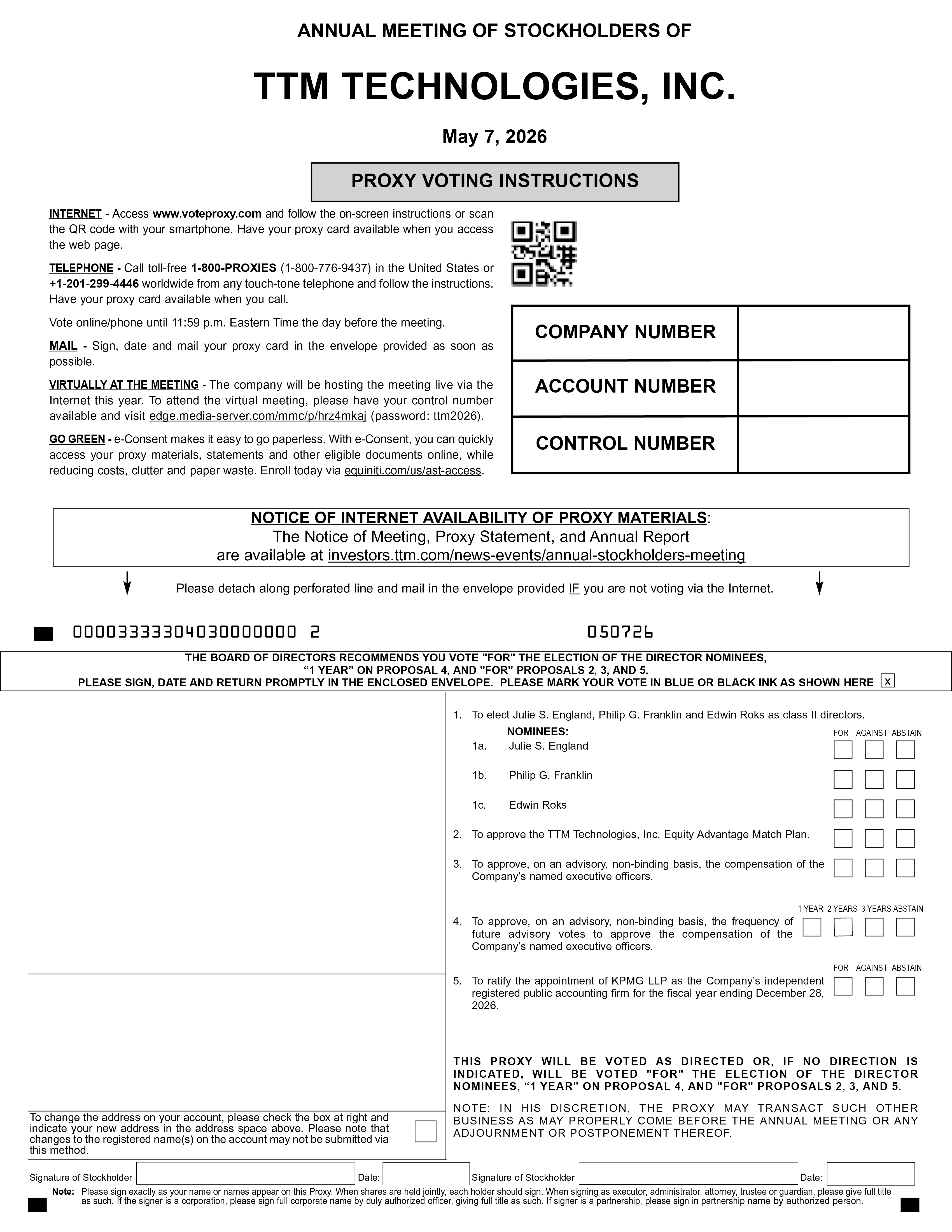
ANNUAL MEETING OF STOCKHOLDERS OF TTM TECHNOLOGIES, INC. May 7, 2026 PROXY VOTING INSTRUCTIONS INTERNET - Access www.voteproxy.com and follow the on-screen instructions or scan the QR code with your smartphone. Have your proxy card available when you access the web page. TELEPHONE - Call toll-free 1-800-PROXIES (1-800-776-9437) in the United States or +1-201-299-4446 worldwide from any touch-tone telephone and follow the instructions. Have your proxy card available when you call. Vote online/phone until 11:59 p.m. Eastern Time the day before the meeting. MAIL - Sign, date and mail your proxy card in the envelope provided as soon as possible. VIRTUALLY AT THE MEETING - The company will be hosting the meeting live via the Internet this year. To attend the virtual meeting, please have your control number available and visit edge.media-server.com/mmc/p/hrz4mkaj (password: ttm2026). GO GREEN - e-Consent makes it easy to go paperless. With e-Consent, you can quickly access your proxy materials, statements and other eligible documents online, while reducing costs, clutter and paper waste. Enroll today via equiniti.com/us/ast-access. COMPANY NUMBER ACCOUNT NUMBER CONTROL NUMBER NOTICE OF INTERNET AVAILABILITY OF PROXY MATERIALS: The Notice of Meeting, Proxy Statement, and Annual Report are available at investors.ttm.com/news-events/annual-stockholders-meeting please detach along perforated line and mail in the envelope provided IF you are not voting via the internet. 00003333304030000000 2 050726 THE BOARD OF DIRECTORS RECOMMENDS YOU VOTE "FOR" THE ELECTION OF THE DIRECTOR NOMINEES, “1 YEAR” ON PROPOSAL 4, AND "FOR" PROPOSALS 2, 3, AND 5. PLEASE SIGN, DATE AND RETURN PROMPTLY IN THE ENCLOSED ENVELOPE. PLEASE MARK YOUR VOTE IN BLUE OR BLACK INK AS SHOWN HERE ☒ 1. To elect Julie S. England, Philip G. Franklin and Edwin Roks as class II directors. NOMINEES: FOR AGAINST ABSTAIN 1a. Julie S. England 1b. Philip G. Franklin 1c. Edwin Roks 2. To approve the TTM Technologies, Inc. Equity Advantage Match Plan. 3. To approve, on an advisory, non-binding basis, the compensation of the Company’s named executive officers. 1 YEAR 2 YEARS 3 YEARS ABSTAIN 4. To approve, on an advisory, non-binding basis, the frequency of future advisory votes to approve the compensation of the Company’s named executive officers. FOR AGAINST ABSTAIN 5. To ratify the appointment of KPMG LLP as the Company’s independent registered public accounting firm for the fiscal year ending December 28, 2026. THIS PROXY WILL BE VOTED AS DIRECTED OR, IF NO DIRECTION IS INDICATED, WILL BE VOTED "FOR" THE ELECTION OF THE DIRECTOR NOMINEES, “1 YEAR” ON PROPOSAL 4, AND "FOR" PROPOSALS 2, 3, AND 5. NOTE: IN HIS DISCRETION, THE PROXY MAY TRANSACT SUCH OTHER BUSINESS AS MAY PROPERLY COME BEFORE THE ANNUAL MEETING OR ANY ADJOURNMENT OR POSTPONEMENT THEREOF. To change the address on your account, please check the box at right and indicate your new address in the address space above. Please note that changes to the registered name(s) on the account may not be submitted via this method. Signature of Stockholder Date: Signature of Stockholder Date: Note: Please sign exactly as your name or names appear on this Proxy. When shares are held jointly, each holder should sign. When signing as executor, administrator, attorney, trustee or guardian, please give full title as such. If the signer is a corporation, please sign full corporate name by duly authorized officer, giving full title as such. If signer is a partnership, please sign in partnership name by authorized person.
ELECTRONIC ACCESS TO FUTURE DOCUMENTS If you would like to receive future shareholder communications over the Internet exclusively and no longer receive any material by mail please visit equiniti.com/us/ast-access. Click on Shareholder Account Access to enroll. Please enter your account number and tax identification number to log in, then select Receive Company Mailings via E-Mail and provide your e-mail address. TTM TECHNOLOGIES, INC. 200 East Sandpointe, Suite 400 Santa Ana, CA 92707 THIS PROXY IS SOLICITED ON BEHALF OF THE BOARD OF DIRECTORS As an alternative to completing this form, you may enter your vote instruction by Internet at WWW.VOTEPROXY.COM and follow the simple instructions. Use the Company Number and Account Number shown on your proxy card. The undersigned hereby appoints Daniel J. Weber as proxy, with full power of substitution, to rep resent and vote as designated on the reverse side, all the shares of Common Stock of TTM Technologies, Inc. held of record by the undersigned on March 11, 2026, at the Annual Meeting of Stockholders to be held virtually at edge.media-server.com/mmc/p/hrz4mkaj (password: ttm2026) at 8:00 a.m. Pacific Time, on May 7, 2026, or any adjournment or postponement thereof, and in his discretion upon any other business that may properly come before the meeting (and any such adjournment(s) or postponement(s)). (Continued and to be signed on the reverse side) 1.1 14475